GREEK PHILOSOPHOBIA · DIVISION 36 / 40
Pyrrho and Sextus: continue to investigate without feigning any certainty
Research, epochē and the question of how to act without fake certainty.
The antique skeptic is not easy to say no to everything. In the pyramidal tradition, the investigation is open because a final ruling is not possible. The question is how to live and act when convincing arguments seem to continue challenging each other.
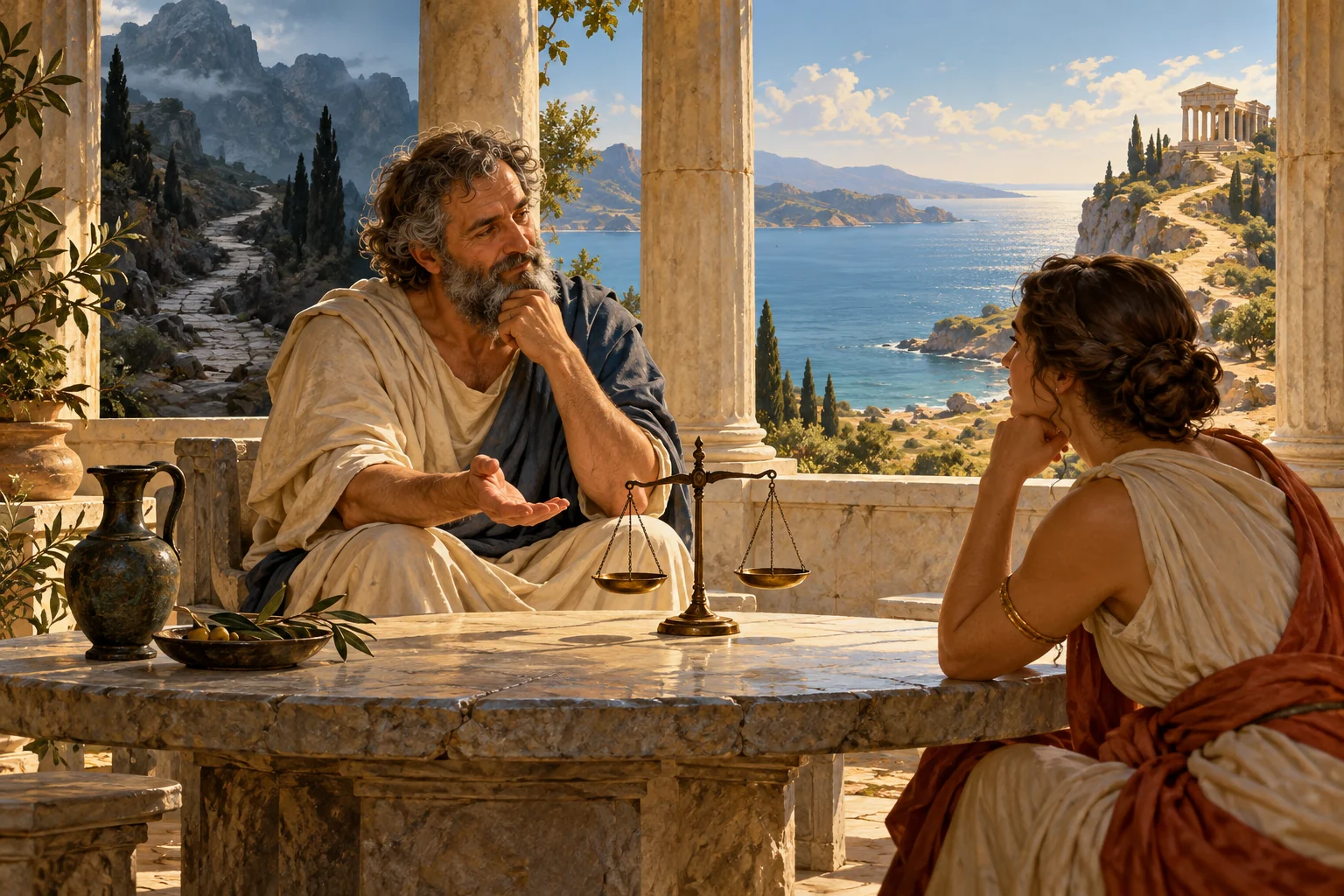
A name and a later school are not identical
Pyrrho van Elis lived in the fourth and third centuries BC. The later pyramidal tradition, however, is not simply a directly preserved teaching program of his. An important source is Sextus Empiricus, who lived much later and explains in his main lines of pyramidism what skeptical research means.
This distinction prevents statements from several centuries from becoming one simple quote of Pyrrho. It is a tradition that develops and reuses arguments. There are also differences within antique skepticism. The skeptical phase of Platoklabs Academy and the pyramidal approach do not fully coincide, even though there are themes that connect them with opponents.
A capacity to face each other
Sextus describes the skeptical ability as opposing phenomena and thoughts. When the reasons appear to weigh equally heavily on both sides, suspension of judgment follows: epochē. The skeptic does not necessarily say that the truth is impossible. He is abstaining from a firm decision on this point.
There is a difference with dogmatic denial. Whoever says no one can ever know anything makes a very broad statement. The pyramid researcher is trying to avoid that closure. His position is more a description of the current state of the investigation than a final look at all possible knowledge.
Suspension is not an obligation to find everything equal
A common misunderstanding is that scepticism would give the same value to any claim. Putting arguments against each other demands attention for their strength. A weak objection is not self-evident because there are two sides. The interesting question is whether the reasons for a given judgment are really decisive.
A contemporary example is an explanation for a phenomenon of which some data are missing. You can say that a reply is best supported for the time being, while postponing a final ruling on a further conclusion. That's not exactly the same as taking over all the pyramidal doctrines. It is an exercise that makes the difference between foundation and certainty visible.
How does a skeptic eat his supper?
Sextus must explain how action remains possible. He refers, among other things, to following what appears, natural needs, customs and learned skills. You can react to thirst without proving a complete theory of the hidden nature of water. Daily life does not have to wait until every philosophical question is resolved.
That answer does raise new problems. How far does the distinction between practical follow-up and real belief go? And can tracking usage weaken a critical attitude to injustice? There are differences in interpretations about this. The tension is part of the subject: a way of life of research must also be able to explain how it chooses when doing nothing has its own consequences.
Rest as a result, no guaranteed product
Ataraxia, undisturbed or free from unrest, plays a role in Sextus' description. The expectation is that the cessation of the compulsion to a final judgment will reduce certain unrest. That's something other than a general promise that doubt solves every burden. The antique researcher also continues to have to deal with ordinary needs and experiences.
Read the skeptics next to Socrates, Pandora's hope and Epictetus' exercise with impressions. The agreement is the focus on what we adopt too soon. The differences are equally important: an investigative dialogue, a mythological expectation and a stoic doctrine of correct judgements are not exchangeable answers.
Think on for yourself
Choose a question to which you do not yet have a final answer. Write down what you do know, what you suspect and what else needs to be investigated. What action is justified while the latter remains open? Also describe what new fact your judgment would actually change; otherwise delay may be a disguised refusal to learn.
Sources and read on
- Sextus Empiricus, Main lines of Pyrronism
Primary text; book I, especially 1–30 about investigation, suspension and living according to what appears.
- Stanford Encyclopedia of Philosophy, Sextus Empiricus
Scientific discussion; also the question of how far the suspension extends.
- Stanford Encyclopedia of Philosophy, Ancient Skepticism
Background to the different schools and the distance between Pyrrho and later pyramidism.
Texts consulted on 29 October 2026. The Dutch explanation is new; the source links give access to ancient texts and scientific context.