MYTHOLOGY & TRAGEDIA · DIVISION 23 / 40
Pandora: the jug, the hope and the question of who is to blame
Why a storage jug and the ambiguity of hope tell more than the familiar box.
Pandora has become known as the woman with the box from which evil escapes. At Hesiodus, however, a large jug is central. Whoever returns to that text discovers not only another object, but also a difficult story about expectation, dependence and the representation of women.
First see the jug again
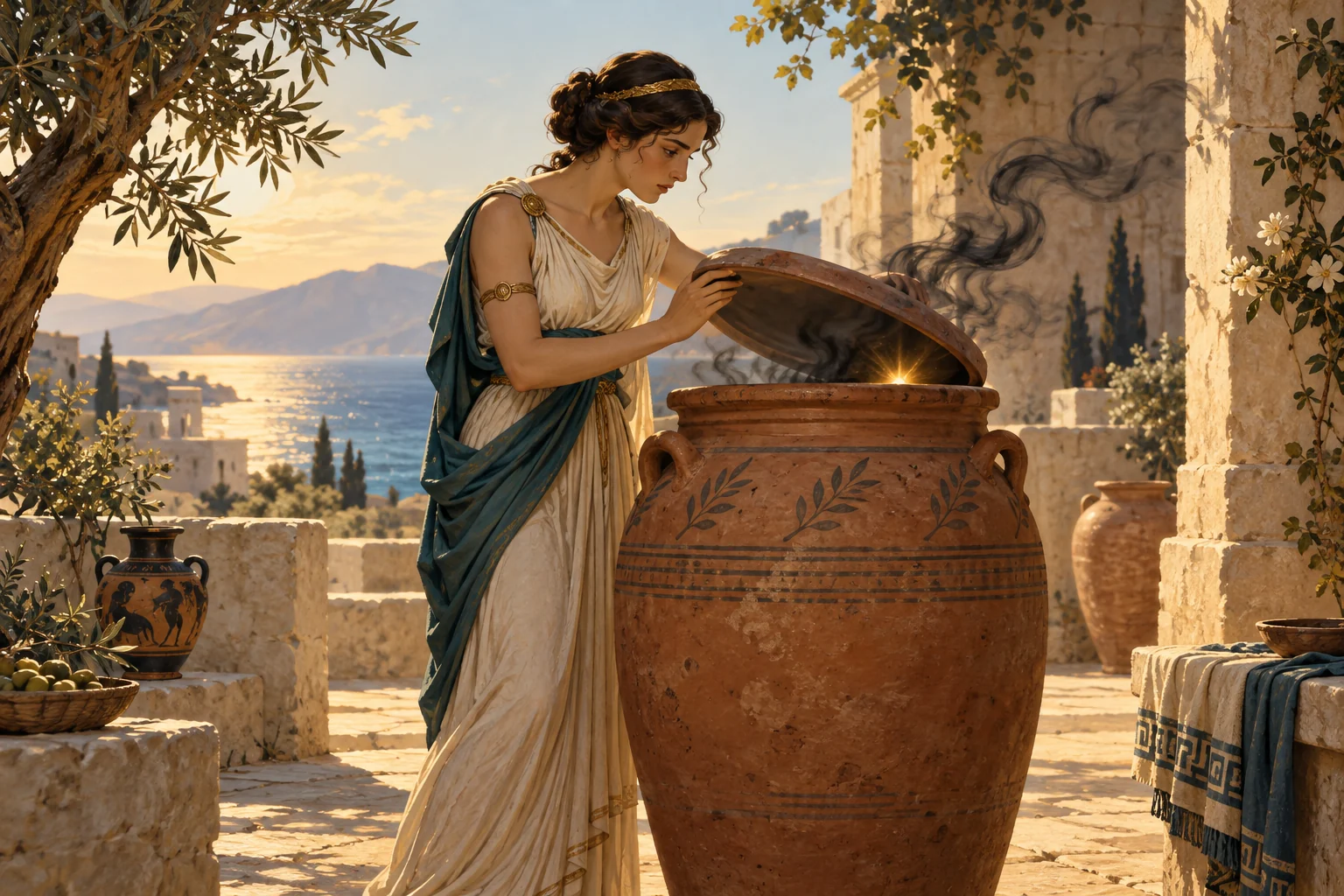
In Works and Days, Pandora is sent as a gift to Epimetheus, despite a warning from Prometheus. When she removes the lid from a pithos, the ailments spread among men. Elpis stays inside. The Greek word pithos indicates a storage jar; the famous box belongs to a later development in tradition. Also the everyday summary of forbidden curiosity puts more emphasis on a motive than the text itself explicitly elaborates.
The difference in object changes the atmosphere of the scene. A supply jar is part of food, storage and the household. It may contain the certainty of a season, but it may also make dependence visible. The idea that the ordinary barrel constitutes a fragile boundary between security and uncertainty is an interpretive possibility. She does not replace the ancient story, but invites to look more closely at the object.
Hope is not a simple final chord
Elpis is usually translated as hope, but can be connected more broadly with expectation. The place of that expectation in the jar is controversial. Is a good kept for the people, or is something they need kept away from them? The fact that Elpis stays inside doesn't automatically determine that question. The modern morality that fortunately always remains the hope, is therefore one reading and not an undisputed subtitle of the passage.
A contemporary example makes the tension understandable. An expectation can hold someone up when action still makes sense. The same expectation can become harmful if it makes a real risk invisible. It is therefore useful to distinguish hope from certainty. You can hope for an outcome without pretending to have enough evidence. Pandora's jug thus becomes a cause for questions about our own handling of uncertainty.
A story about people, written from a perspective
Hesiodus' performance of the first woman is within a distinct male view of labor, marriage and burdens. We do not need to take that perspective in order to understand it historically. The story also shows how a culture can depict debt by making a certain figure the origin of general problems.
A careful reader therefore asks two things at once. What's the story trying to explain? And who's gonna pay the price for that statement? When a community summarizes complex setbacks as the fault of one kind of person, the story becomes clearer, but possibly more unjust. This question of a culprit is an actual application; it does not prove that every antique listener understood the text in the same way.
The difference between explaining and justifying
A myth can make an existing world understandable without making that world morally acceptable. That distinction is important with Pandora. We can describe that the text connects femininity, seduction and burden. It does not follow that women are really responsible for human suffering, or that such images should remain outside criticism because they are old.
Conversely, the text doesn't get any more interesting when we smooth its uncomfortable sides. It is precisely the tension between literary power and problematic representation that deserves attention. A strong narration can appeal to a reader and at the same time transfer beliefs he rejects. Critical reading requires that both reactions may exist side by side.
The jug in the knowledge universe
The connection with Prometheus follows the textual connection between fire, gift and counter-reaction. The connection to the Cretan storage cabinet is a comparison around preservation and vulnerability, not a historical origin claim. With the skeptics a third thread arises: how do you live with expectations when the outcome remains uncertain?
Think on for yourself
Rewrite the castle once with Elpis as a comfort and once with Elpis, as a misleading expectation. What data from the story support each slot? Then write down one point where your own desires send the explanation. An interpretation becomes stronger when it recognizes its preferences and can identify its textual reasons separately.
Sources and read on
- Hesiodus, Works and Days
Primary text, 42–105; Pandora, the pithos and Elpis.
- Hesiodus, Theogony
Primary text, 570–616; another effect of the gift and representation of women.
Texts consulted on 29 October 2026. The Dutch explanation is new; the source links give access to ancient texts and scientific context.