MYTHOLOGY & TRAGEDIA · DIVISION 29 / 40
Asklepios: dreams, healing and reading a shrine
A god of healing, a sacred landscape and the bronze criticism of dreams and dance scriptures.
Asklepios connects the Greek imagination of healing with places where people sought help, spent the night and recorded their experiences. His sanctuaries are interesting as religious and social worlds. They're not a collection of timeless medical prescriptions.
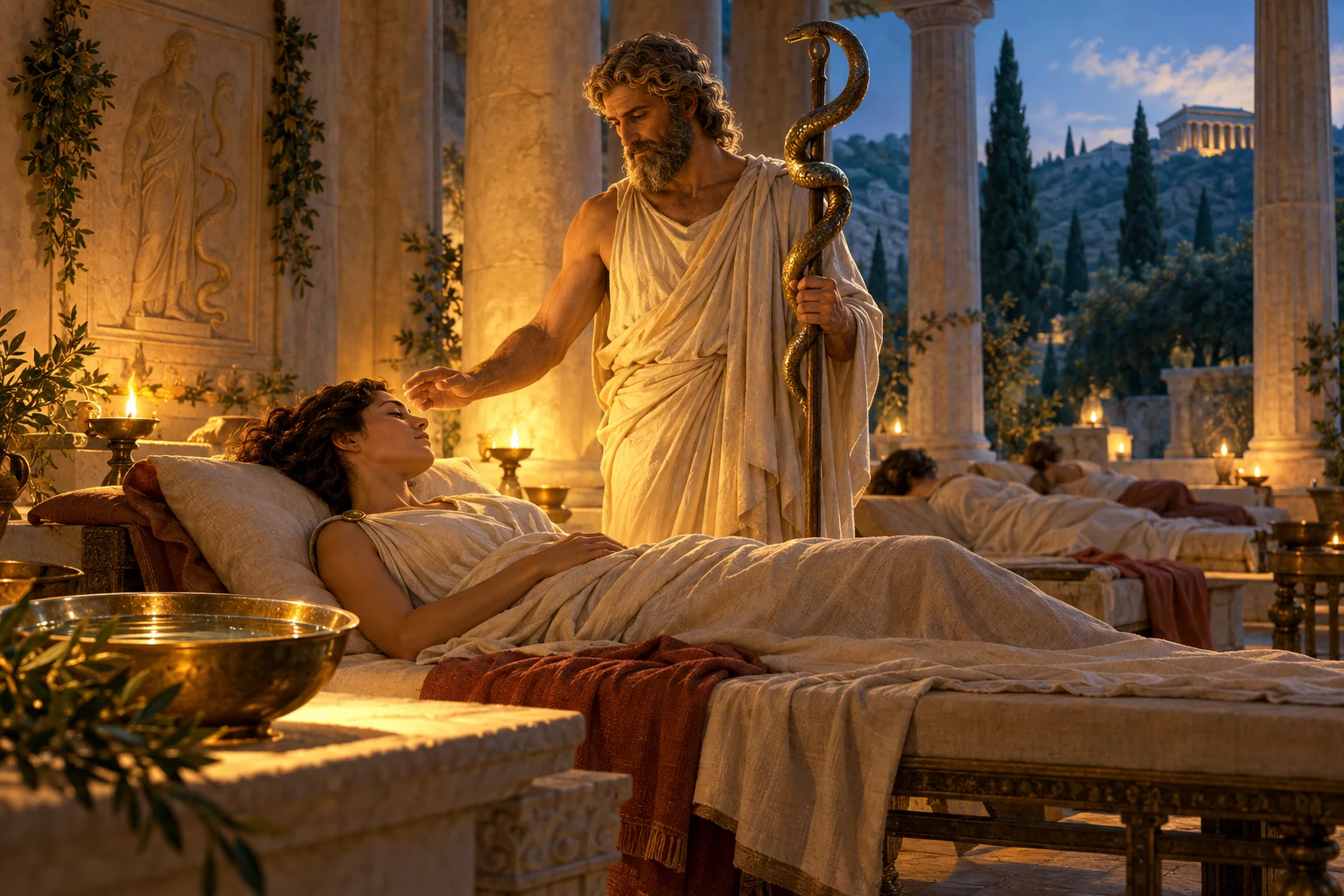
A healer between mortality and divinity
In Pindarus... Third Pythic ode, Asklepios is raised as an exceptional healer by Cheiron. The story connects its ability to a limit: also the return of a dead person may appear in the divine order as an overrun. Other ancient sources tell the family history and the exact circumstances differently. A mythical biography is therefore not a file in which all the testimonies fit together.
The interesting question is what the existence of such a healer means to mortal people. Looking for help presupposes hope for change. At the same time, not every frontier can be lifted. The story thus creates a tension between cans and limits that we also find with Prometheus, without the two figures having the same function or cult.
Epidaurus as more than one temple
The sanctuary of Asklepios at Epidaurus included various types of buildings and facilities. In addition to cultural spaces there were places for stay, water, movement and joint activities. The whole shows that a visit could include an environment and a sequence of actions. The visitor not only acted for an image and then immediately returned home.
UNESCO describes the complex as a special testimony of the healing cults in the Greek-Roman world. This gives us a spatial entrance: where could people wait, rest, come together and shape their expectations? A map can support such questions. It cannot in itself prove what every visitor thought or what outcome a separate person experienced.
Sleeping with an expectation
In practice called incubation or enkoimesis, visitors sought a meeting with the healing god during sleep. Dreams and their interpretation gained meaning within the cult. The experience stood in an environment of preparation, stories and shared expectations. For the historical reader it is important not to reduce this to one simple contradiction between faith and medicine.
Such a contradiction can easily project contemporary categories to the past. People could seek different kinds of help side by side. That does not mean that all the old explanations must be equally convincing to us. It means that we first reconstruct what questions and practices belonged to the participants, before we assess them with current knowledge.
What does a healing story prove?
Inscriptions with stories of healing give information about what a shrine wanted to show and what experiences were attributed to the god. They are not the same as independently controlled registrations of all visitors and outcomes. We do not know through such selection how many people left without improvement or what other factors were involved.
This bronze criticism is more than distrust. A dance thesis can be sincere and yet not provide sufficient evidence for a causal explanation. Therefore, distinguish between the experience, interpretation by the person concerned and the conclusion of a later researcher. Then, at the same time, the document can remain valuable for the history of hope, language and social recognition.
A staff with one snake
The staff of Asklepios is usually connected to one hose. That motive should not be automatically identified with the winged staff of Hermes with two snakes. The confusion is recognizable in modern visual language, but the antique figures have different roles. A small visual detail can thus be an entrance to much greater differences in meaning.
In the knowledge universe, the reading route leads to Demeter and Persephone, to the demand for certainty among the skeptics and to the interpretation of sacred places. The connection to Cretan sanctuaries is comparative. It does not imply any proven direct pedigree between any Minoan cult use and the much later described practice in Epidaurus.
Think on for yourself
Read an antique thank-you story with three questions: what is the event described, what explanation is given for it, and what information is missing to test that statement? Then think about which questions an archaeological map can answer and which can only be approached by texts or other research.
Sources and read on
- Pindarus and other antique testimonies about Asklepios
Source collection; especially Pindarus, Pythian ode 3.5–58.
- UNESCO, Sanctuary of Asklepios at Epidaurus
Archaeological context of the sanctuary and the buildings.
- Pausanias, Description of Greece 2.27
Primary text; cult statue, sleeping space, healing inscriptions and terrain.
Texts consulted on 29 October 2026. The Dutch explanation is new; the source links give access to ancient texts and scientific context.