GREEK PHILOSOPHOBIA · DIVISION
Socrates: the question and life under study
Not written leather, but a method that tests beliefs for their reasons.
Socrates did not write philosophical books as far as known. What we know about him comes from various sources, including Plato, Xenophon and the comedies of Aristophanes. His philosophy is therefore also a problem of source criticism: who speaks when Socrates speaks?
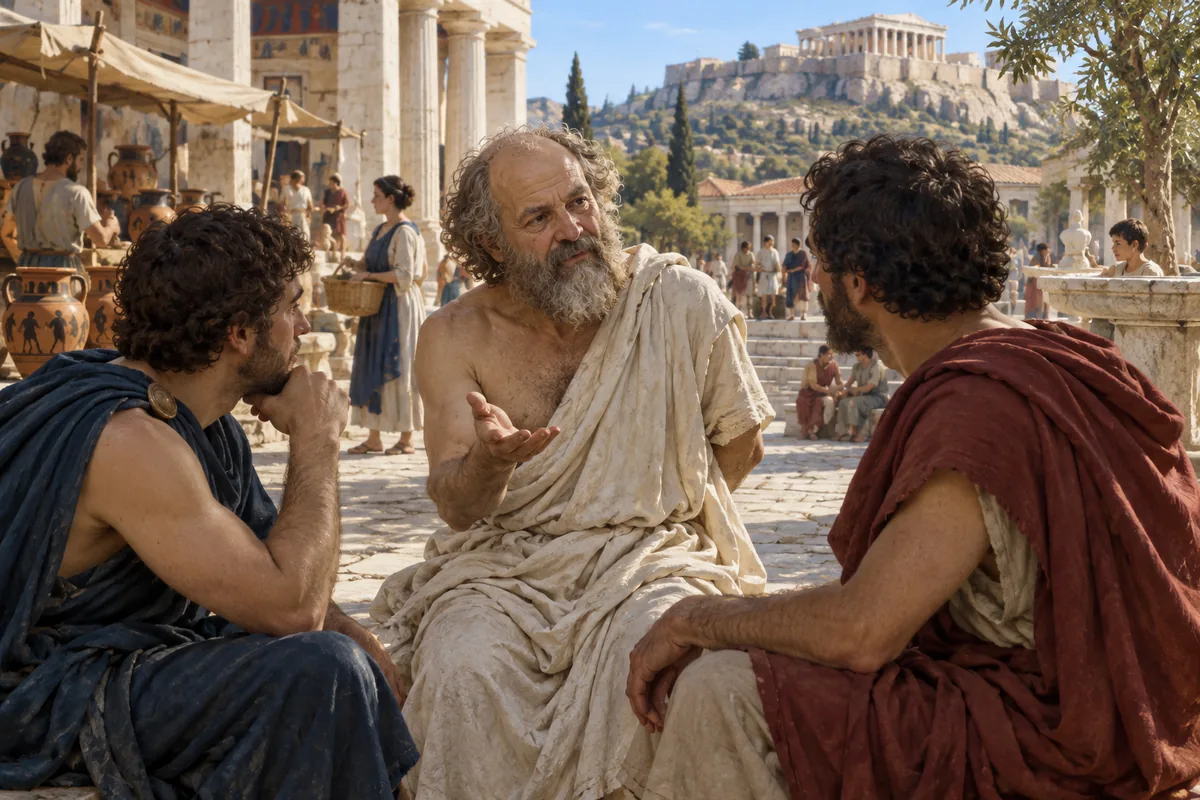
The Elenchus: a conversation keys
In Plato's early dialogues Socrates asks someone for a definition: what is courage, piety or justice? He then investigates whether the answers correspond to other beliefs of the interlocutor. This keying method is often called elenchus. The goal is not always a conclusive answer; often the conversation mainly reveals contradictions.
Socrates I know that I don't know anything. In Apology, he says that his wisdom may consist in the fact that he does not think he has knowledge when he does not. So the method does not require total skeptical silence, but honesty about the quality of your reasons.
A problem of sources
Plato makes Socrates a speaker in many dialogues, but not every conversation needs to be historical transcription. Xenophon gives his own portrait; Aristophanes mocks him as a natural philosopher and sophist in De Wolken. These images are different. Historical Socrates cannot be completely separated from the literary Socrates that later readers know.
A careful reader therefore writes down which source claims something and for what purpose. Plato & Plato & Pology Apology presents Socrates & Philosophy defense, but is not trial minutes. Xenophon's memories defend him against certain accusations. The differences are not only obstacles: they show how Athens struggled with education, religion and political criticism.
Process and responsibility
In 399 In Athens, Socrates was sentenced to death for impiety and the influence of young people. Apology proposes his refusal to give up his philosophical calling to save his life. In the Kriton Plato discusses obedience to laws; the texts work out a philosophical problem, not just a biographical report.
Socrates' death makes his method political. Those who continue to ask questions may irritate those in power; but a city also has reason to ask what limits apply to education and public responsibility. The dialogue shows this tension without providing a simple rule for any conflict between individual and community.
View question
Choose a belief that you often hear. Ask for a definition first, then for an example and then for a possible counter example. Do you change your mind, or are you just changing the words you're defending her with?
Sources and read on
- Plato, Apologies, Euthyphro, Meno and Kriton; Xenophon, Memorabilia; Aristophanes, The Clouds.
- Internet Encyclopedia of Philosophy, "Ancient Greek Philosophy"