GREEK PHILOSOPHOBIA · DIVISION 34 / 40
Epictetus: what is our fault and what a judgment does to us
Prohairesis, the use of impressions and the limits affect an outcome.
Epictetus explores freedom from a sharp question: to which things do we attach our value, whereas its outcome does not depend solely on ourselves? His answer requires exercise in judgment, not denial that the outside world can actually touch people.
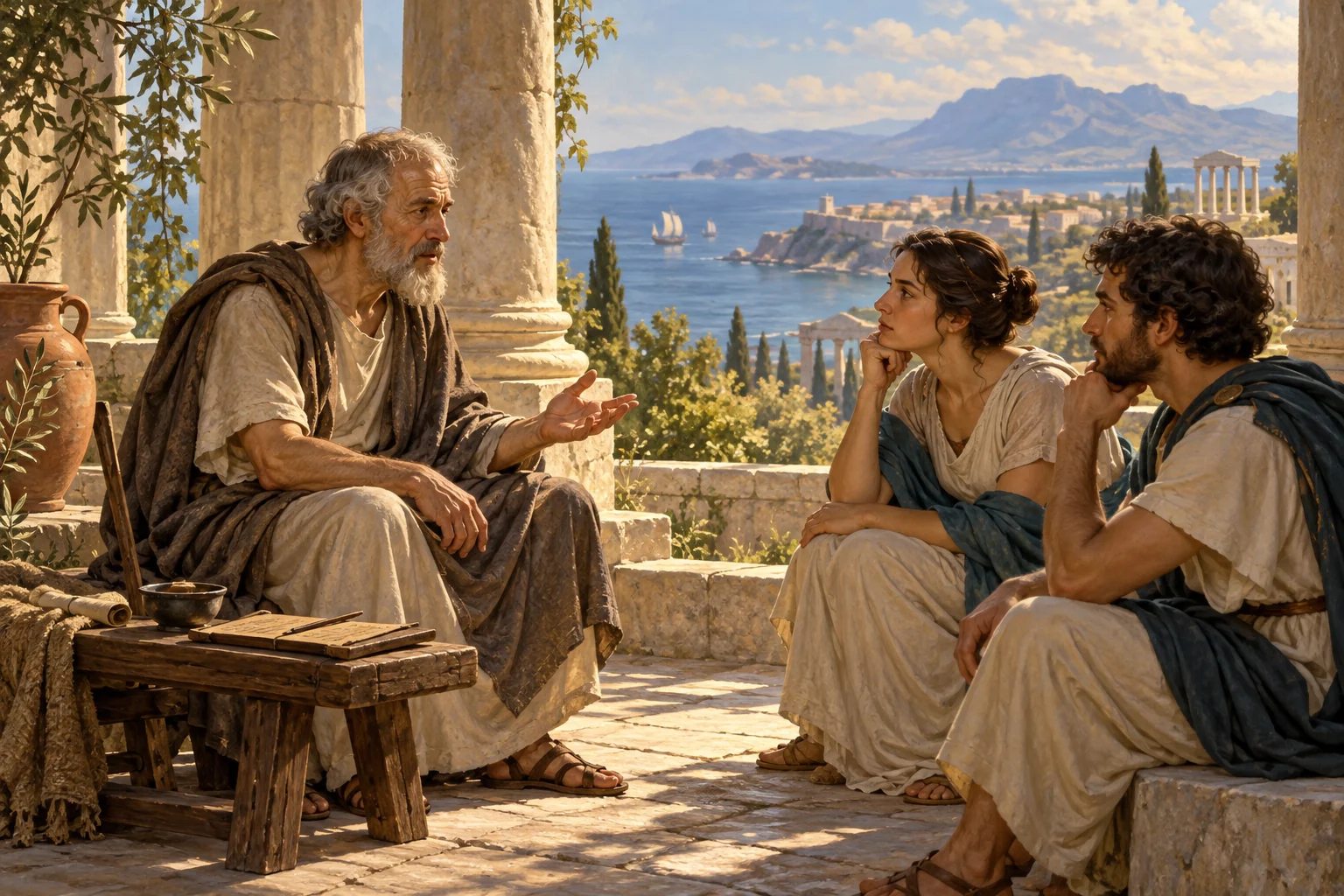
A voice that sounds through a student
Epictetus lived in the first and second centuries AD. He was enslaved before and later taught. What if his philosophy is handed over, is mainly preserved through Arrianus: the Conversations and the short Handbook. We do not read a sound recording, but a written representation of education and the organization of that education for readers.
The origins and living conditions make the subject of freedom intrusive, but do not self-prove any philosophical argument. A reasoning still needs to be examined on its content. Also a famous living example cannot replace the question of whether a distinction is made right and whether it is sustainable in a concrete situation.
To us or not to us completely?
The Handbook begins with the distinction between what is ours and what is not ours. This does not simply include two bins of fine and annoying events. It concerns one's own judgmental and choosing activity in relation to, among other things, property, reputation and outcomes. The Greek concept of prohairesis is used for the moral choice or willpowers that are central to the exercise.
A result can also be influenced by your preparation without being fully in your control. It therefore helps to keep preparation and guarantee apart. This is a useful contemporary application, but it does not automatically make the stoic doctrine the modern statement that you only have to choose your own response. The first impression and the immediate fear can also happen to you before you have thought carefully about it.
Impression, consent and action
A situation may first appear as humiliating or dangerous. Then the question arises as to what judgment you attach to it and what action it follows. Epictetus wants students to examine the use of impressions instead of treating each first appearance directly as a completely correct description.
What if a conversationalist doesn't answer? The fact may be that there is no response yet. The explanation that you are deliberately disrespected is an additional step. Maybe that explanation is correct, maybe there's some information missing. The exercise does not consist of the command to feel nothing. It begins by recognizing the moment a perception is made into a definite interpretation.
Freedom cannot become an excuse for injustice
The thought that a person's moral value is not entirely determined by circumstances can be strong. It becomes problematic when an outsider claims that damage, oppression or humiliation does not matter. Inner exercise and the responsibility to combat injustice are several questions. One answer doesn't fire us from another.
Epictetus also discusses roles and obligations towards others. Philosophy is not, therefore, a mission to leave the world. A critical reader may ask whether the strong emphasis on judgment does enough justice to all vulnerabilities. This way the conversation remains open without losing the useful distinction between action and outcome.
Practice without declaring yourself infallible
An important feature of education is that the student is not yet the sage he wants to become. Understanding the distinction does not mean that he can apply it all the time. That difference prevents a new form of vanity in which one becomes proud of the fact that he is supposed to get through nothing.
In the knowledge universe Epictetus fits alongside Marcus Aurelius and the Sirens. At Marcus we see repeated self-incitation; at Odysseus a pre-made appointment for a future moment of disruption. The connection is comparative: the hero of the epic has not become a pupil of a much later living philosopher.
Think on for yourself
Describe a recent disappointment in three sentences: what happened, what explanation did you give it and what did you do next? Which sentence can you directly support, and which contains an assumption? Think of one action that can really improve the situation without fully guaranteeing its outcome.
Sources and read on
- Epictetus, Handbook
Primary text, including 1, 5, 20 and 30. Composed of Arrianus.
- Epictetus, Conversations
Primary text, especially I. 1 II. 10 and IV. 1; overview by book.
- Stanford Encyclopedia of Philosophy, Epictetus
Scientific explanation of prohairesis, impressions and the ethical exercise.
Texts consulted on 29 October 2026. The Dutch explanation is new; the source links give access to ancient texts and scientific context.