KRETA · FAITH & CULTURE HISTORY
The Greek Orthodox Church: faith, history and living Crete
From apostolic roots and Byzantine icons to the Easter night and monasteries of the island.
Added: · approx. 46 minutes read · 41 chapters
1. A living tradition in Crete
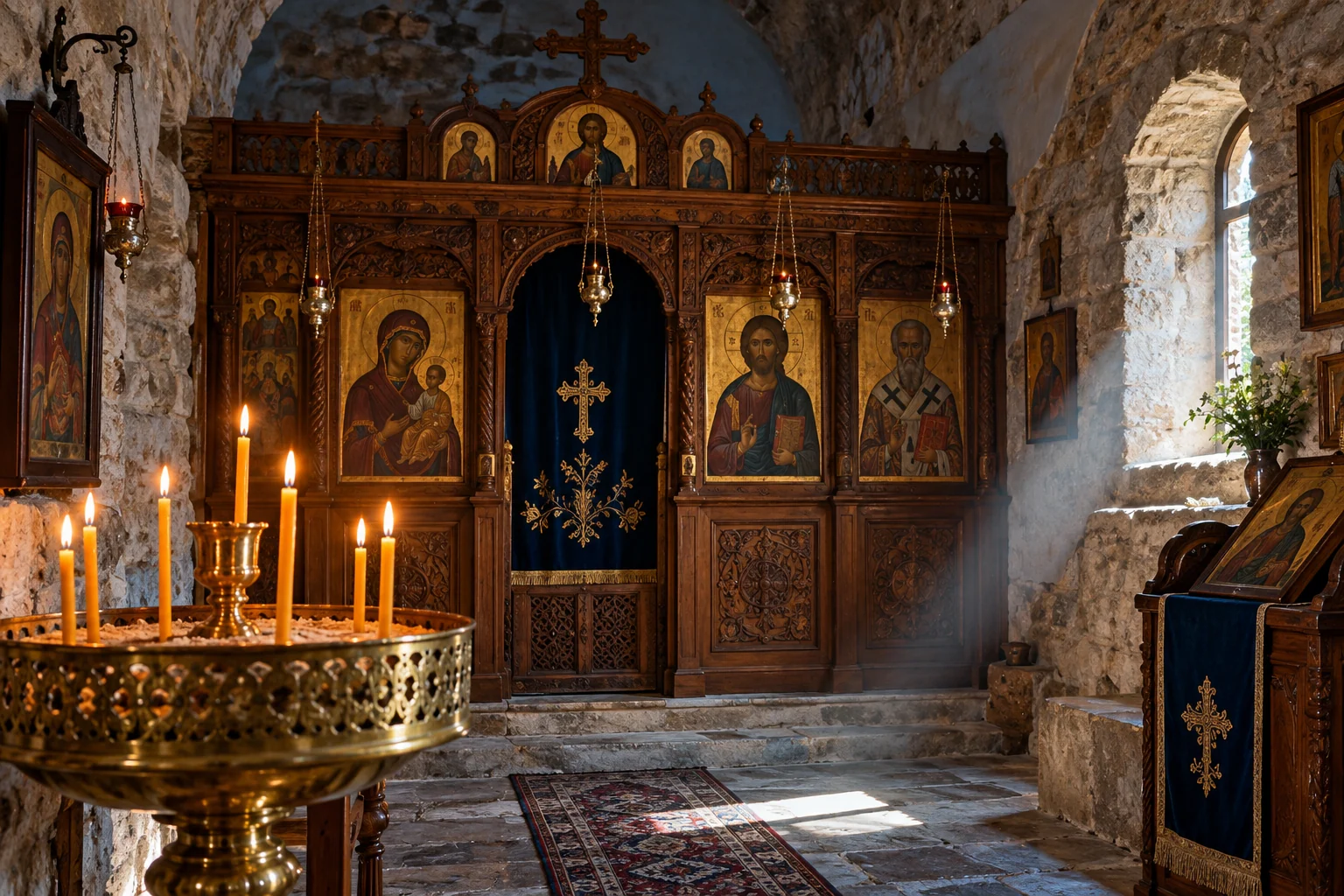
A candle for an icon, a priest in the village square, a church bell above a valley: on Crete the Greek Orthodox tradition runs through daily life. Anyone who looks at the buildings alone misses the community she uses. Those who read only about the doctrine of faith lack the landscape in which those beliefs have taken shape. This file brings both of them together: what the church believes, how it celebrates and what traces its history has left on the island.
The Church describes itself as the continuation of the apostolic community of faith, gathered around Christ. That's her religious self-understanding. For the cultural historical visitor questions are also important about governance, art, power relations and local memory. Both perspectives have a place here. A pronunciation of faith is therefore interpreted as a statement of faith, while a monument is not automatically treated as proof of religious tradition. [1]
Read the file consecutively or choose a route: faith and history; entering the church; feasts and moments of life; or the ecclesiastical landscape of Crete. The practical visit advice is an editorial tool. The local sign, the administrator and the serving priest remain decisive for what is possible during a visit.
2. What does Greek Orthodox mean?
Orthodox in this context means both the right faith and the right glorification of God. Faith and worship belong together: a doctrine is also sung, prayed and depicted. The word Greek refers to language, history and the Byzantine liturgical tradition. It does not mean that someone has to be ethnically Greek in order to become Orthodox Christians. Orthodox communities exist worldwide in many languages and cultures.
The Eastern Orthodox churches share a sacramental and theological tradition, but have different administrative connections. A parish in Crete therefore does not belong to one global organisation with the same governance structure as the Roman Catholic Church. Nor is every church called Orthodox part of exactly the same church community: the oriental Orthodox churches, such as the Coptic and Armenian Church, have their own historical development. This guide deals mainly with the Byzantine, Eastern Orthodox tradition. [2]
A useful first question is always: is it about the general orthodox doctrine, a Greek custom, a Cretan history or a use of this one parish? That distinction prevents one perception from being elevated to rule for millions of believers.
3. Father, Son and Holy Spirit
The Orthodox Church confesses one God as Father, Son and Holy Spirit. She speaks of three persons sharing one divine nature. By this she does not mean three separate gods or one person playing three roles alternately. The language tries to describe a mystery of faith without reducing it to a simple model. The creed and the cross sign make that trinitarian conviction visible. [3]
In the orthodox proclamation, Jesus Christ is the Son of God. His birth, life, crucifixion and resurrection are the heart of the ecclesiastical year. Christmas and Easter are therefore more than remembrances of a distant past: in worship they are celebrated as events that now determine the life of the community. [4]
For a visitor this is a bookmark for the connection between words and images. A representation of Christ, a baptism formula and the opening of a prayer are not separate decorations next to the doctrine. They give the same conviction different forms. Anyone who recognizes that repetition can follow a service better without understanding every Greek word.
4. Bible, tradition and council
In Orthodox tradition, the Bible has a central place in sacred tradition. Tradition here is the transfer of faith and ecclesiastical life: Scripture, prayer, council, church fathers, icons and liturgy. So it's more than just a collection of old habits. Orthodox authors make a distinction between that tradition of faith and changing human customs. Not everything that has ever happened in a church has the same religious status. [5]
The ecumenical councils of the early church formulated statements about, among other things, the Trinity and Christ. Their language arose in concrete conflicts. Words like person and nature were given precise meanings, because a small shift according to the persons concerned could have great consequences for faith. The creed of Nicea-Constantinopel remains a recognizable summary of that legacy. [2]
Read an ecclesiastical source therefore also on genre. A hymn wants to pray and praise; a council text sets limits to a doctrine; a holy life gives a spiritual example. A modern inventory of a monument tries to date construction phases and works of art. Such texts answer different questions and are not easily interchangeable.
5. Salvation, theosis and prayer life
An important concept is theosis, often translated as deity. According to the orthodox explanation, it means participation in God's life by grace, not that a man becomes a second god or takes over God's being. Growth in love, prayer and communion with Christ is central. The tradition distinguishes God's inaccessible being from his active presence, often referred to as divine energies. That last word is theological, not as geometric or physical energy. [6]
This explains why redemption is not merely proposed as solving a legal debt problem. Also healing, renewal and restoration of relationships are important images. At the same time, these accents should not be used to flatten other Christian traditions: there are also different views and a rich prayer life. An Orthodox-Catholic dialogue text from 2003 for example, requires care in assessing each other's tradition. [54]
For the reader in Crete, this concept is mainly related to action and conviction. Fasting, a rule of prayer or a moment of silence are meant from this perspective as an exercise of the whole person. It is not automatic techniques that guarantee a result. An outsider does not have to share that conviction to understand its seriousness.
6. The long history between East and West
Orthodox and Roman Catholic churches have common roots in the early Christian world. Their removal developed over centuries, due to linguistic differences, political contradictions, administrative questions and theological conflicts. The year 1054 is a well-known landmark, but no conclusive explanation for a separation that suddenly became complete in all places. The looting of Constantinople by Crusaders in 1204 deepened the fracture significantly. [7]
Two well-known points of dispute are the position of the bishop of Rome and the philioque: the words added in the West about the departure of the Holy Spirit also from the Son. For orthodox criticism, this concerns both the content and the question of who was competent to change the common creed. A business comparison should take such differences seriously without expecting one and the same explanation from any Catholic or Orthodox. [8]
In Crete, this broad history got a local face. Venetian buildings and Latin institutions stood alongside orthodox communities. A facade with renaissance motives is therefore not automatically proof that the entire building was Catholic; construction, commissioning and liturgical use must be examined separately. The island shows just how political boundaries and cultural exchange could be mixed up.
7. Church of Greece, Patriarchate and Church of Crete
The Church of Greece and the Church of Crete are not administratively the same. The Church of Greece obtained autocephaly in the nineteenth century: it governs itself with its own church head. The recognition by Constantinople followed in 1850. Moreover, the ecclesiastical map of current Greece is more complex than one national border suggests. [9]
The Church of Crete has a semi-autonomous position under the Ecumenical Patriarchate of Constantinople. It has its own ecclesiastical structure and synod, while the relationship with the patriarchy remains essential. Semiautonomous therefore does not mean completely independent. The patriarchy itself mentions the Church of Crete within its ecclesiastical context. [10]
For this guide the distinction is important because a rule, contact address or administrative pronunciation from Athens does not automatically describe the local situation in Crete. The same applies to information from America, Russia or any other Orthodox country. The general interpretation of faith can have a lot in common, while opening hours, language and pastoral habits vary from place to place. For local matters, please refer to the relevant metropolitan oil, parish or monastery.
8. A timeline to organize history
This timeline is an orientation. It connects various scales: the general church history, the administrative development of Greece and the history of Crete. A religious tradition about the earliest period is not the same kind of evidence as a dated building or a modern administrative act. [7][9][11][12]
| Period or year | Meaning for the file |
|---|---|
| Apostolic Time | The Church of Crete connects its origin with Paul and Titus; Titus is considered her first bishop. |
| Early Byzantine period | Gortyna is an important church center of the island. |
| 787 | The second council of Nicea confirms the worship of icons, with distinction between worship and worship. |
| 843 | The restoration of icon worship becomes an important moment of memory in the Orthodox tradition. |
| 1054 | Known benchmark in the long process of removal between East and West. |
| 1204 | Crusaders plunder Constantinople; the removal is further deepened. |
| Venetian period in Crete | Orthodox communities live within a political system with Latin ecclesiastical institutions. |
| Ottoman period in Crete | Church and monasteries function under changing power relations; local histories differ. |
| 1833 and 1850 | Declaration and then patriarchal recognition of the autocephaly of the Church of Greece. |
| 1866 | The siege and explosion of Arkadi have a central place in the Cretan memory. |
| 1967 | The seat of Crete is elevated to the archdiocese. |
| 2016 | The Holy and Great Synod takes place on Crete, at the Orthodox Academy. |
9. Paul, Titus and the early church on the island
The church history of Crete begins in its own tradition with the apostles Paul and Titus. Titus is the first bishop and patron saint of the island church. In the early Byzantine period, Gortyna was both an administrative and a ecclesiastical center. The historical sketch of the Archdiocese connects the early ecclesiastical organization with that place. [11]
Here, careful language is useful. The name of a saint may refer to a person from the tradition of faith, a church building, a holiday or a later relic. Those are connected but different things. A church called Agios Titos therefore does not have to be the original building of the Apostolic time.
Who goes on a journey can use this as a research question: what was dug up in this place, what was built later and what does the ecclesiastical memory tell us? Notice the difference between an archaeological information board and a devotional text. The first, for example, tries to indicate walls and building phases; the second can explain why believers perceive the place as sacred. Together they show how a landscape has history and meaning.
10. The parish: community around a place
A parish is the local community of faith. The priest is there pastor and pastor, while the ecclesiastical life is also carried by laymen. Think of vocals, maintenance, preparation of celebrations and care for the building. From an orthodox perspective, the church is therefore more than a collection of monuments: worship is celebrated by a concrete community. [1]
For the visitor this changes the way of looking. A church door closed for a tourist tour can later open for a service. A small building without remarkable art treasures can be an important point of gathering for residents. The size of the monument says little about its meaning for a family or village.
Try to distinguish between watching and participating on a visit. A quiet place in the back can be suitable for a service. Walking around to each chapel, having a conversation next to a praying visitor or placing a photographer in front of the altar changes the room for others. Attention to that shared space is the basis of respectful church visit, even if no one has explicitly suspended a ban.
11. Learn to read a church space
In the traditional layout we distinguish the front space or narthex, the ship where the community meets and the shrine with the altar. According to orthodox explanation, the decor depicts the connection between the gathered community and God's kingdom. Crickets and vaults can emphasize that vast space. However, a small Cretan village church does not need a dome or grand map. [13]
Start by looking at three simple questions: where do people collect, where is the liturgical center and what images connect these places? This way the church becomes readable without the need for each piece of furniture to be immediately appointed. Compare possibly two buildings: a simple chapel and a large city church. The scale and decoration change, while certain features remain recognizable.
The sanctuary is not a general visitor's room. Do not walk behind the iconostasis or through liturgical doors to find a better position. Those interested in architectural art can often learn more by looking quietly from the ship than by crossing every border. Also in the case of an empty church, the building remains a place with its own customs and functions.
12. Iconostasis, altar and liturgical doors
The iconostasis is the icon wall or icon stand between the ship and the shrine. It is sometimes described only as separation, but the orthodox explanation also emphasizes connection: Christ, Mary and the saints are visibly involved in the celebrating community. Around the central doors are usually Christ and the Mother of God with the child. Size and further organization may vary. [14]
The open and closed doors and the movement of clergy are part of the liturgical action. Therefore don't just look at the wall as a still work of art. The same space gets a rhythm during the celebration by singing, processions, lectures and offering the eucharistic gifts. [15]
For an art historical visit, a simple observation is helpful: what images are part of the fixed architecture, which ones stand on separate desks and which are visible for a party? Also record the material. Cut wood, metal fittings and painted panels each require their own craftsmanship. Do not touch old surfaces to check wood, age or relief; an inventory or museum text provides more reliable information without damage.
13. Icons: worship, visual language and meaning
An icon is a sacred image within Orthodox tradition. The church distinguishes between worship of the depicted and worship, which belongs to God. A bow or kiss for an icon is therefore not a worship of wood and paint. The defence of icons is linked to the belief that Christ really became human and can be depicted as such. [16]
The visual language often follows recognizable types. A title, posture, clothing, object or place in a larger composition helps to read the performance. Don't expect a simple secret code from every detail. Workshops, periods and local clients made choices; damage and restorations can help determine the current view. The inscription is therefore often a better starting point than a quick interpretation of a colour.
In a church, icons have a different use environment than in a museum. That includes candles, prayers and celebrations. In a museum, dating, technique and origin come to the fore. Both ways of looking can exist side by side. For a photo, this means that the praying person is not part of a freely available touristic decor for an icon.
14. Image battle and the Cretan art world
The icon battle in the Byzantine Empire was more than a taste difference about decoration. Opponents and defenders connected the images with questions about Christ and the right form of worship. The Council of 787 confirmed the legitimacy of icon worship; after a renewed struggle the restoration of 843 a permanent liturgical place. [12]
Crete later offers a rich terrain to study icon painting. For example, in Toplou works are kept connected to the Cretan school; the description of the heritage includes a Pantocrator associated with Andreas Ritzos. Such attributions are art-historical judgments, not a signature that any visitor can establish himself. [17]
In an icon collection, look for differences between works, not just a general Byzantine appearance. Is a performance still or storytelling? How are faces, folds and architecture built? Is there a donor depicted or an explanatory inscription? These questions help to see a collection as work of painters, clients and communities. The religious function and artistic history are two entrances to the same object.
15. Candles, incense and the sign of the cross
The orthodox cross sign is usually made with thumb, index finger and middle finger together, from forehead to chest and then from right to left shoulder. The combined fingers refer to the Trinity. The gesture connects the body to prayer and is for believers more than a greeting or an automatic sign of recognition. [18]
Candlelight, the smell of incense and movement give the church visit a sensory dimension. A visitor can be present with care without mimicking all actions. Light a candle only where intended; use the holder present and leave sufficient distance to clothing, paper and other visitors. A gift is not access to someone else's prayer and does not create a right to photograph.
When considering that the same act can carry different personal meanings. Someone can light a candle out of gratitude, grief or habit. There's no reliable reading from the outside. Precisely for this reason, restraint is valuable: a short observation does not need to be made immediately into a story about the personal faith of the person concerned.
16. The divine liturgy step by step
The divine liturgy is the Eucharistic celebration. It brings together the community for prayer, Scripture and the celebration of bread and wine as the body and blood of Christ. The liturgy is not treated in the orthodox explanation as a dramatic imitation of the Last Supper, but as participation in the reality it celebrates. [15]
| Component | What a visitor can recognize |
|---|---|
| Common prayer | A series of prayers and sung answers, with prayers for church and world. |
| Lectures | Among other things, an apostle sing and an evangelical sing; the proclamation is part of this word service. |
| Large entry | The gifts are brought to the altar in a liturgical procession. |
| Faith | The community confesses its faith. |
| Anaphora | The great Eucharistic thanksgiving, with memory of Christ's salvation work. |
| Epiklese | The invocation of the Holy Spirit about communion and gifts. |
| Communion and road transport | Participation in the Eucharist, thanksgiving and return to everyday life. |
This overview is a tool for tracking, not a roadmap for every local celebration. The liturgy has several sung and read parts, and some prayers are less audible for the visitor. If you're only halfway in, it's best to find a place quietly. Preliminary questions when the actual liturgy starts helps, because a morning program can also include other services. [19][20]
17. Eucharist, communion and distributed bread
The Orthodox Church considers the Eucharist to be a true sacramental community with Christ. The Holy Spirit is called upon about the gifts and about the gathered believers. This language shows that attention is not only on individual objects: the community itself is also involved in prayer. [20]
Communion is not a general welcome for all visitors. It is intended for orthodox believers who are prepared according to church and pastoral practice. Those who are not orthodox do not participate on their own. Also for Orthodox visitors it is wise to contact them in advance if the local practice is unknown. [21]
Bread distributed afterwards can be antidorone: blessed bread that must be distinguished from Eucharistic communion. [55] If in doubt, ask kindly what is offered and for whom it is intended. A short question prevents a visitor from considering two different actions as the same. Try not to judge a service on the number of things you were allowed to participate in; being present carefully can be an appropriate form of being a guest in itself. [22]
18. Other services and the rhythm of the day
Not every orthodox service is a eucharistic liturgy. Vespers are part of the evening, orthros is part of the morning; there are other prayer services and occasional celebrations. An announced divine service can thus be of a different character than the Sunday morning celebration that a visitor expects. In a monastery, prayer rhythm can also structure a larger part of the day. [23]
Therefore, ask for the name and start time of a service rather than just whether there is a wrong. The word wrong is understandable to many Dutch speakers, but divine liturgy is here the more precise name for the Eucharistic celebration. Those who especially want to hear the vocals do not have to limit themselves to Sunday; the nature and extent of the local celebration remain decisive.
For a first acquaintance, it is useful to note afterward what you recognized: recurring answers, a Scripture reading, a procession, silence or a change of vocal voice. This is often more fruitful than constantly searching in a travel guide during the service. Later you can connect those observations to the appropriate part of the liturgy.
19. Byzantine vocals: words worn
Byzantine vocals are a vocal tradition that is closely linked to the liturgical lyrics. UNESCO describes it as essentially unanimous and organized in a system of eight tones or modes. The melody and rhythm serve the text. The tradition is passed not only through notation but also through listening, pretending and practicing. In 2019 Byzantine vocals, at the suggestion of Greece and Cyprus, were included on the representative list of intangible cultural heritage. [24]
For a listener the relationship between word and melody is especially interesting. A syllable can be stretched, while another phrase continues faster. First try to recognize the sung answers and then listen to the way the singer uses breath, emphasis and silence. It sounds different than the polyphonic choir that some Western visitors are familiar with.
Our separate study on Byzantine vocals goes deeper into this music. This church file gives the liturgical context: the vocals are not separate next to the celebration as a concert song, but also form the way the community prays.
20. The church year and the different calendars
The church year begins on 1 September. The feast of resurrection, Passcha, is the liturgical center of the annual cycle. Therefore there are fixed holidays next to a moving series around Easter, Ascension and Pentecost. Reading the church year as a regular list of national free days does not do that coherence. [25]
Greek orthodox communities usually use a calendar that coincides with the bourgeois calendar for the regular celebrations. [53] The Easter calculation follows its own traditional method, based on the Julian calendar and an ecclesiastical lunar calculation. This allows orthodox Easter to coincide with western Easter, but also to fall later. So it is not simply a fixed number of days each year. [26]
When planning a visit, the practical conclusion is simple: check the year and the local announcement. An old blog can mention the right weekday for the wrong year. Moreover, don't assume that every ecclesiastical celebration starts at the hour you know from the Netherlands. The liturgical evening and the calendar day can connect differently in an announcement than a visitor expected.
21. The Great Lent: preparation for Easter
The great Lent time prepares the community for Easter. Prayer, repentance and the practice of austerity belong together. In the ecclesiastical explanation, it is not just a diet, but the way in which one lives and relates to others. The services and Scripture readings of this period therefore have their own character. [27]
The term fasting can also indicate two things: the abandonment of food for communion and the longer-term ascetic food rules of a fasting period. That distinction explains why sayings about not fasting on Sundays can be confusing. An interruption in eucharistic fasting does not automatically mean that the whole food rule of the 40-day period will expire. [28]
For the traveller it is good to recognise the period in the environment without making it a test of personal piety. Ask in a restaurant what a dish contains instead of applying its own schedule to everyone. Also within a family people can fast differently. Age, health and pastoral guidance play along; a general description is not a personal instruction.
22. Good Week: from entrance to grave
The Good Week leads the believers along the last days of Christ. The services read and sing the events in connection with Easter's expectation. The order is not an ordinary historical tour: lectures, images and prayers give the memory a liturgical form. A visitor who is present several nights can see how the atmosphere develops. [29]
On Good Friday, Christ's death and burial is central. A flowered beard with the epitaphios, an image of the tomb, can form a striking center. Around its use there are liturgical and local habits. A procession is therefore best to follow as a worship on the move, not as a parade organized exclusively for spectators. [30]
Choose a place where you can keep the passage and follow instructions from the organization. Ask in advance if photography is allowed. The most beautiful point of view is not always the best place to stand. People who wear, sing or pray should have space; residents and older visitors should also be able to participate without obstacles.
23. Passover: the night of resurrection
The Easter celebration makes the resurrection the great turning point of the church year. During the night celebration, light, preaching and the Easter greetings go together. The well-known words Christos anesti mean Christ has risen; the answer Alithos anesti means truly, He is risen. The ecclesiastical texts emphasize the victory over death and destruction. [31]
The services of Saturday and Easter night each have their own place. Those who come only to the midnight moment see a powerful image but only part of the preparation and celebration. The transition from modesty to celebration is better understood when the preceding services are also read. [32]
For a first visit it is wise to check the time and access at the parish. With candles, keep space between flame, hair and clothing. Outside it can be busy; choose a place where you can also easily get away. Local celebrations are not the same everywhere and do not form the core of Easter in itself. That core remains in the orthodox faith the resurrection of Christ.
24. Water ordination and the feasts of the Mother of God
On 6 January celebrates Theophanie, with the baptism of Christ and the revelation of the Trinity as central themes. The big water dispersal is part of this party. On a coast or port, a public celebration can also make the religious act visible in the local landscape. In the liturgical sense, it involves more than a winter tradition of swimming or water. [33]
Mary is often referred to as Theotokos, Mother of God, and Panagia, the Holy One. The name Theotokos also says something about Christ within the orthodox doctrine: the one born of Mary is the Son of God, man-made. On 15 August her sleep is celebrated, the Koimisis. The party has its own preparation and liturgical meaning. [34]
Those who read the names of churches and monasteries will notice that a church can be named after a specific party or icon type. Therefore, write down the full name. Panagia alone is often insufficient to clearly identify a monument, holiday or route. Thus, the Greek name on a sign becomes a substantive indication instead of just a difficult to pronounce place name.
25. Fasting through the year and Cretan cuisine
In addition to the great Lent, the orthodox calendar has other fasting periods, including preparation for Christmas, the apostle fasting and the period for 15 August. Certain weekdays also have a fast character, with exceptions in specific weeks. Which products are avoided and when relaxation applies, depends on calendar and ecclesiastical practice. [35]
The Greek word nistisimo refers to fitness for fasting according to the said rule. It is not a reliable substitute for an ingredient list: seafood or honey can, for example, fall within a use that does not match one's understanding of vegan. Allergens must also be checked separately. This practical language confusion is more important than judging from outside whether a court is strict enough.
On our site this is a substantive link with legumes, vegetables, bread and the pantry. Those who understand fasting as a cultural context, read a menu with more attention to the season and the occasion. Who wants to cook can read through the existing recipes and look at the concrete ingredients there.
26. Baptism and myronology
Baptism means integration into the life of Christ and into the ecclesiastical community within the Orthodox Church. The act is linked to dying and rising with Christ. Young children are also baptized. The godparent has a religious role in the creed and the guidance of the child; that role goes beyond a festive family name. [36]
The myron anointing, crismation, usually follows the baptism. The anointing with sacred myron is connected to the gift of the Holy Spirit. As a result, the orthodox recording in the church is different from that in traditions where baptism and formalization are usually years apart. Young children can also be brought to communion after baptism and anointing. [37]
As a guest at a baptism it helps to ask in advance where you can stand and when pictures are appropriate. The family may have their own photographer, but that doesn't mean that everyone can walk freely during the sacramental act. The report of such a day becomes richer when it does not consist exclusively of photographs: remember, for example, the name of the church, the role of the godparents and the way the community receives the child.
27. Marriage: crowns, community and responsibility
In the orthodox wedding celebration, the crowns, stefana, play a recognizable role. Marriage is celebrated as a blessed community of life, with joy and responsibility. The joint cup and the tour make it visible that it is a shared road. The symbolism is not limited to romantic decoration for a photo. [38]
A comparison with a western marriage is particularly useful when it identifies concrete elements. Who speaks, which prayers are read, where are bride and groom and how is the community involved? Do not necessarily expect the same building up of vows and speeches as at a bourgeois ceremony or a service from another church tradition.
A visitor or invited guest can avoid much confusion by asking practical questions to the family in advance. What is the time of the ecclesiastical celebration, what is the dress forecast and where is one then received? A wedding celebration remains a personal event. The fact that the door is open or the square is publicly accessible does not make the attendees a free subject for a travel reportage.
28. Confession, anointing and pastoral care
Confession is linked in the Orthodox tradition to conversion, forgiveness and restoration of community. It is not understood as a noncommittal conversation without religious significance, but also not merely as the completion of a list of violations. The meeting with the priest has a pastoral and sacramental context. [39]
The anointing, euchélaion, brings together prayer and anointing. The church prays for healing and forgiveness. The ritus is not only intended for the very last moment of life. Religious explanation speaks of caring for the whole person and places physical suffering in a broader spiritual reality. [40]
These are personal forms of care. A visitor should therefore keep more distance than during a public tour of a building. A priest speaking to someone in a corner of the church may be engaged in a confidential meeting. Photographing or listening in is not appropriate. Those who have questions about tradition should ask for a general discussion afterwards, without using the content of the meeting of another as a reason.
29. Death, remembrance and the community of saints
The orthodox funeral combines grief for death with the Christian expectation of resurrection. The prayers speak of the deceased in relation to God and the community. Remembering services keep that connection visible. The ecclesiastical thought is that the relationship in faith and love does not simply end with death. [41]
Saints are also part of that wider community. They are worshipped as men in whom God's holiness is manifest, and reverence for them is distinguished from worship from God. A church name or icon therefore not only reminds of a historical person, but can also indicate a pattern for a local community of faith. [16]
If a funeral or memorial takes place during your visit, treat the situation first as an event of people in mourning. Connect to directions or leave quietly when your presence feels inappropriate. Don't ask to repeat a ritual for a photo. A travel story can be meaningful without revealing the personal sadness of strangers. For memorial food or distributed bread, friendly questions are better than assuming that every offer has the same meaning.
30. Priests, deacons, bishops and robes
The three main degrees of the sacred ministry are deacon, priest and bishop. They have different tasks within the worship and leadership of the church. In the Orthodox tradition married men can be ordained deacon or priest; a marriage is normally concluded before ordination. Bishops are chosen from the celibate clergy. This short description is not a complete overview of all canonical exceptions. [42]
The liturgical clothing makes the office visible. The epitrachelion is the priestly stole; the deacon carries an orarion; the omophorion is a characteristic bishop's robe. The clothing does not only have a decorative function, but gets a religious meaning in prayers when dressing up. [43]
If you want to learn how to follow a service, you don't have to remember the whole wardrobe. Start with the tasks: who leads prayer, who sings prayers, who reads and who serves at the altar? The black daily clothing of a clergyman is different from the complete liturgical robe. Therefore, do not simply draw conclusions about rank or personal way of life from a colour or head cover.
31. Monastery life: prayer, labor and hospitality
Orthodox monastery life is aimed at a life of prayer and devotion. Monks and monians take vows; community life, obedience and austerity shape that choice. A monastery is therefore primarily a community of living and faith, even if it has a museum, shop or visitor entrance. [44]
For reading a complex a few words are useful. The catholikon is the main church, not a clue that the building is Roman Catholic. A metochi is a dependent property or a dependent establishment of a monastery. The term stavropegisch refers to a special ecclesiastical bond with the patriarchy. For the exact status of a separate monastery, its own official description must be followed. [45]
When visiting, look at the relationship between audience and decided. The church and a museum can be accessible, while living areas, workshops or a garden are not. An open gate is not a general invitation. Ask before you photograph someone at work. If you buy a product in a monastery shop, take a moment to read the origins; a place of sale does not in itself tell where and by whom everything is made.
32. Arkadi: monastery and place of memory
Arkadi has an exceptional place in the Cretan memory through the siege and explosion of 1866. The monastery became a focal point of the rebellion against Ottoman authority. The disaster and the death of those present were echoed internationally. The Greek Ministry of Culture also describes the architecture of the large two-storey church and the later collections of the monastery. [46]
A visit therefore deserves more than one lecture. It is a religious place, an architectural ensemble and a memorial of war and loss. The impressive church facade can attract the first attention, but the meaning of the complex is not only in that façade. Also take time to explain the events and how the memory is presented.
Compare the genre of different texts. A memorial thesis wants to honor, a historical study can critically examine numbers and attributions, and a museum text has to briefly convey a complex story. There's no need to squeeze all those functions into one final story. It is precisely the distinction that helps to take both historical research and significance for visitors and residents seriously.
33. Preveli: two complexes above the south coast
Preveli consists of two monastery complexes, the lower monastery and the rear or upper monastery, at some distance from each other. The official heritage route distinguishes the deserted lower complex, dedicated to John the Baptist, from the rear monastery, dedicated to John the Theologian. The relief and the view of the Libyan Sea give the buildings a striking location. [47]
That distinction is practically important. An indication Preveli can refer in directions to a monastery, a wider environment or a visit in combination with the coast. So check which complex is meant before connecting a route or photo to a building. The same goes for the holy name: John the Baptist and John the Theologian are different persons in the Christian tradition.
Look on the ground at the way the architecture handles the slope. Where are church, courtyard and other spaces relative to each other? How is height difference detected? Such observations connect the monastery with our geographical records. The landscape here is not a loose background behind religion, but a concrete condition for building, accessibility and daily use of the place.
34. Toplou and the religious art of East Crete
Toplou, in eastern Crete, has the appearance of a reinforced complex around a courtyard. The official description links building history, damage and restoration with the long history of the monastery. The collection includes icons, manuscripts, old prints and prints. Special is the icon Great art Thou, Lord of Ioannes Kornaros from 1770, with an extensive imagination of the prayers of the great water dispersal. [17]
For the visitor that is a nice connection between text and image. An icon may contain more than one single portrait: different scenes and inscriptions can unfold a whole prayer text or theological thought together. When looking, first find the center and then read how the smaller performances are arranged around it.
For those travelling from Sitia, Toplou can be a reason to explore the eastern half of the island through its religious history. Don't make the museum collection a quick stopover just on your way to another destination. Check the current accessibility via the official information; this file explains the meaning and pretends not to give live opening hours or rates.
35. Gonia, Orthodox Academy and the present
Gonia is located near Kolymbari in West Crete. The heritage description indicates the fortified appearance, the church and the collection of icons and manuscripts. The complex shows that a monastery can be a place of worship and a repository of cultural historical objects at the same time. [48]
In the same area lies the Orthodox Academy of Crete. That's where I found it. 2016 the Holy and Great Synod place. Not all autocephalous Orthodox churches participated; it is therefore more careful to speak about that concrete synod than to present it without explanation as a meeting of literally all orthodox churches. The official texts are accessible through the Academy. [49][50]
This is a useful counterweight to the idea that orthodoxy is only about the past. Apart from monument care and liturgy there are conversation, study and social questions. Those who want to know current statements can best read the dated document themselves: who drew it up, on behalf of which meeting and for what purpose? A general description of orthodoxy is not proof that every believer, parish or ecclesiastical institution thinks exactly the same about a contemporary subject.
36. Heraklion: Agios Minas, Agios Titos and collections
In Heraklion different aspects of church history can be compared within walking distance. The official religious city route mentions the large and older church of Agios Minas, Agia Ekaterini Sinaiton with its collection of icons and ecclesiastical objects, and Agios Titos. The route connects buildings, collections and the worship of Titus within one urban environment. [51]
A good walk is not a competition to check out as many churches as possible. Choose two or three places and compare their function. Which room is especially an active church? Where is history explained as a museum story? What information about a relic, what about architecture and what about an earlier construction phase?
Write down the full name and place in photos. Agios means holy or sacred and occurs in hundreds of names; only that word is not a useful caption. Try to keep a detail in its environment: an icon without church name and without information about origin later tells less than a carefully listed observation. The city thus helps to teach faith, art and the historical use of buildings to read side by side.
37. Panagia Kera at Kritsa: frescoes in conjunction
Panagia Kera at Kritsa is important because of its extensive and well-preserved murals from various stages of Byzantine art. The official monument description makes it clear that the different spaces and paintings must be considered as a coherent whole. The building thus complements the portable icons from museum collections. [52]
A fresco is in a permanent place. The relationship to a vault, passage or adjacent scene is part of the way it is read. So first look at the whole wall or space and then look at one face or detail. In case of hard-to-recognizable scenes, ask for an available map or official explanation instead of a quick resemblance.
The existing file on weaving and embroidery in Kritsa offers a different entrance to the village. Both subjects show how material culture conveys stories, but they are not the same tradition and do not need to be put into one statement. It is precisely the careful connection of different forms of craftsmanship that makes a visit richer: textile in a village context, painting in a church and the landscape in which both have their place.
38. People's faith, wonder stories and historical questions
Around an icon, source or saint there may be stories about protection, healing or a special appearance. Within the community of faith such traditions can have a great significance. A cultural history file can describe that meaning without presenting a miracle as a scientifically established event. Therefore, name who tells the story and what kind of source it stores.
Also distinguish between ecclesiastical doctrine and local customs. The orthodox interpretation of tradition itself emphasizes that not every human custom belongs to the sacred tradition. It is therefore careless to perform one amulet, village story or personal statement as an official doctrine of the entire church. [5]
A useful way of asking is: what does this mean for the people who keep it? That opens up space for memory and experience. The question of whether something is historically demonstrable remains valid, but requires other evidence. This allows respect and critical research to go hand in hand. Whoever interviews someone for their own travel report also asks permission for the use of name, photo and personal experience of faith.
39. Church visit: a practical guide
Wear quiet clothing that covers shoulders and knees and follow additional instructions on the spot. Some monasteries apply specific clothing rules or make covering clothing available. Treat those rules as local instructions; do not try to derive from one experience a universal requirement for all Orthodox buildings. Stop your phone and speak softly when others pray.
Request permission for photography. No flash is a sensible starting point for old paintings, but a ban on photographing also applies without flash. During a service, do not record identifiable people without their permission. Do not walk past for a lecture, procession or prayer moment to get a better picture. A monopod or selfie stick can be as disturbing as a big tripod.
Do not enter the sanctuary and touch frescoes, icons and liturgical objects out of curiosity. If you want to follow an action, first see how it is executed and ask for explanations in case of doubt. For visitors there is no obligation to participate in a cross sign or iconenkus. Quiet and attentive presence is appropriate.
Before departure, check current access, clothing rules and accessibility with the official administrator. A monument and an active church can have different opening times; a monastery feast can temporarily change the use of the space. The brief opinions here are editorial and do not replace local instructions.
40. A small Greek glossary
The list below helps with signs, conversations and museum texts. The Dutch description gives the meaning in this file; a Greek word may have a wider use in another context. The list is not a transcription system or a full pronunciation lesson.
| Greek | Read Shape | Meaning |
|---|---|---|
| Εκκλησία | ekklisia | Church: both community and, to context, building. |
| Ορθοδοξία | orthodoxia | Orthodoxy. |
| ναός | naos | Church building or temple. |
| ενορία | enoria | Parish. |
| ιερέας | ieras | Priest. |
| παπάς | Dad | Common name for a priest. |
| διάκονος | diakonos | Deacon. |
| επίσκοπος | episkopos | Bishop. |
| μητρόπολη | mitropoli | Metropolitan area or seat. |
| μοναστήρι | monastiri | Monastery. |
| μονή | moni | Monastery, often in the official name. |
| μοναχός | monachos | Monk. |
| μοναχή | monachi | Monial or nun. |
| ηγούμενος | igoumenos | Abbot or Monastery Commander. |
| καθολικό | katholikon | Church of a monastery. |
| τέμπλο | templo | Iconostasis or icon screen. |
| εικόνα | ikona | Icon; also general image or image. |
| τοιχογραφία | tichografia | Wall painting. |
| Θεοτόκος | Theotokos | Mother of God. |
| Παναγία | Panagia | Allerholy; common name for Mary. |
| Άγιος / Αγία | Agios / Agia | Sacred or sacred, male/female. |
| Θεία Λειτουργία | Thia Litourgia | Divine liturgy. |
| Εσπερινός | Esperinos | Vespers or night shift. |
| Όρθρος | Orthros | Morning shift. |
| Πάσχα | Passover | Easter. |
| Ανάσταση | Anastasi | Resurrection. |
| νηστεία | nistia | Fasten. |
| νηστίσιμο | nistisimo | Suitable for the intended fast rule. |
| κερί | keri | Candle; also was, depending on the context. |
| θυμίαμα | thymiama | Wizard smoke. |
| αγιασμός | agiasmos | Sanctification; also water ordination or sacred water to context. |
| προσκύνημα | proskynima | Pilgrimage or worship, depending on the context. |
41. Frequently asked questions
Can I enter a church as a non-believer?
At a church accessible to visitors, however, with respect for the celebration and local directions. An open service does not mean that all spaces or all sacramental actions are freely accessible.
Do I have to make an icon kiss or a cross sign?
No. A visitor can be quietly present. A religious act only mimics a photo doesn't fit as well as looking carefully.
Is the church in Crete part of the Church of Greece?
Administratively, the Church of Crete must be distinguished from the Autocefale Church of Greece. Crete has a semi-autonomous position under the Ecumenical Patriarchate. [9][10]
Is every monastery with catholic in the description Catholic?
No. Katholikon is here the name for the main church of a monastery. The word in itself says nothing about Roman Catholic use. [45]
Why Greeks celebrate Christmas 25 December?
The usual Greek ecclesiastical calendar currently coincides with the bourgeois calendar. The different Easter date is due to the Easter calculation, not because all parties have simply shifted. [26]
Can everyone go to communion?
No. Eucharistic communion is prepared for Orthodox believers. Ask a priest in doubt about local practice; do not confuse communion with possibly blessed bread. [21][22]
Could an orthodox priest have been married?
Yes. In ordinary practice, a married man can be ordained a priest; marriage then precedes the ordination. That's something other than being able to marry freely after ordination. [42]
Are icons the same as images of gods?
According to Orthodox doctrine, no. The worship is directed at the person depicted; worship belongs to God. The file describes this theological explanation and does not equate it with any personal interpretation. [16]
Is fasting the same as vegan food?
No. Ask for concrete ingredients and the Lent rule. An indication on the map is also not a guarantee about allergens.
Can I expect the same opening hours everywhere?
No. Church, museum and monastery can each have their own access. Check recent information with the administrator, especially around services and big parties.
Why is this file under Geography?
There we also collect the cultural history and the religious landscape of Crete. The connections with music, language and food help to continue reading, without classifying the whole church as a gastronomic or mythological subject.
What's a good first route?
Start with the chapters on church space, icons and liturgy. Then choose one place, for example Heraklion, Kritsa or Toplou. So you connect the general explanation with a concrete experience instead of wanting to remember everything during one visit.
Sources and read on
Consulted on 30 October 2026. Church sources explain their own tradition of faith; heritage sources are used for monuments and art. Historical events, religious tradition and editorial visitor advice are distinguished in the text. The listed places are not a list of current opening hours.
- OCA · Church appalled
- Greek Orthodox Archdiocese · Teachings of the Orthodox Church.
- OCA · The Three Divine Persons
- OCA · Incarnation
- OCA · Tradition
- Greek Orthodox Archdiocese · Spirituality
- Greek Orthodox Archdiocese · History of the Orthodox Church.
- OCA · The Filioque Clause.
- OCA · Eastern Europe and Greece
- Ecumenical Patriarchate · A Brief Historical Note
- Archdiocese of Crete · Historic sketch by Theocharis Detorakis
- OCA · Iconoclasm
- OCA · Church Building
- OCA · Icons.
- OCA · The Divine Liturgy, Questions & Answers.
- Greek Orthodox Archdiocese · The Seventh Ecumenical Council
- Orthodox Crete · Holy Monastery of Toplou
- OCA · Sign of the Cross
- OCA · Eucharistic Canon: Anaphora.
- OCA · Epiklesis
- OCA · Communion
- Greek Orthodox Archdiocese · What to Expect When Visiting an Orthodox Christian Church.
- OCA · The Daily Cycles of Prayer
- UNESCO · Byzantine chant, registration 2019 ↗
- OCA · Church Year.
- Greek Orthodox Archdiocese · Dating Passcha in the Orthodox Church.
- OCA · Great Lent
- OCA · Lenten Fasting..
- OCA · Holy Week
- OCA · Holy Friday
- OCA · Easter Sunday: The Holy Passcha
- OCA · Holy Saturday.
- OCA · Epiphany
- OCA · Dormition of the Theotokos.
- OCA · Fasting & Fast-Free Seasons of the Church.
- OCA · Baptism
- OCA · Chrismation
- OCA · Margin
- OCA · Penance.
- OCA · Holy Unction
- OCA · Funeral.
- OCA · Holy Orders
- OCA · Fortifications
- OCA · Monasticism.
- Orthodox Crete · The Church of Crete, monasteries and patriarchal protection
- Greek Ministry of Culture · Arkadi Monastery
- Orthodox Crete · Preveli Monastery.
- Orthodox Crete · Gonia Monastery
- Orthodox Academy of Crete · Holy and Great Council
- Holy and Great Synod · News Bulletin Number 1, 2016 ↗
- Orthodox Crete · Route of the City of Heraklion
- Orthodox Crete · Panagia Kera at Kritsa
- OCA · Essential Orthodox Christian Beliefs, chapter calendar, p. 60–62 ↗
- Orthodox-Catholic Dialogue · Joint Declaration on the philioque, 2003 ↗
- Greek Orthodox Archdiocese · The Office of Oblation: Antidorone