NARRATOR CHARGE · DIFFERENCE
Greek name days: calendar, family and hospitality
What you celebrate, when you congratulate and why birthdays just count.
Added: · approx. 8 minutes read · 11 chapters
1. A party that goes by your name
In Greece, an ordinary calendar day can change into a series of phone calls, wishes and visits because someone is celebrating their name day. The connection usually runs through the ecclesiastical commemoration of a sacred or religious feast with which the name relates. A name party calendar helps to find that relationship, although not every name has one unambiguous fixed date. [1]
The well-known statement that Greeks celebrate name days instead of birthdays is too absolute. Both can have a place. A cultural guide from the Greek Ministry mentions name days as important as birthdays; the emphasis then differs per person and family. [2]
Those who understand this see more than a strange alternative to a Dutch birthday. A name day connects a personal name to a shared calendar. Friends with the same name may receive wishes on the same day, even if they have different ages.
2. The ecclesiastical calendar as background
The holy calendar contains remembrances throughout the year. A name can be recognized directly in a sacred manner, by a shortened form or by several memorial days. Therefore, a list of the most common names is an entry and not a full decision tree for each name bearer. [1]
The distinction between a holy day and an individually chosen celebration is important. A church calendar says when a memorial takes place; the family can tell what date it uses for its name. A person does not need to be intensively involved in the church to continue a family custom.
Interest is sufficient for visitors. You don't have to know all the saintly lives to congratulate someone. However, it helps to check the name and date first when you send a personal wish.
3. Birthdays don't go away
A birthday is about a date of birth; a name day about a name and the calendar with which it is connected. That difference explains why both can exist side by side. Someone can keep a birthday small and celebrate a name day extensively, or exactly the other way around.
Therefore, avoid conclusions based on one household. When friends say they don't do much about birthdays, they describe their own practice. They do not make a rule for all Greek children, families or generations.
Practically it is simple: remember what is important to this person. A question like what day do you celebrate your name day? is more friendly and reliable than presenting a calendar date as if it were fixed for everyone with the same call name.
4. A small calendar to start with
The examples below are the listed calendars and ecclesiastical holidays. They're not exhausting. Related names, shoots and family use can give you a different choice. [3][4][5][6][7][8]
| Usual date | Examples of names | What you're checking |
|---|---|---|
| 1 January | Vasilis, Vasiliki | The form of the name and the family use. |
| 7 January | Giannis, Ioannis, Ioanna | Call sign and full name. |
| 23 April, sometimes postponed | Georgios, Giorgos, Georgia | The Easter date and the calendar of that year. |
| 21 May | Konstantinos, Kostas, Eleni | Whether this memorial is the personal holiday. |
| 15 August | Maria, Despoina, Panagiotis | Marian names have different traditions and holidays. |
| 26 October | Dimitris, Dimitrios, Dimitra | The name form and the chosen day. |
| 6 December | Nikolaos, Nikos, Nikoleta | Confirm the personal name day. |
Use such a table as reminder for a call. She does not replace confirmation of the name carrier, especially when you plan an invitation, gift or annual reminder.
5. Why Georgios doesn't always fall on the same day
The feast day of Saint Georgios will be with 23 April. When the day falls on or for Passover according to the ecclesiastical calendar, the celebration can be moved to the Monday after Easter. That is a clear example of the influence of the moving Easter cycle on an apparently fixed date. [4]
If you copy an old social media post, you can follow the wrong year. Look at the calendar of the year in question. A general birthday app does not have such ecclesiastical shifts by itself.
Here too a personal conversation remains useful: some people send a short wish on the known date and celebrate on the liturgical day. Take their preference as a starting point and do not make it a test of calendar knowledge.
6. Names belong to people, not just lists.
Call names can differ greatly from the written name in a calendar. Also spelling in Latin letters varies: the same Greek name can be displayed differently in travel documents, messages and Dutch texts. That sometimes makes searching difficult, but doesn't change the person.
If in doubt, ask how the name is written in Greek. Find the full name and check which holiday the person is using. Especially with names with more than one possible religious connection prevents unintended certainty.
A calendar year also has more memorial than the handful of well-known holidays on a tourist list. For a careful message, the shortest route is often a question to the person himself or someone from his family.
7. What do you say on a name day?
A common wish is Χρόνια πολλά!: literally many years, in this context a heartfelt celebration. Να χαίρεσαι το όνομά σου! desires someone joy at his or her name. You can add the name to make it personal.
| Greek | Dutch meaning | Usage |
|---|---|---|
| Χρόνια πολλά! | Happy birthday / many more years! | A short, broad party wish. |
| Χρόνια πολλά για τη γιορτή σου! | Happy birthday! | Explains the cause. |
| Να χαίρεσαι το όνομά σου! | That you may bear your name with joy! | A personal name day wish. |
| Ευχαριστώ πολύ! | Thank you very much! | A natural answer to wishes. |
A simple message in your own words is also good. The intention is attention, not demonstration of perfect grammar. If you are not sure about the Greek approach, you can write the name after the wish.
8. Hospitality without fixed rules
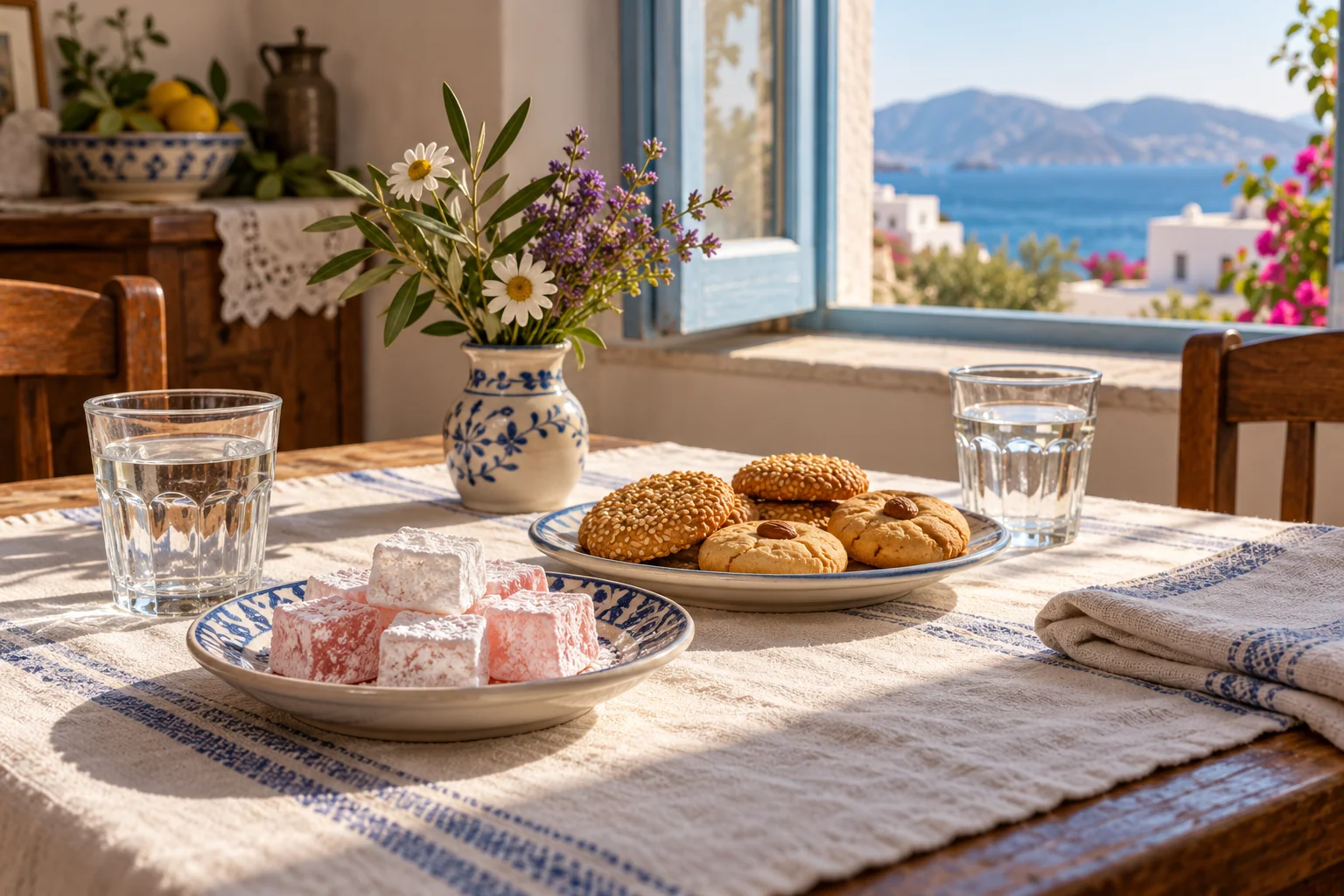
Name days can give rise to visitors, a treat or a joint meal. What that looks like depends on the family, working day and available time. Some people like to receive; others celebrate outside the door or only with their neighbours.
Don't assume everyone keeps an open house. Ask if coming over comes out, especially if you don't know someone well. A short call can be worth more than an unexpected visit with many expectations.
A gift helps the same modesty. A small attention may be appropriate, but there is no universal obligation to bring something specific. Please consider the host or hostess and ask for preferences when eating or drinking.
9. Church, village and party are not the same
A personal name day can coincide with a large church party or a local panigiri. This makes the day more visible, but the different events remain distinguishable. A village party has its own organization and history; a family party revolves around concrete people.
The commemoration of Constantine and Helena on 21 May and the holiday of Nicolaas on 6 December, for example, are recognizable ecclesiastical anchor points. How an Eleni or Nikos spends that day at home doesn't automatically follow. [5][8]
This separation also prevents a visitor from making every celebration a folkloristic spectacle. When you are invited, you are a guest of people with personal relationships and memories.
10. Attention remembering a name
The power of a name day is often in something small: someone remembers your name and thinks about you one day. The shared rhythm of the calendar can make that attention easier. That explains something of social significance without having to claim that everyone has the same habits.
For those who come regularly to Crete, it is a pleasant floor of contact. After a conversation, write down the date that someone calls themselves. Thus the calendar becomes a collection of relationships instead of a list of supposed rules about the Greeks.
11. Frequently asked questions
Greeks don't celebrate birthdays?
That's too general. Birthdays and name days can exist side by side; the personal emphasis varies.
Does everyone with the same call name have the same holiday?
Not necessarily. The full name, religious connection and family tradition can play a role.
Can a name day shift?
Yes. Georgios is a well-known example in which the Easter cycle can influence the liturgical celebration. [4]
You want me to drop by unexpectedly?
No. Ask for a visit. A heartfelt wish is also an appropriate way to show attention without visiting.
Sources and read on
Consulted for this edition on 30 October 2026. Historical descriptions, scientific research and current public sector information have different functions. Practical home recipes and editorial advice are where indicated own effects.
- Eortologio · Composite Greek name days calendar
- Greek Ministry · Multicultural Guide ( 2013 ): name days and birthdays
- Eortologio · Calendar January
- Greek Orthodox Archdiocese · Feast of the sacred Georgios and Easter Cycle
- Greek Orthodox Archdiocese · Constantine and Helena, 21 May pomelos
- Eortologio · Calendar
- Eortologio · Calendar October
- Greek Orthodox Archdiocese · Saint Nicholas, 6 December ↗