GREECE · ISLAND CULTURE & RESEARCH
Ikaria and the blue zone: longevity in Greece
Island culture, healthy ageing and the limits of evidence.
Added: · approx. 18 minutes read · 18 chapters
1. The Greek island behind the blue story
When Greece is called a blue zone, it is usually about Ikaria, not the whole country. This mountainous island is located in the eastern Aegean, near Samos. It has its own history, village life and landscape. The fame as an island of long-lived people has added a new layer: Ikaria is often presented as a place where people automatically become a healthy hundred. That's an attractive story, but it requires a more careful explanation. [1]
There is serious investigation into very old inhabitants of the island. At the same time, not every popular claim about their health or age has been proven. This dossier therefore looks at three different questions: are there relatively many high-age people, how do the inhabitants studied live and what can you derive from them about causes? Those who keep these questions apart will discover a more interesting island than a simple recipe for immortality.
2. What's a blue zone?
A blue zone is an indication of a geographical area associated with a striking concentration of long-lived people. The demographic approach must include a defined place, a particular population and verifiable data. The concept has also gained popular and commercial life, with books, documentaries and lifestyle programs. Those applications are not the same as the original population survey. [2]
Ikaria is one of the best known examples, along with parts of Sardinia. But a place on such a list is no guarantee that every resident will reach an exceptional age. Nor is it a medical recognition that gives the whole island the same status forever. Research into earlier birth generations tells something other than a current description of all residents.
For the reader, therefore, the best starting question is: what people and what years is this about? An interview with one hundred-year-olds, a 90-plus-year-old study and an analysis of all birth and death data provide different types of information.
3. Ikaria is not a middle name for Crete
Crete and Ikaria are different islands. They share parts of Greek culture, but differ in scale, location, history and local lifestyle. On Ikaria, the northern regions around Evdilos and Raches are named in studies after the oldest inhabitants. The selection of these areas is relevant: an investigation on a part of the island does not automatically describe the whole island or all Greeks. [3]
Crete has its own place in the history of nutrition research. The island was one of the Greek research areas of the Seven Countries Study, next to Corfu. That's a different research tradition than the blue zone studies at Ikaria. It is therefore more careful to link Crete with the development of research into food and cardiovascular diseases than simply to call it a blue zone without any justification. [4]
| Ikaria | Crete |
|---|---|
| Known in stories about blue zones and very old islanders. | Known in the history of Mediterranean food research. |
| Studies sometimes specifically select the oldest inhabitants of north-western municipalities. | The historical Seven Countries cohort consisted of men from certain rural villages. |
| An own local context; no model for the whole of Greece. | Nor one unchanging lifestyle for all residents. |
4. Why checking age is necessary
An impressive age deserves the same control as any other research given. For example, researchers compare civil registers, family data and mortality data. A reminder or identity document may be useful, but one source alone does not solve every problem. Name confusion, missing early registration and migration should also be investigated.
Austad and Pes defend in a publication from 2025 the demographic underpinning of the known blue zones. They also describe for Ikaria combining administrative data and family information. Their article responds to criticism of age validation and argues that controlled data should be distinguished from uncontrolled age claims. [2]
That does not mean that every question is closed. The quality of age control and whether an entire population can be shown to live exceptionally long are linked, but are not identical. You can identify a series of very old residents well and still need more data on the entire population, the comparison group or the evolution through time.
5. There is also scientific discussion
A scoping review by Candal-Pedreira and colleagues, published in the journal Aging and Disease in 2026, evaluates the available literature on blue zones. The authors find the demographic underpinning of Ikaria less strong than the popularity of the example suggests and argue for further research. They point, among other things, to limited population data and to the many studies that mainly describe lifestyle. [5]
This assessment differs from the defence by Austad and Pes. It is therefore too clear to write that the whole phenomenon has been proven for good, but it is also too simple to dismiss all the studies involved as fraud. The concrete discussion concerns data, demarcation and the criteria for assessing exceptional lifetimes. Both publications can be found at the bottom. [2][5]
This file therefore uses blue zone as the well-known designation of Ikaria, with explicit attention to uncertainty. A scientific reservation does not make the island any less interesting. It prevents a cultural story from being sold as an established biological fact.
6. What the studies actually describe
An investigation under 71 residents of 90 years and over in Evdilos and Raches took place in 2012–2013. The researchers described social contacts, nutrition and physical activity. Many participants had regular contact with family and others and remained active. Compliance with a Mediterranean diet was present, but was not considered to be exceptionally strong by the authors. [6]
A related article on the health of this group also shows that an old age is not the same as absence of disease. Among the participants were high blood pressure and diabetes; about two thirds had at least one chronic condition. The romantic image of an island without age problems doesn't fit in. [3]
These studies are valuable as a description of researched people. They are not an experiment in which randomly chosen participants were assigned a Ikarian lifestyle for decades. As a result, they cannot determine how many extra life years a meal, an afternoon nap or a village party causes.
7. The counter, the denominator and the survivors
Suppose a village counts remarkably many ninety-plussers. Then you also want to know how many people live there in total, how many young people have left and whether older people are returning. The proportion of old people can change through different processes. That's not automatically the same as a higher chance of becoming 90 from birth.
In addition, the selection of survivors. Anyone who is interviewed at a high age has reached that age. The researchers don't meet the same people with the same past habits who died before in the same way. The observed habits of survivors can therefore give an incomplete picture of the causes of survival.
Another example: healthy people can walk more easily and visit social meetings. When hikers appear healthier in an investigation, part of the connection can therefore also go the other way. These methodological examples are a guide to the aforementioned observation studies. They do not mean that any connection is meaningless; they show why cause and effect require further research.
8. The Mediterranean diet
The interest in Ikaria fits with the wider interest in Mediterranean food: many vegetable products, legumes, vegetables, fruits, cereals and olive oil, within a varied diet. That is something different than automatically calling every Greek dish healthy. Portions, preparation, salt, total nutrition and personal conditions remain important. The World Health Organisation is emphasising variation, balance and the composition of the whole diet. [7]
The Spanish PREDIMED study investigated a Mediterranean diet with extra olive oil or nuts in people with an increased cardiovascular risk. The 2018 republished analysis reported a lower number of serious cardiovascular events in the intervention groups than in the control group. The re-analysis followed identified problems with the allocation of participants. This is relevant intervention knowledge about cardiovascular outcomes in that studied population, no evidence that an island meal makes a hundred. [8]
A useful culinary question is therefore not what secret product to buy, but how an ordinary week is built. How often do vegetables and legumes come on the table? What replaces a product in the meal? A pattern is not reliably judged by one attractive sign on holiday.
9. Coffee, herbs and the danger of one miracle cure
A study from 2013 In elderly residents of Ikaria, the relationship between coffee use and a measure of blood vessel function was investigated. The researchers found an association with mainly cooked Greek coffee. However, the measured outcome was not a proven increase in lifetime, and the study does not prove that coffee was the cause of the difference found. [9]
This easily results in too big a leap in popular stories: a product contains certain substances, a laboratory measurement seems beneficial, so the product would be the secret of a long life. There are no questions between these steps about quantity, comparison, other habits and long-term health. The same caution applies to herbal mixtures, honey and supplements linked to the blue zone idea.
You can enjoy a cup of coffee or herbal tea without making a health promise. This dossier does not give a prescription to treat a condition with beverages or herbs and does not prescribe a daily dose. It describes the cultural significance and helps to assess the research claim on its actual size.
10. Move as part of the environment
In a mountain village activity can be generated by everyday tasks: climbing up a slope, taking care of a garden or visiting someone further away. The interesting thing is not only how much willpower a person has, but how the environment makes movement possible or necessary. In a comparison of very old inhabitants of Ikaria and Sardinia, Poulain and colleagues investigate the relationship between behaviour, health and environment, in addition to possible genetic factors. [10]
For older people, an environment that supports activity is also an independent subject of health policy. The WHO stresses accessible possibilities that suit one's abilities and circumstances. That's bigger than giving everyone the same walk or the same training goal. [11]
A romantic picture of a steep staircase can easily hide that the same staircase is an obstacle for someone with reduced mobility. The lesson for a village or district is therefore not that everything has to be more difficult to reach. More interesting are safe paths, places to rest and reasons to meet others. These are editorial questions about living environment, no guarantee at a certain age.
11. Family, village life and staying connected
Social contacts attract a lot of attention in the stories about Ikaria. The study carried out under the 71 90+ describes a lot of mutual and family involvement. It does not follow that every family on the island is harmonious or that no one is lonely. A selected group shows a certain part of social life. [6]
The importance of social connection is also investigated outside Ikaria. The WHO distinguishes between objective social isolation and the subjective sense of loneliness. A large number of contacts are not automatically the same as meaningful relationships; quality, desired proximity and the ability to participate also count. [12]
For a visitor, this can change the view of the village square. It is not just about cosiness that you can photograph, but about repeated contacts and mutual responsibility. Who helps when someone doesn't show up? Can an older resident contribute something himself? Such questions are less spectacular than secret food, but make daily life more concrete.
12. Panigiria, faith and afternoon rest
Panigiria are local celebrations that are often organized around a holy feast. In the researched group at Ikaria, some very old inhabitants still participated in such meetings and religious activities. Even afternoon rest occurred. These observations describe parts of their lives; they do not prove an independent life-long effect of a feast, belief or nap. [6]
Cultural cohesion is interesting. A party can bring music, food, encounter and memory together. An ecclesiastical calendar gives recurring occasions to see acquaintances. Us file on the Greek Orthodox Church Explains that background more extensively. This does not mean that religious participation has the same meaning for every resident.
For sleep also, a description is not a requirement. From the existence of afternoon naps among researched elderly people, you can't infer that everyone has to sleep during the day or live longer. The whole day and night rhythm, any complaints and the personal situation remain relevant. The cultural story may create curiosity without becoming a sleeping treatment.
13. Wine is not a necessary step towards a long life
Wine is sometimes given the role of a health product in Mediterranean travel stories. However, the fact that some long-lived people use alcohol does not prove that it has made them old. Here too, the selection of survivors and other living conditions play a role.
WHO describes alcohol as a substance with health risks, including cancer. The Dutch Health Council concludes in its opinion from 2026 that there is no safe level of alcohol consumption. The blue zone story is therefore no reason to start drinking or using alcohol as a prevention. [13][14]
Dinner and spending time with others do not require wine. Water, coffee without medical promise or any other appropriate drink can share the same social table. Thus, the difference between a cultural habit that you can describe and an action that you would recommend as a health advice.
14. Long life and getting old are different questions
The highest age reached is a striking number, but does not say everything about life before it. Can people move, make decisions, maintain contacts and do what they think is important? The WHO approaches healthy ageing from this functional capacity, which arises in the interaction between personal possibilities and the environment. [15]
That perspective helps not treat old age as a competition. A person with a chronic condition can have a meaningful daily life thanks to tools and good support. Conversely, the absence of one diagnosis tells little about loneliness, pain or dependence. The studies at Ikaria therefore look more than just birthdays.
Access to care is also part of the story. An island can offer proximity and mutual support, but distance and transport can present problems at the same time. The existence of local solidarity does not render professional care superfluous. The life cycle of a ninety-year-old cannot be summarized in the few lifestyle choices a visitor sees during one week's vacation.
15. An island changes with its generations
A photo of an older gardener is not a cross section of the life of all young islanders. Work, transport, food supply, migration and care change. A way of life from the youth of someone who is now ninety can be very different from the daily life of a 30-year-old.
This is also apparent from Cretan nutrition research. A follow-up of surviving participants in the Seven Countries Study investigated changes in nutrition and cardiovascular risk factors after thirty years. Such a study shows why a historical diet should not be treated as an unchanging property of an island. [16]
For the blue zone idea, an important research question follows: does a possible gap persist in subsequent generations of birth? A reputation can last longer than the circumstances on which it is based. That is why we always refer to the study period and do not present old percentages as an actual census of Ikaria.
16. Visiting Ikaria without making the residents into evidence
Ikaria is a residence and travel destination, not an outdoor laboratory for tourists. Evdilos is a port town on the north coast; Agios Kirykos is located on the south side. The mountain villages and coastal towns have different rhythms. The official Greek tourist information provides a first geographical introduction, but a travel route is not a health intervention. [1]
A respectful visit begins with ordinary interest: a walk, a conversation if someone has time for it, a meal and attention to local history. Ask for permission before you photograph recognizable residents. Do not automatically ask someone questions about age or illness because the island was found in a documentary.
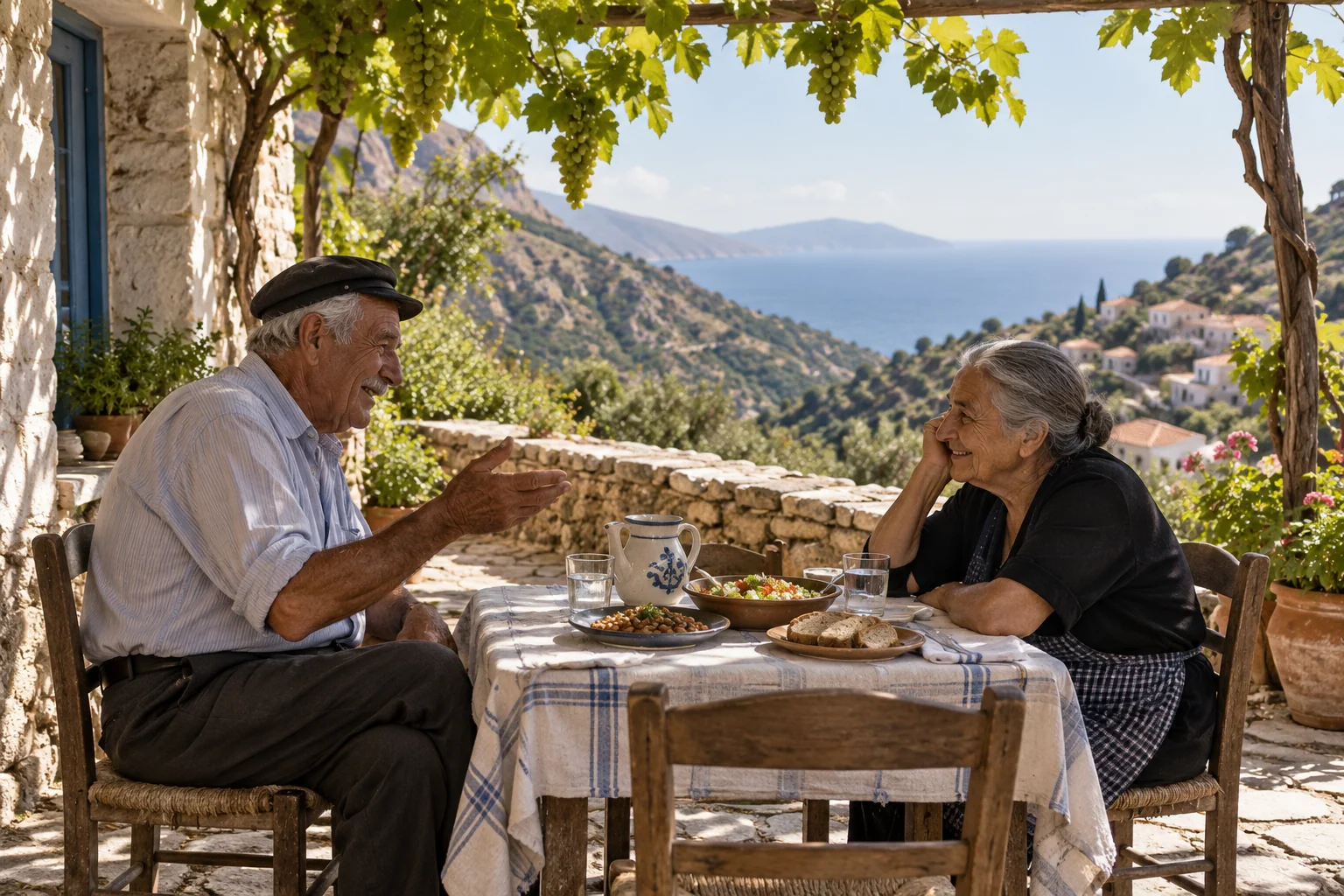
The atmospheric illustration of this file shows an imaginary encounter. The persons depicted are not real participants in a study. The image supports the cultural story and provides no evidence of the health, ages or lifestyle of Ikaria residents.
17. What you can take from the story
The most fruitful result of this dossier is another way of looking. Nutrition is related to the whole meal and the whole week; moving with the environment; social contacts with the ability to continue to participate. That broad look is useful without promising that mimicking some island habits will give rise to a certain age.
For general health choices, well-founded recommendations and the personal situation are more important than the name of a destination. This dossier is primarily about understanding research and culture. It does not provide a personal treatment plan and provides no reason to replace prescribed care with a blue zone program.
| Popular pronunciation | More careful formulation |
|---|---|
| Everyone on Ikaria lives to a hundred. | There is research into exceptional old age; it does not apply to every resident and demographic support is discussed. |
| The secret is one kind of food. | Studies look at several related factors; one proven island secret has not been found. |
| Anyone who drinks coffee will live longer. | A coffee study found a connection with a vascular measurement, not a proven extension of life. |
| In Crete, it's exactly the same. | Crete has its own research and nutritional history. |
| A blue zone vacation will make you healthier. | A travel experience is not a controlled trial or medical treatment. |
18. Frequently asked questions
Where is the Greek blue zone?
Ikaria, in the eastern Aegean Sea, is the Greek island known by this name. The term does not refer to the whole of Greece. [1][2]
Is it scientifically proven that all Ikariotes live much longer?
No. There are studies of age and lifestyle, but the definition and strength of demographic support are discussed. None of this proves that all residents are exceptionally old. [2][5]
Is Crete also automatically a blue zone?
No. Crete is important in historical Mediterranean food research. That's a claim other than a validated concentration of exceptionally long-lived people. [4]
Are the old people all free of disease?
No. Health research 71 Ninety-six-six also describes chronic diseases. High age and absence of disease are different things. [3]
Is wine part of the advice?
No. The file does not recommend drinking alcohol for health reasons. The existence of long-lived drinkers proves no protective effect. [13][14]
Can I copy the lifestyle at home?
You can be interested in meals, daily movement and social connection. That's different than being able to achieve the same lifespan. An island history cannot be taken over as a short checklist.
Sources and read on
Consulted for this edition on 30 October 2026. The study period is independent of the date of publication. Descriptive studies, intervention studies and assessments of demographic support have been distinguished. This is background information on culture and research, not personal medical advice.
- GNTO / Visit Greece · Ikaria.
- Austad & Pes ( 2025 ) · The validity of Blue Zones demography: a response to criticals
- Legrand and Others ( 2019 ) · Assessment of the Health Status of the Oldest Olds Living on the Greek Island of Ikaria
- Seven Countries Study · The Greek cohorts Crete and Corfu
- Candal-Pedreira and Others ( 2026 ) · Blue Zones, an Analysis of Existing Evidence through a Scoping Review
- Legrand and Others ( 2021 ) · Description of Lifestyle, Including Social Life, Diet and Physical Activity, of People ≥ 90 years Living in Ikaria
- WHO ( 2026 ) · Healthy diet
- Estruch and Others ( 2018 ) · PREDIMED, corrected and republished analysis
- Siasos and Others ( 2013 ) · Consumption of a boiled Greek type of coffee is associated with improved endothelial function
- Poulain and Others ( 2021 ) · Specific features of the oldest old from the Longevity Blue Zones in Ikaria and Sardinia
- WHO · Promoting physical activity for older people: a toolkit for action.
- WHO ( 2025 ) · Social connection linked to improved health and reduced risk of early death
- WHO · Alcohol, fact sheet
- Health Council ( 2026 ) · Alcohol and health in the broad sense.
- WHO · Healthy Ageing and Functionalability
- Kafatos and others ( 1997 ) · Heart disease risk-factor status and dietary changes in the Cretan population over the past 30 Years..