NARRATOR CHARGE · DIFFERENCE
Buried, excavated and remembered in Greece
About local tomb duration, bone retention and the meaning of commemoration.
Added: · approx. 9 minutes read · 12 chapters
1. What's the story in five years?
The story contains a recognizable practice, but the fixed five-year period makes it too easy. In several Greek municipal cemeteries, graves are re-used after a certain period of use and the bones are transferred. The duration and procedure vary by municipality, cemetery and grave category.
A concrete Cretan example is the rules published by Ierapetra from 2015. This includes three-year-old graves, excavation after that period and conditions for renewal. In the municipality of Volvi, a published regulations for certain places with lack of space describe just five to nine years. [1][2]
So the right question is not after how many years do the Greeks do this?, but what cemetery, which grave and what rules? This dossier explains the background; a proper burial requires confirmation of the current local procedure.
2. A grave is not always a permanent place
Those who are accustomed to their own family grave may experience a temporary right of use as a strange interruption. However, the first burial and later location of the bones are different parts of a longer process. The disappearance of an individual grave does not automatically mean that the family ends the memory.
The municipal information of Athens distinguishes three-year-old graves, family graves and various facilities for bone preservation. That shows why one general description is not sufficient. A grave category also determines which questions should be asked to the administrator. [3]
Space use, administrative arrangements and religious significance can be relevant at the same time. There is no need to explain the practice solely from geography, nor to make every municipal term a church rule.
3. Local examples side by side
The examples below show differences, no national ranking and no guarantee that an old regulation has remained unchanged since then. [1][2][4]
| Published Source | What's in it. | Meaning for the reader |
|---|---|---|
| Ierapetra, rules out 2015 | Among others, three-year-old graves and an extension scheme. | A Cretan counter example of the claim always five years. |
| Volvi, municipal regulations | Five to nine years in these areas with lack of space, with local conditions. | Even a five-year term doesn't tell the full story. |
| Florina, municipal instruction | A minimum normal duration of seven years, with separate provisions for special cases. | There are also longer local deadlines. |
These sources have been consulted on 30 October 2026. Anyone who has to make arrangements will request the current regulations and the written arrangements for the concrete grave. A web page from another municipality cannot provide permission or deadline for this.
4. What does excavation mean in this context?
The Greek words εκταφή, ektafi, and ανακομιδή, anakomidi, may appear in information about excavation and transfer of bones. This file concerns the ordinary cemetery plate procedure after a period of use. That's something other than a court dig for investigation.
Ierapetra describes in the published regulations responsibilities of next of kin and cemetery service, possible presence of family and priest and transfer to bone preservation. The source thus shows that the procedure also has an administrative and practical organisation. [1]
An outsider sometimes sees only the most striking moment. For the family, there is a period of contact, memory and possibly tension. Therefore, write about involved people and agreements, not an anonymous national peculiarity.
5. Water and wine: usually the bones
The formulation the bodies are excavated and washed with wine can evoke a wrong image. An anthropological description in the publisher's fragment The Violence of Death describes the washing of the excavated bones with water and wine and the later placement in an ossuary. [5] The contemporary service provider Athens Funals calls ritual wine and a prayer at the ceremony, depending on what is asked. [7]
These descriptions give examples, no evidence that every family or cemetery follows exactly the same ritual. Words such as washing, sprinkling and blessings should not be used simply as the same action.
The relevant distinction remains: this description concerns the bones after excavation, not a general rural rule that a complete body is washed with wine after exactly five years. The handling of material remains also requires the relevant service and applicable regulations; this file is not an implementation manual.
6. What's an ossuary?
An ossuary is a place for the storage of bones. In Greek information οστεοφυλάκιο, osteophylaxis, for. The precise device may differ: a device for individual bone boxes is not automatically the same as a common storage facility.
The Athens cemetery service mentions, among other things, the transfer and preservation of bones and separate payments associated with them. Such an administrative list shows that detention is a separate phase and not simply a forgotten box after the funeral. [3]
In case of a practical situation, ask how identification, retention period, access and future shipment are arranged. The appearance of a building doesn't tell you that. A family can also have different expectations about what happens to the remains afterwards.
7. Orthodox faith and municipal rules
The Greek Orthodox background gives death and remembrance a meaning in which prayer and the expectation of the resurrection can be central. The Archdiocese describes memorial service at certain times after a death and mentions the grain of kollyva as a symbol of resurrection. [6]
That ecclesiastical perspective should not be confused with a national five-year period. The meaning of prayer is a question other than the availability of a grave or the conditions of a congregation.
A family can experience the later transfer as care for the deceased, as a new confrontation with loss or as both. A theological explanation does not predict how each individual experiences the moment. Space for difference is more important here than a romantic representation of an always harmonious tradition.
8. Remembering is more than a tombstone
In Orthodox practice, remembrance can go through prayers, services, family visits and a meal. The moments described by GOARCH constitute a ecclesiastical framework, not a compulsory programme that is followed in the same way in each household. [6]
For a visitor it helps to ask what is appropriate at that time. Sometimes presence is welcome; sometimes the family wants peace or only a small circle. You don't have to imitate a ritual to show respect.
Moreover, the meaning of a deceased does not reside exclusively in a physical place. A name in a conversation, a family photo or preparing a remembered dish can be equally important for next of kin. These are personal forms of memory, not an alternative that should be prescribed from the outside.
9. If the expected situation is not reached
A period of use on paper does not guarantee that biological processes have been completed exactly at that date. A cautious explanation will keep those two things apart. Florina's municipal instruction also shows that special circumstances and health regulations can lead to different deadlines. [4]
This is no reason to present a body's condition as moral judgment of the deceased. A folk story about dissolution is not a reliable determination of one's life, belief or fate after death.
In the event of uncertainty, the family will contact the cemetery service and, if necessary, the competent professional. A general website cannot consent to reburied, transport or treatment of remains.
10. What families can ask in advance
Ask for grave category, duration of use, current costs and contact at the end of the term. Learn how a possible extension is requested and what options exist for the bones. Please also confirm who may take a decision and what documents are required.
Write down appointments. This prevents family members from having a different oral reminder years later. Make sure that the administrator has a reachable contact address, especially when the family lives partly outside Greece.
Transport across national borders, inheritance or other legal consequences will require the authorities concerned. This dossier deliberately does not mention a fixed national tariff or universal application period: the examples cited do not justify them.
11. Visit a cemetery with attention
A cemetery is first a place of next of kin and only then a source for cultural history. Don't photograph recognizable grieving people and don't approach a ceremony as an unexpected attraction. Request permission for a personal story or recognizable grave detail that you want to publish.
Note local clues, clothing that suits the environment and the tranquility of the place. A closed room for bone retention is not an invitation to investigate what's behind the door.
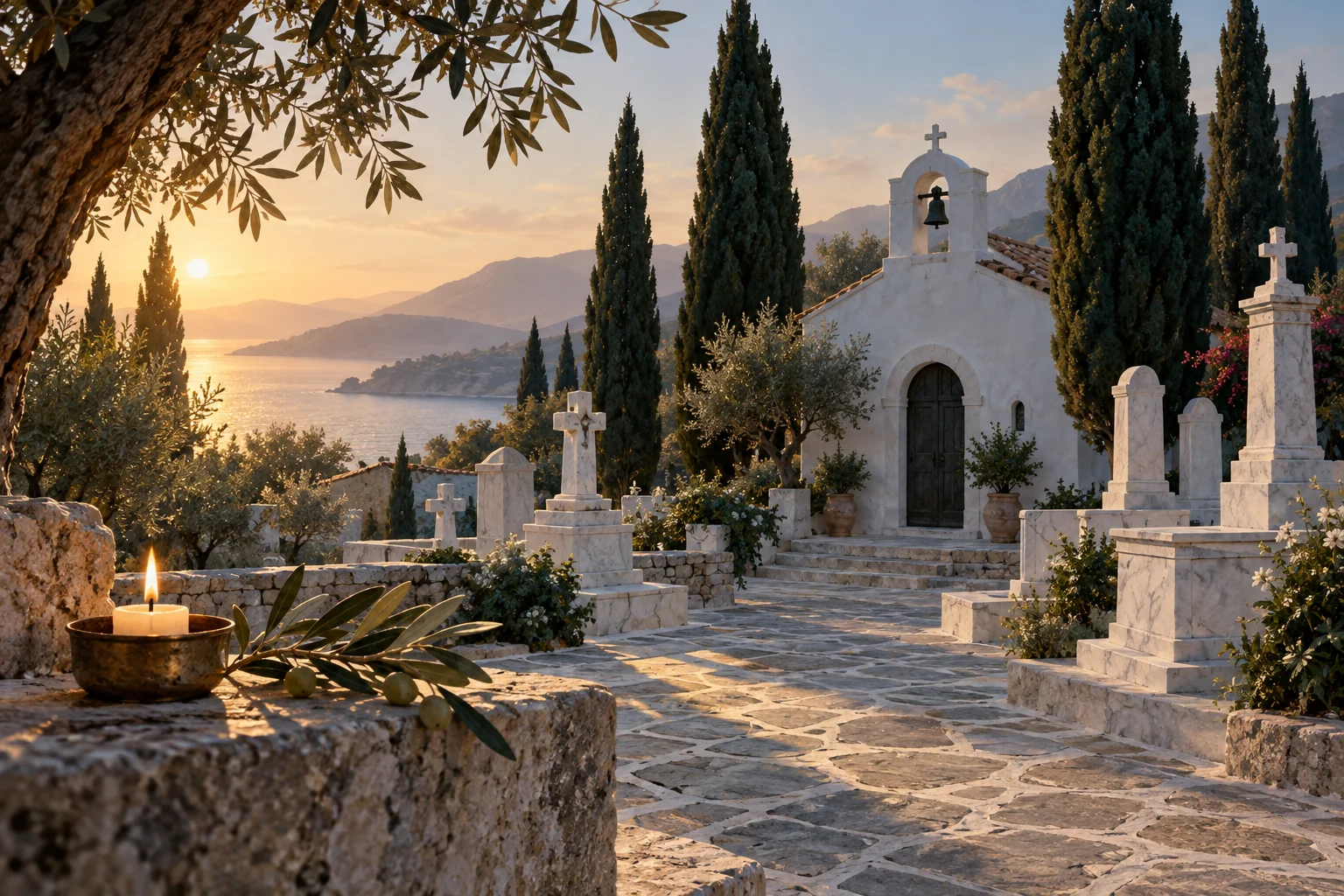
The image in this article is an AI-spherical illustration of an imaginary cemetery. No real family graves or remains are depicted. The sources and the local context are decisive for understanding practice.
12. Frequently asked questions
Is everyone in Greece being dug up after five years?
No. Municipal regulations and grave categories differ. The sources cited include three, seven and five to nine years.
Is the whole body washed with wine?
The quoted anthropological description is about cleaning bones after excavation. That must not be generalised into one universal ritual.
Is the ossuary the same as a crematorium?
No. An ossuary is for bone preservation. Cremation is another act.
Is the term a rule of the Orthodox Church?
A municipal tomb duration and ecclesiastical significance must be distinguished. No national ecclesiastical rule of exactly five years has been demonstrated in these sources.
What source is leading if I have to take care of something?
The current regulations and the confirmed agreements with the competent cemetery service for the concrete grave.
Sources and read on
Sources checked for this edition on 30 October 2026. Antique texts, later tradition, dictionaries and contemporary practical descriptions have different functions. Own calculation examples, listening questions and language examples are editorial effects.
- Municipality of Ierapetra · Published cemetery regulations, decision 275 / 2015 ↗
- Municipality of Volvi · Publicised municipal cemetery regulations
- Municipality of Athens · Cemetery service B: services and tomb categories
- Municipality of Florina · Practical instructions and local funeral time.
- The Violence of Death · Anthropological Publisher fragment, p. 224; no national regulation..
- Greek Orthodox Archdiocese · Remembrance services and collyva.
- Athens Funerals · Own description of excavation services and ceremony, not a national standard