LIVE KRETA · Village & textile
Kritsa: woven stories and embroidered memories
Learn to look at thread, technique and the hands behind the pattern.
Added: · approx. 6 minutes read · 8 chapters
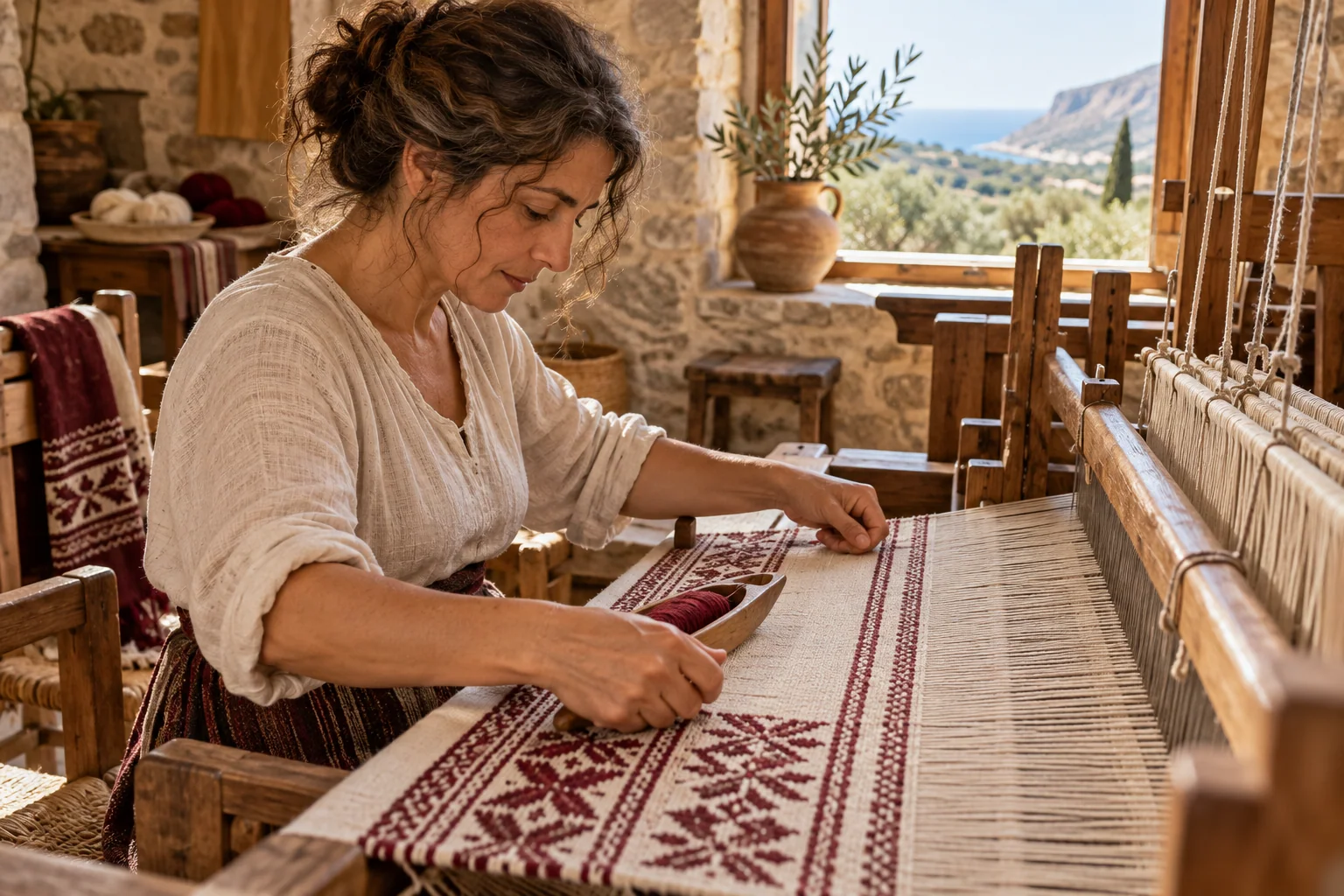
1. More than a decorative village statue
Kritsa is located in the east of Crete and is already connected in our guide to the villages around Agios Nikolaos. This file zooms in on textiles: what do you see when a canvas hangs on a façade, where differences in weaving and embroidery and how can you recognise the work of a maker behind a pattern? A village is not an outdoor display case. Behind a displayed object are ordinary choices about work, sales, use and maintenance.
Visit Greece calls weaving and embroidery as characteristic traditions of Kritsa. That's our source for the local link. It does not mean that every textile is manufactured in a shop on the spot or that all residents practice the same trade. For a specific object, maker, technique and origin remain separate questions. [1]
2. Keep weaving and embroidery apart
Weaving creates a tissue because wires intersect according to a system. The threads that are stretched on the rope form the shear; the impact is carried through. In the case of embroidery, a motif shall be affixed with stitches on or by an existing fabric. Both techniques can be carefully, time-consuming and richly decorated. The distinction says something about the construction, not about the cultural value.
Take a simple thought experiment. Suppose you removed one colored line from a pattern. Does this change the cohesion of the tissue itself, or does it leave a surface where decoration was missing? In reality, of course, you don't pull a thread. You can view the back if the owner allows, or ask for a technical explanation. For example, textile reading is a research into material and structure.
3. The actions before the pattern
The Museum of Cretan Ethnology describes how wool is washed, carded and spun before it ends up on the rope. These are general parts of the historical textile chain in Crete, not exclusively Kritsa's recipe. The distinction prevents one museum description from wrongly becoming a manual for each local workshop. [2]
An uneven thread, another fiber or a change in tension has consequences for the work. That's why expertise is also in preparation and recovery. Ask not only how long the visible pattern lasts, but also how much time it takes before the first row can be woven. Thus the conversation can shift from a quick price comparison to understanding labor.
4. Geometry, colour and the limits of symbolism
Windows, tires and repetition are strong visual aids to examine a canvas. Look at symmetry, a transition between two colors and the place where a pattern ends. Is the edge an independent design? Is the same unit the same everywhere? Those are perceptible characteristics. Its meaning requires a next step: a creator, a collection description or a carefully documented source.
The UNESCO Sites network in Crete describes in the wider region textiles with geometric and floral motifs, as well as woven bags and blankets. That supports the idea of diversity. It does not justify giving every window all over Crete exactly the same old meaning. That's why we keep a family story recognizable as a family story. [3]
5. Textiles as a domestic archive
A towel may contain repairs, discolorations and modifications. For example, a stopped place shows that throwing away wasn't the only choice. But wear doesn't date itself. An heirloom may also have been modified later, and a new object may repeat an older pattern. The question of who used a canvas is therefore at least as important as the question of how old it is.
The agricultural museum in Piskopiano places weaving tools and textiles between other parts of rural life. This approach helps to take domestic work seriously. An embroidered piece is not only a beautiful pattern; it may have been part of clothing, decor, a gift or a ritual of life. That needs to be investigated per object. [4]
6. Questions that open a conversation
| Question | What you can discover with it |
|---|---|
| Is this woven, embroidered or a combination? | The construction and decoration |
| Who made it? | Maker, family or workshop |
| Which fibers have been used? | Material selection and maintenance |
| Is this a design of your own or an acquired pattern? | The relationship between innovation and transfer |
| Can I see the back, too? | Stabbing, wire finishing and technique |
| How can I wash or store this? | The intended use in daily life |
An answer doesn't have to be a long historical explanation to be valuable. The simple communication that an object has been created elsewhere is also useful information. A store is not obliged to be a living museum, and a visitor does not have to treat every product as evidence of a lost past.
7. A second visual language: Panagia Kera
At Kritsa lies Panagia Kera. The municipal information describes a church with three beech and important paintings from the thirteenth and fourteenth centuries. This dossier uses it as a point of comparison: both textiles and murals require attention to material, technique, representation and the conditions in which they were made. That is an editorial reading connection, not a claim that a particular embroidery motif comes directly from that church. [5]
So you can practice two kinds of looking next to each other. In a church, you investigate how images relate to space. With a cloth you look at how decoration relates to fold, edge, garment or domestic use. Photographing and touching have their own rules in both places; follow the instructions of the administrator or maker.
8. A living tradition allows for difference
A contemporary maker can choose different colours, work with other materials or translate a parent pattern into a new usage. Therefore, the file does not constitute a ranking in which only repetition is authentic. The more interesting question is what is consciously passed on and what is consciously changed.
Use Kritsa as the starting point for our craft file and then for the Cretan dialect. The words with which one describes a technique are also heritage. Write with permission the name of a material or action, ask what it means and save the context. Thus the textile becomes a connection between tangible objects, language and personal memory.
Sources and read on
Sources consulted for this edition on 30 October 2026. Historical publications and dated project descriptions are not a live state of affairs. The practical questions of viewing and research are our editorial reader.