GREEK PHILOSOPHOBIA · DIVISION 32 / 40
Diogenes: practicing freedom in the public square
Possession, shame and boldness explored by a pronounced way of life.
Diogenes asks philosophical questions with his way of life. A simple cloak, a jug and an unexpected gesture can become as important to him as a reasoning. The stakes are not gloomy distrust, but the question of how much power habit, possession and prestige a person get.
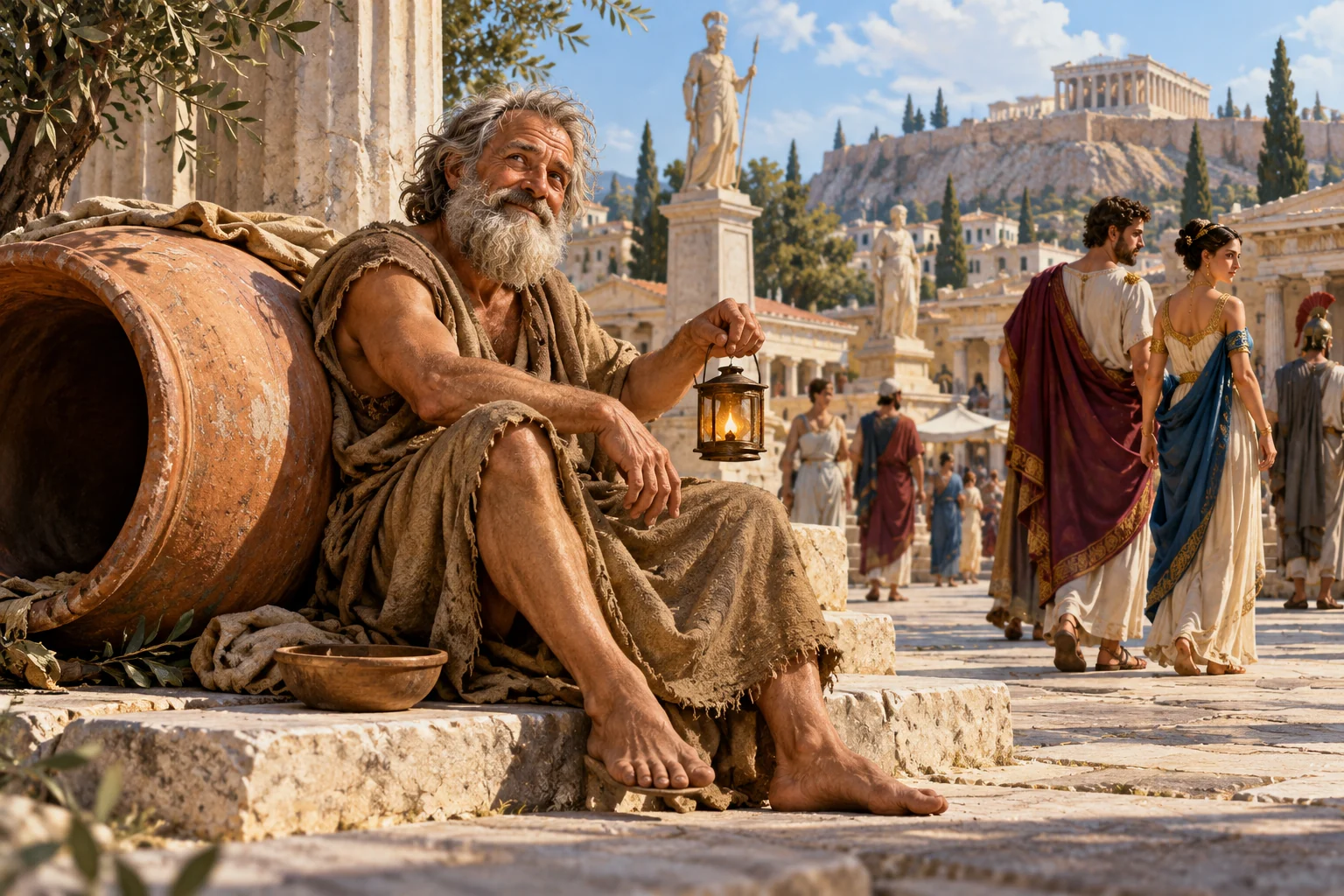
The philosopher and the stories about him
Diogenes van Sinope is known from a tradition of short scenes. An important source is Diogenes Laertius, who collected philosopher lives centuries later. That distance means that we can't read witty anecdotes as controlled diary notes. They do show what image one wanted to preserve of a kynic lifestyle.
His famous stay should also be carefully proposed. In ancient tradition it is a large pithos, a pottery storage vessel, not a wooden barrel. That doesn't make the image a fully verifiable biography. However, it restores a material detail that is easily overwritten by later performances.
Kynisch is not the same as modern cynical
By a cynical attitude we often mean that someone behind beautiful words suspects only self-interest. The antique synism has a different bet. It focuses on the exercise to live according to nature and with less artificial needs. Self-satisfaction is something other than independence: the question is what desires you control yourself and what desires you actually control.
An expensive habit can give pleasure and at the same time make it vulnerable to loss of status or income. The kynic question is not just whether the object is pleasant. She's also what you have to keep doing to keep it. Thus, property does not become a collection of things, but a relationship in which the owner sometimes gets more obligations than freedom.
Askēsis: Practice instead of consenting only
A man can say convincingly that appearance does nothing to him and still disturb him at the first rejection. That's why the kynicians get so much weight. A thought must be able to be tried in a concrete way. It is the difference between a view of freedom and the ability to act boldly under uncomfortable circumstances.
That's what makes Diogenes difficult. Practice can expose insights, but it can turn into display. Anyone who proves that he does not need the opinion of the public can become very dependent on that same audience to make the demonstration succeed. This tension is an interpretive question to the life form, no reason to dismiss any provocation as an empty stage.
Freedom and shame
Parrhēsia, speaking boldly, gets a special sharpness with the kynic figure. An unusual act can show that a rule is only customary. At the same time, not every civilisation of another is therefore justified. There is a moral difference between confronting a powerful person and humiliating a vulnerable person that does not disappear by the word honesty.
A contemporary reader can therefore ask who carries the risk in a scene. Is the provocation directed against bloated authority, or does it make a mockery of someone without protection? That question will make the reading more accurate. It prevents independence from being confused with the freedom to regard any consequence as unimportant to others.
What's left without the heroic anecdote?
Perhaps the most useful question is not whether we should live like Diogenes. It is about what needs are really our own and which we have learned to count. A simple meal, a conversation in the square and time that is not spent on possession can then become philosophical subjects.
In the knowledge universe, this file connects with Epicurus, the sophists and the village square. The similarities with a sober lifestyle are comparative points. They do not make a Cretan kafeneion a direct heir to the synism. What can be shared research is how good life becomes visible in everyday habits.
Think on for yourself
Choose an asset that is also an obligation. Describe what it gives you and what you need to support, earn or radiate. What would happen if you paid less attention to it for a week? The question is not whether austerity is always better, but whether you can still choose freely.
Sources and read on
- Diogenes Laertius, Life of Diogenes, book VI
Antique, much later collection of testimonies; especially VI. 20–38 and VI. 63–71. Use the anecdotes with attention to their tradition.
Texts consulted on 29 October 2026. The Dutch explanation is new; the source links give access to ancient texts and scientific context.