MYTHOLOGY & TRAGEDIA · DIVISION 25 / 40
Odysseus and the Sirens: listen, knowledge and limit yourself
The promise of knowledge, the attention of a hero and the crew who carries his plan.
The Sirens seduce Odysseus with a promise of knowledge. His solution is remarkable: he temporarily makes himself less free in order to sustain a determination. The episode not only investigates temptation, but also the organisation of attention and responsibility.
What the song promises
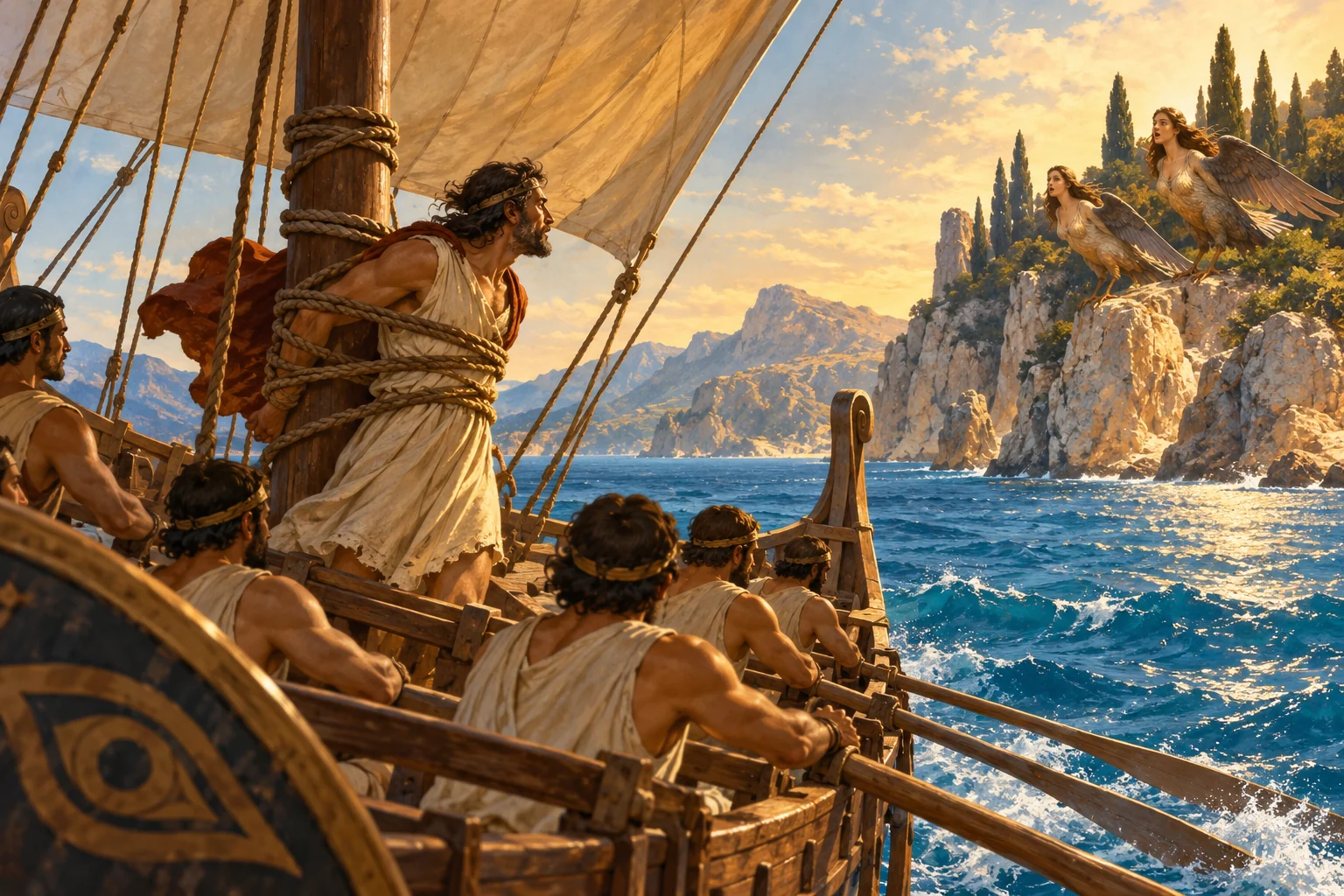
In book 12 From the Odyssey, Kirke warns of the Sirens. Odysseus must close his men's ears with wax. If he wants to hear the song himself, he'll have to get tied to the mast. When the Sirens address him, they promise, among other things, knowledge of what is happening around Troy and what is happening on earth. The attraction is not just a beautiful voice: it is the prospect of knowing more.
Odysseus wants to be released while listening. His men do exactly the opposite and tie him more firmly according to the previous instructions. The pre-made plan wins from the later impulse. That construction makes the adventure special: insight at a quiet moment must protect the person who under other circumstances will want something different.
The bird shape does not come easily from this passage
On many antique images, Sirens appear with a female head and a bird body. That image is not the same as the later representation of mermaids with a fishtail. However, the Homer passage does not describe their body extensively. It is therefore careful to name the poem and the image tradition separately, even when an illustration brings them together.
This little separation is a good exercise for the entire mythology section. A familiar image can become so strong that we believe to recognize it literally in every text. Ask one detail: is it here, is it from another source, or is it an addition to an artist? Thus a performance remains real without several testimonies merging unnoticed.
Connecting yourself as a form of action
A contemporary comparison is the preposition of a distracting device when you want to work concentrated. The agreement is not in the device or the danger, but in the structure of the decision. Someone chooses at a first moment which room he will have at a second moment. A restriction can therefore be part of a conscious plan.
But not every limitation is liberating. Who sets the terms? Can the person in question make himself known outside the agreed danger? And who controls that helpers do not abuse their role? The mast scene doesn't offer a universal excuse to hold someone against his will. It can help to discuss the difference between a self-chosen appointment and an imposed form of control.
The crew makes the adventure possible
Odysseus gets the exceptional experience of listening. His men row through without hearing the same knowledge. That difference deserves attention. The known hero can take a risk because others carry out instructions and persevere with a task. Anyone who only admires the smart leader misses the division of labour that carries his plan.
Here too, modern application begins with a question and not with a quick condemnation. Is unequally divided experience justified by a common goal? Who gets recognition for the success of the plan? A story about personal control can also become a story about leadership and the limits of trust in a leader.
Knowledge can have a price
The Sirens offer seemingly unlimited insight, but their environment makes it clear that listening is dangerous. This raises a question other than whether knowledge is good. Under what circumstances is it wise to pursue knowledge? Not every answer that seems to be accessible needs to be worth pursuing at any time.
In the knowledge universe, this file connects with the Odyssey, the language of music and Epictetus' examination of impressions and judgments. Those are lee ties. The episode is not an antique theory about social media, although a comparison with attention management can help you to look at both topics more closely.
Think on for yourself
Think of one appointment to protect your own purpose. Write down the purpose, the chosen limitation and the circumstances in which you want to be able to adjust her again. Then describe who fulfils the role of the rowers. Is the plan still sensible when their importance is taken into account?
Sources and read on
- Homer, Odyssey 12
Primary text; book 12, in particular 39–54 and 158–200.
- The Metropolitan Museum of Art, Dangerous Beauty
Museum research and objects; the section on Sirens and their bird form, p. 37.
Texts consulted on 29 October 2026. The Dutch explanation is new; the source links give access to ancient texts and scientific context.