MYTHOLOGY & TRAGEDIA · DIVISION 30 / 40
Britomartis and Diktynna: a Cretan goddess between net and landscape
Cretan cult, Artemis and the various stories about a goddess and Minos.
Britomartis is a pronounced Cretan entrance to Greek mythology. Her connection with Diktynna and Artemis shows how a goddess can carry different names, places and stories. It is precisely the differences between antique counters that make her interesting.
Not a single life story.
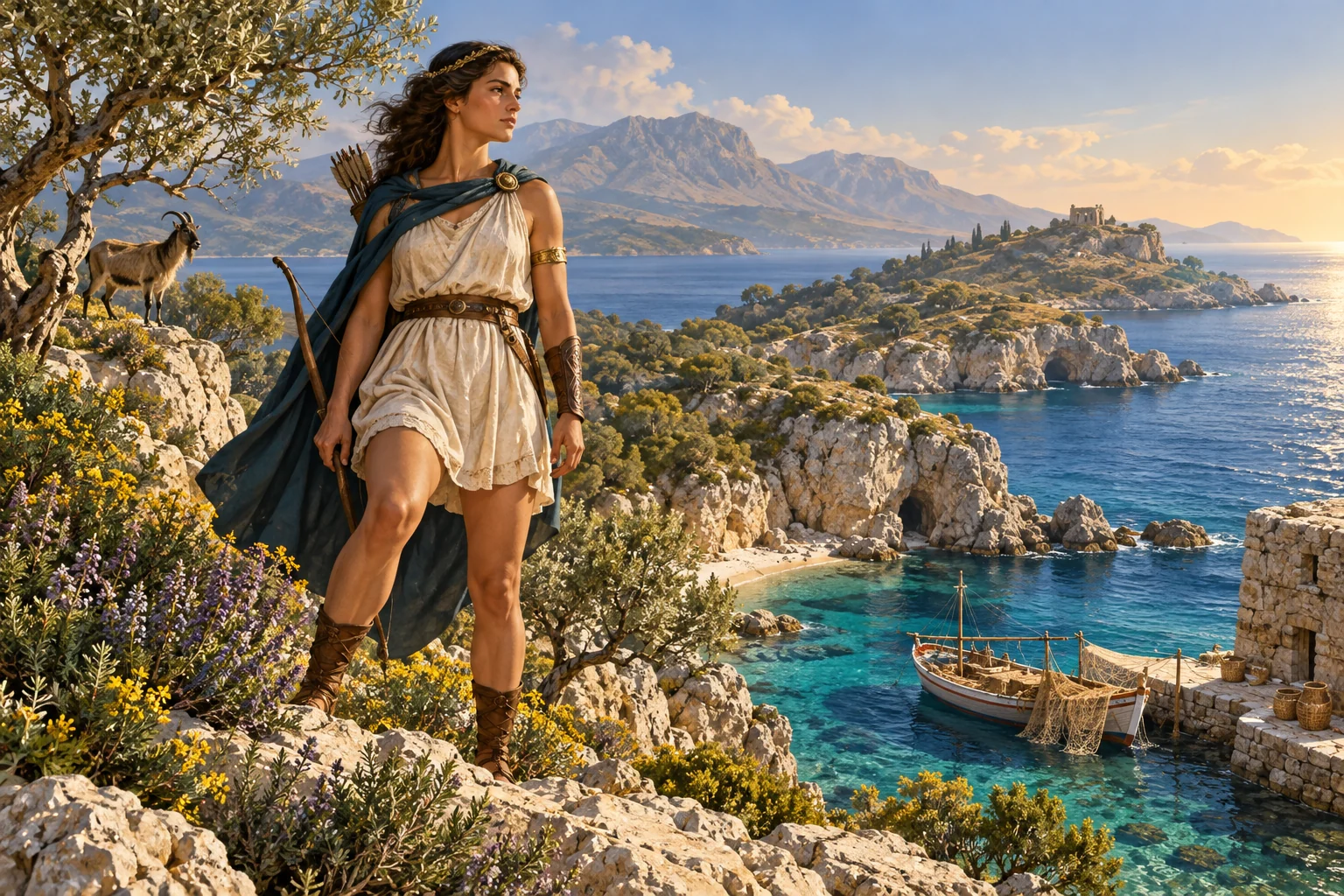
Callimachus tells Artemis in his hymn about the Cretan Britomartis, the pursuit by Minos and her escape from the sea, where nets are given a role in the story. Diodorus Siculus also treats Britomartis, but prefers a statement in which it invents nets. He precisely rejects the story that would imply her helplessness and Minos.
That contradiction is valuable. We don't have to solve her by inventing one complete version in which every detail happens anyway. The authors show different beliefs about what suits a goddess and a king as righteously proposed. The rewriting of a story may also include an assessment of an appropriate image of God or ruler.
Which explains a name and not
Ancient authors connect Diktynna with nets and play with the Greek word diktyon. Such a statement makes a story understandable to their audience. However, it is not an automatic established historical etymology. A narrator can explain an existing name through an attractive story without knowing how that name really came into existence.
That distinction also helps with other local myths. A rock, cave or cape can be linked to an event because the story gives meaning to the place. It does not follow from this that the event has been found to have occurred in that place. Keeping the landscape as a bearer of stories is something other than using the landscape as independent evidence for every narrative.
Near Artemis, without erasing all differences
Britomartis and Diktynna are placed in ancient sources close to Artemis and sometimes identified with her. However, it is not always wise to treat local names only as interchangeable labels for one uniform goddess. A community could have its own cult site, memory and accent, even if other Greeks recognized a known divine kinship in it.
A useful comparison is that between a widely recognizable theme and a local version. The agreement allows a meeting; the difference tells something about the place. But that too is a tool for our interpretation. We cannot assume that every community described its religious relations exactly with the same categories.
A story about independence
The version of the chase can be read from Britomartis' refusal and escape. Her scope for action is under pressure, but the narration does not end solely with her vulnerability. The transition to divine honor makes it possible to think about protection, freedom and the border of Minos' power.
Diodorus reveals that another narrator could object to such a performance by Minos. This makes the question of who can tell a story important. Does a recount protect the reputation of a ruler? Does she retain the experience of the haunted? A reader can explore these choices without making the ancient authors contemporaries.
Learn Crete without a straight line of origin
With Cretan goddesses there is a great temptation to divert any later name directly from the Minoan world. Sometimes continuity and change are research questions for which archaeological data are important. However, the story alone does not prove an uninterrupted cult history from the bronze age to the classical or Hellenistic period.
Read this file together with Minoan shrines and the portrait of Minos. The first link guards the boundary between text and archaeology; the second shows how the reputation of the same king can change per narration. The sea, the yacht and the nets also offer clues to view the landscape more closely.
Think on for yourself
Compare the versions of Callimachus and Diodorus. What performance does each author think is plausible or appropriate? Then write down what a visit to a cult site can add to that comparison. What question remains undecided after seeing the landscape?
Sources and read on
- Callimachus, Hymne to Artemis
Primary text; Hymne 3, approximately 189–205, about Britomartis and the nets.
- Diodorus Siculus, Library 5.76.3–4
Primary text; alternative explanation of Diktynna and criticism of another myth version.
Texts consulted on 29 October 2026. The Dutch explanation is new; the source links give access to ancient texts and scientific context.