KRETA · MYTHOLOGY · DIFFERENCE
Europe: a princess between worlds
A Phoenician princess, a god in bull form and the changing meaning of a name.
The story of Europe connects the eastern coast of the Mediterranean with Crete and later with a whole continent. The myth tells about desire and power, but also about how stories afterwards provide landscapes and identities with meaning.
A story with more than one beginning
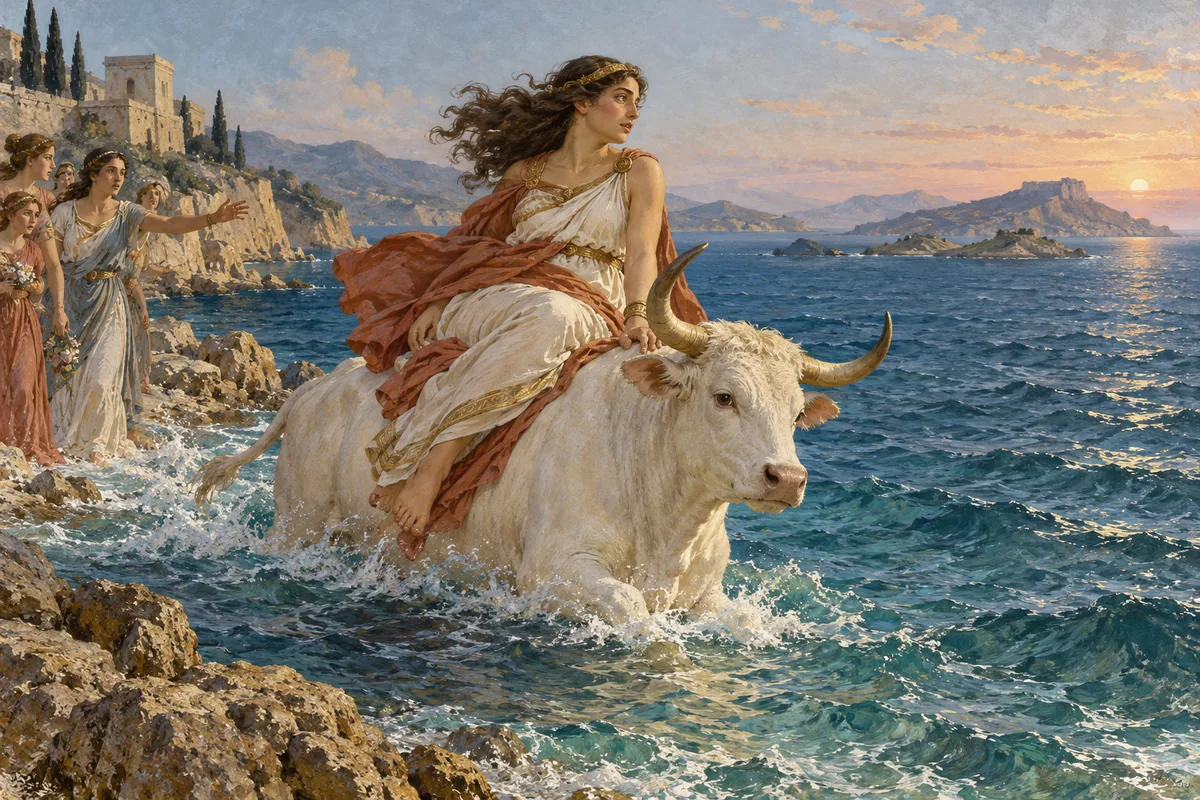
In the most famous version Zeus sees the Phoenician princess Europe on the coast and turns him into a friendly white bull. When she climbs on his back, he swims to Crete. There he takes his divine form. Europe will be the mother of Minos, Rhadamanthys and Sarpedon. Tradition does not exist as one unchanging story: authors differ about the family of Europe, the route of the bull and the place of the meeting.
Herodotus tells the story in the context of conflicting memories of abductions between Greek and Asian communities. The myth is also a story about perspective: who calls something a kidnapping, who calls a marriage, and who attribute the movement of people to gods? A careful reading separates the storytelling voice and historical reality.
Europe in Crete
In Crete, Europe has a dynastic meaning. Her son Minos is connected in later traditions to Knossos, Navy, Laws and the Minotauros. Thus a sea movement becomes an origin story for royal authority. That makes the story interesting next to the archaeology of the Bronze Age, but it does not prove that historical palace culture declared itself with this myth.
Artists have often depicted Europe on the back of the bull, sometimes with its veil as a sail. The scene shows her acting and vulnerable at the same time: she chooses to sit on the animal, but does not control the destination. That tension makes the image useful for later stories about migration, power and the limits of consent.
From person name to continent
The name Europe is known early in the Greek world, but the exact etymology is uncertain. The modern geographical significance grew gradually. It is therefore too easy to say that the continent is directly and at one time named after the mythological Europe. Myth and chart language have influenced each other over the centuries.
So read the story on three levels: as a godly story, as a dynastic story of origin and as a later name tradition. Each level asks different questions. The myth tells a lot about the imagination of borders and kinship; she is not a travel report or historical record of a princess.
View question
If Europe itself is brought to another shore, who has the right to claim its story as the origin of a continent? Compare the old story versions with modern maps and watch who speaks, who moves and who captures the name.
Sources and read on
- Herodotus, History 1.2; Apollodorus, Library 3.1.1; Homer Hymne to Aphrodite 5.
- Metropolitan Museum of Art, "Minoan Crete"