KRETA · MYTHOLOGY · DIFFERENCE
Minos: king, legislator and judge
How one figure changed from ruler of Crete to judge of the dead.
Minos is at the same time a king in stories about Knossos, an opponent of Athens and in some texts a judge in the underworld. The different roles did not all arise at the same time. Together, they show how a legendary name was constantly filled in politically and morally.
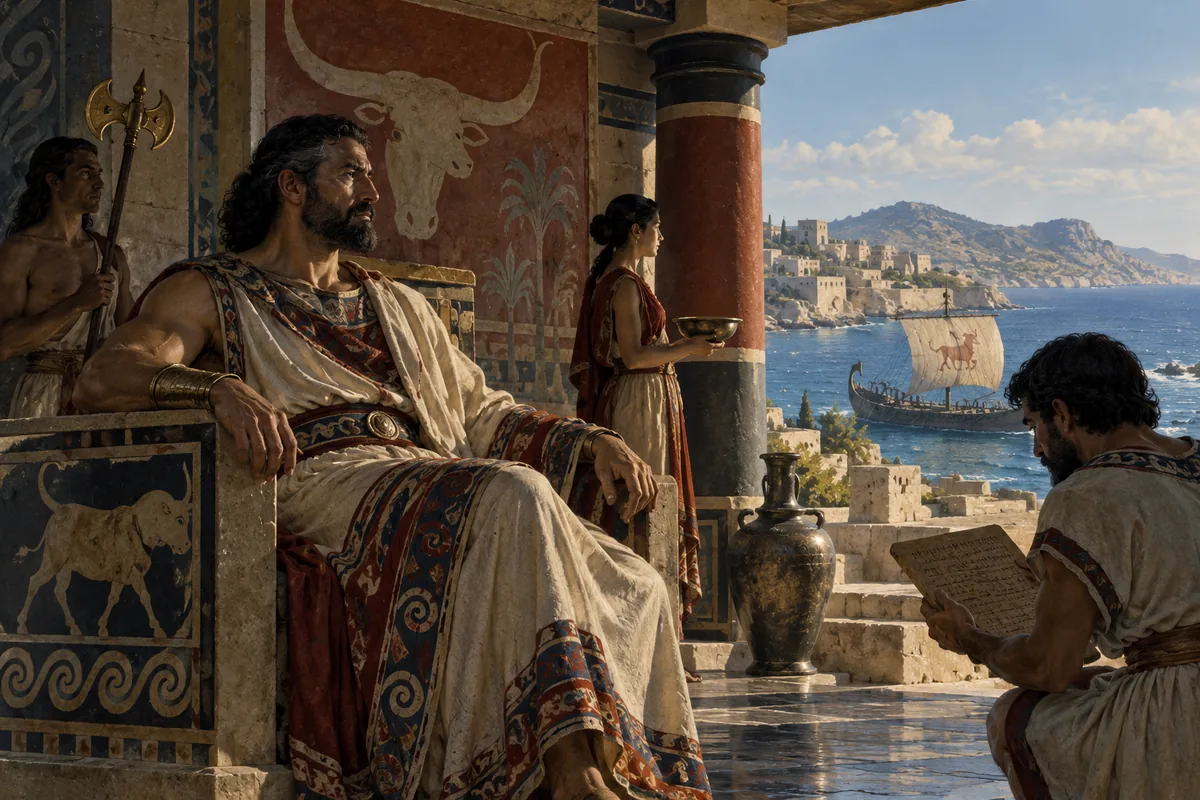
The Minos of the Monkeys
In the Iliad and Odyssey Minos appears as a powerful king from a distant past. The Odyssey mentions him in a passage about the dead as the son of Zeus who speaks with a golden scepter. That short picture is not a complete biography; later writers build various stories around it.
In the myth cycle around Theseus, Minos is connected to the Athenian estimate and the Labyrinth. His power is both political and familial: he reigns, but is also confronted with the consequences of his house's actions. Pasiphaë, Androgeos and Ariadne get their own roles and motives in different versions.
The legislator consulted by a god
In the Laws Plato has an Athenian visitor with a Spartan and a Cretan talking about legislation. The dialogue begins with the question of whether their laws are set by a god or by humans. Minos is mentioned as a legislator who, according to tradition, consulted with Zeus. Plato uses that tradition to investigate the relationship between divine authority and human governance.
The Laws is a philosophical dialogue, not an archive report on Minoan law. Plato's interlocutors are literaryly designed, and the imaginary city of Magnesia serves to develop a political theory. So, when discussing the dialogue "Kreta" we have to distinguish between real Cretan institutions and Plato's philosophical construction.
Historic king or conjoined memory?
Some researchers have linked Minos to a title or dynastic name in the Bronze Age; others stress that the ancient texts present him as an individual without archaeology confirming his biography. The palaces of Knossos are historical, but the evidence does not say that one concrete Minos ruled exactly over the realm from the myths.
The name can summarize memories of power in Crete. Later Greek stories place their own tensions with Crete at a time before the Trojan wars. That gives the stories cultural significance, but does not make them reliable chronicles. The question "Who was Minos?" Therefore, first asks: in what text, period and political context?
View question
Compare Minos as judge in the Odyssey with Minos as opponent of Theseus. Does your judgment change when a king simultaneously represents the law and causes the consequences of his own exercise of power?
Sources and read on
- Homer, Odyssey 11.568–571; Plato, Laws 1.624–626 and book 3.
- Stanford Encyclopedia of Philosophy,.