KRETA · MYTHOLOGY · DIFFERENCE
Minoan sanctuaries: what do we really know?
Cave, mountain top, palace and writing: Reconstructing religion without filling the silence of Linear A.
The Bronze Age Crete's religion is rich in images and difficult to describe at the same time. Archaeologists find caves, mountain sanctuaries, sacrifices and ritual objects, but the Minoan scripture Linear A is not deciphered. A good guide reveals what evidence is, what interpretation remains and where popular stories become too definite.
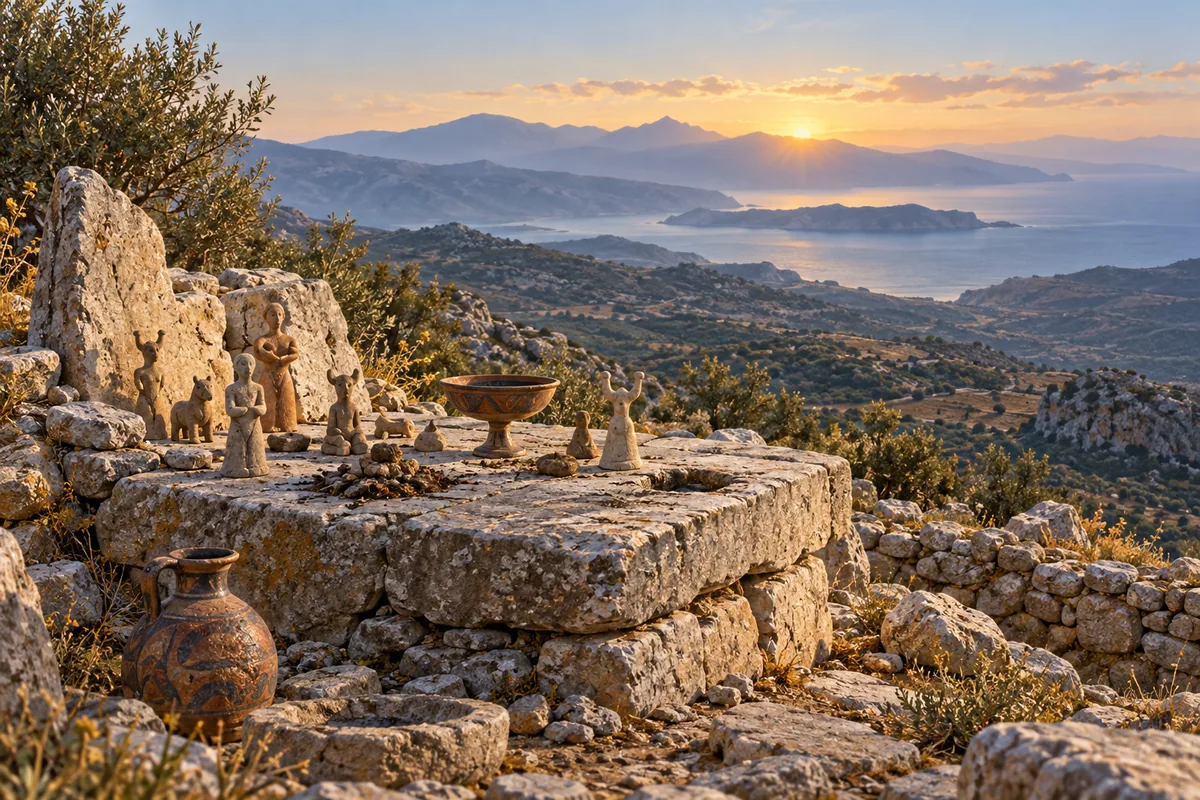
A landscape full of ritual places
Minoan religious actions did not take place only in palaces. Archaeological research also points to caves, springs, mountain peaks and outdoor spots. Objects such as libation vessels, figurines and ritual objects were found in various contexts. The meaning depends on location, low and use traces, not only on what an object looks like for a modern viewer.
The Metropolitan Museum describes palaces as centres with both economic and ritual functions and also mentions caves, springs and mountain sanctuaries. That broad network prevents us from imposing a single temple religion as a model on a society with different regional practices.
Why the "Mother Goddess" doesn't explain everything
Early diggers used terms like "Mother Goddess" to summarize female figures and natural images. That interpretation has influenced how Minoan religion was presented to the public. Nowadays, researchers ask which objects really represent the same thing, how iconography changes and whether a figure is a goddess instead of priestess, admirer or mythical character.
A figurine without inscription does not automatically tell the name or function of the figure shown. Repeated forms may indicate shared symbolism, but they do not resolve the meaning automatically. It is wiser to put multiple hypotheses side by side than to project one identifiable goddess onto each image.
Linear A and the limits of reading
Linear A was mainly used in Crete from about 1800 to 1450 BC The script contains characters for syllables and goods, but the language has not yet been deciphered. Short administrative tablets show quantities and goods; cultic objects show that writing could also occur outside of bookkeeping.
So we can reconstruct parts of the material world without being able to read Minoan prayers or gods names. The silence of writing is not an invitation to write modern fantasies into it. She marks exactly where our knowledge ends and where careful comparison should begin.
View question
Choose a Minoan object and note separately: what is immediately perceptible, what is an archaeological interpretation and what is a modern popular explanation? This simple distinction makes museum visits much richer.