GREEK PHILOSOPHOBIA · DIVISION 37 / 40
Aristotle & Politica: who can decide about the good life?
Who is a citizen, who bears the burden and who can determine the common benefit?
For Aristotle, a political community is not just about survival. She also organises a view of good life. That still makes his questions fruitful, but his answers cannot be read separately from the exclusions he defends or accepts.
The political animal and the discussion on justice
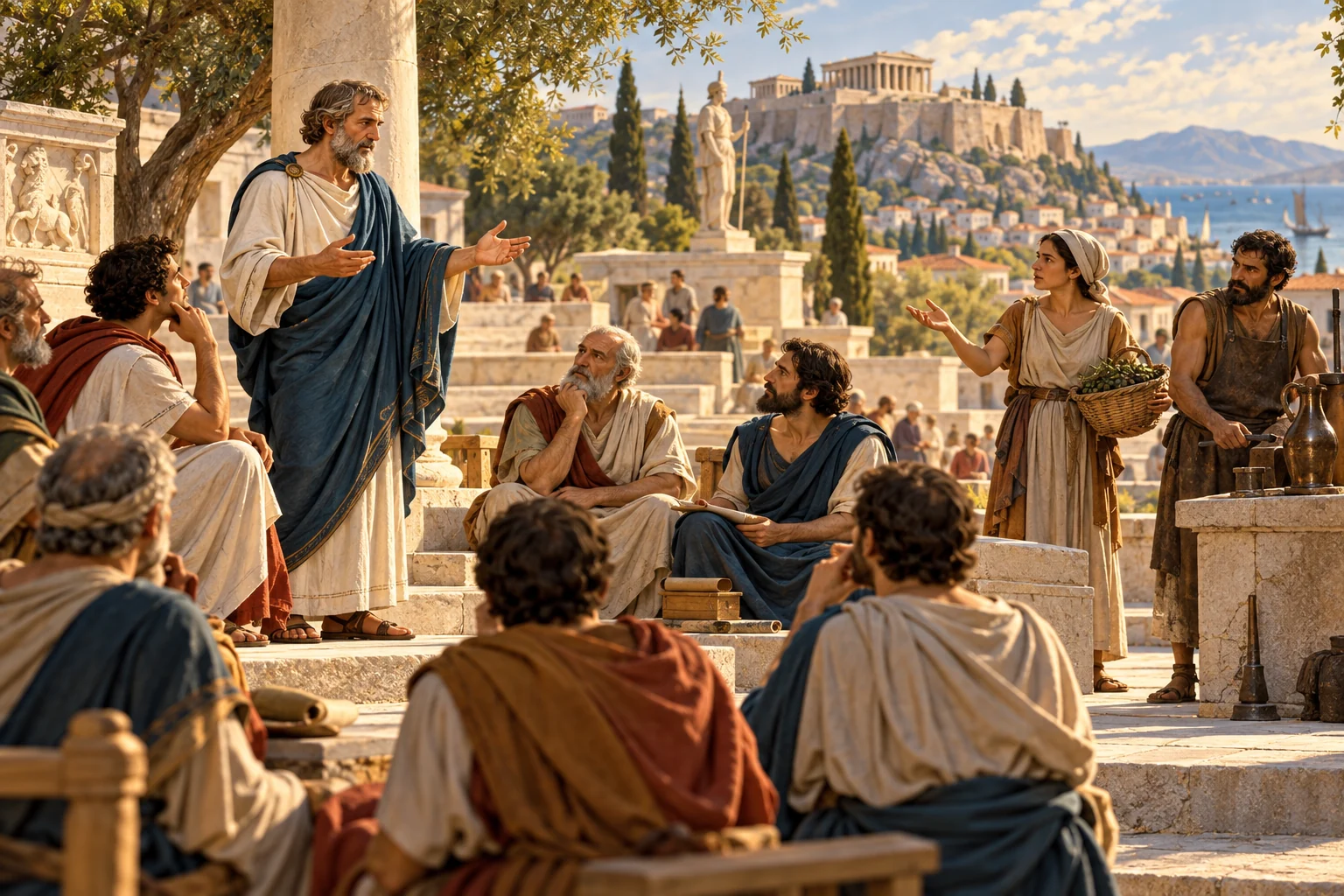
In the first book of the Politics, Aristotle refers to man by nature as a political animal. He connects the political community with the human ability to speak of the beneficial, good and just. As a result, the policy does not appear as a random arrangement between individuals who are otherwise completely independent.
This is a targeted presentation of the development of human relationships. That's a philosophical explanation, not a neutral archaeological account of the origin of every city. That is precisely why you can examine the reasoning: why should a community that makes life possible also determine how that life is best organized?
Resident is not an automatic citizen
Book 3 makes the demand for the citizen sharp. Living in the same place is not enough to be a citizen in the full political sense. Aristotle connects citizenship with participation in the reflection and justice process. At the same time, the interpretation may differ between state forms. Anyone who is a citizen of one order may fall outside the control of another.
That distinction remains enlightening. A person can experience the consequences of decisions on a daily basis without having an equal say in them. That is not to say that the modern state simply has the same structure as the antique policy. The comparison helps to appoint living, subject to rules and actually co-decisions separately.
A theory with a problematic boundary
Aristotle defends in book 1 the idea of natural slavery and organizes relations between men, women and others hierarchically. Such arguments are not innocent decorations around a further fully equivalent community. They also determine who may speak for themselves and whose actions are presented as a means of life for others.
A critical reading therefore does not have to choose between unconditional admiration and discarding the whole work. You can find a distinction about citizenship analytically valuable and reject a justification for slavery. But then you also have to examine cohesion: does the free time available for one group support employment and exclusion from another?
The general interest as a difficult measure
Aristotle distinguishes the rule for the common advantage of governing for the own benefit of those in power. This creates a measure that goes beyond the question of how many people exercise authority. One, a few or many can use their power in different ways.
The tricky follow-up question is who decides what common advantage means. A privileged group can describe its own way of life as the importance of the whole community. For a contemporary study, it is therefore useful to look not only at the justification of a decision, but also at the distribution of participation, burdens and possibilities to object.
Learn to read the city from the absent voice
Imagine a square where civilians talk about using water. Who has time to be there? Who has to work in the meantime? Who uses the water, but doesn't get the right to speak? This exercise shows that political space is more than a meeting place. It also consists of terms and conditions that make participation possible or impossible.
In the knowledge universe, the Politica is therefore next to Antigone, the Oresteia and Plato. Antigone shows man against the order; the Oresteia investigates the form of a binding judgment; Plato discusses the arrangement of a city. Together they offer different scales on which the same demand for justice can be approached.
Think on for yourself
Make a decision in a community you know. Make a distinction between those who choose, those who carry the execution and those who experience the consequences. Are these groups falling together? What reason can justify a difference, and what possibility of correction should at least exist?
Sources and read on
- Aristotle, Politica I
Primary text; I. 1–2 about the community and I. 4–7 about the problematic justification of slavery.
- Aristotle, Politica III
Primary text; III. 1–3 on citizenship and III. 6–7 on state forms and common benefit.
Texts consulted on 29 October 2026. The Dutch explanation is new; the source links give access to ancient texts and scientific context.