GREEK PHILOSOPHOBIA · DIVISION
Aristotle: virtue in daily action
Eudaimonia, character and practical wisdom as a lived philosophy.
Aristotle not only asks which rules are right, but also which kind of person can make good choices. In his ethics, habit, character, insight and community are connected. The good life is not an instant mood, but a form of human bloom over a whole life.
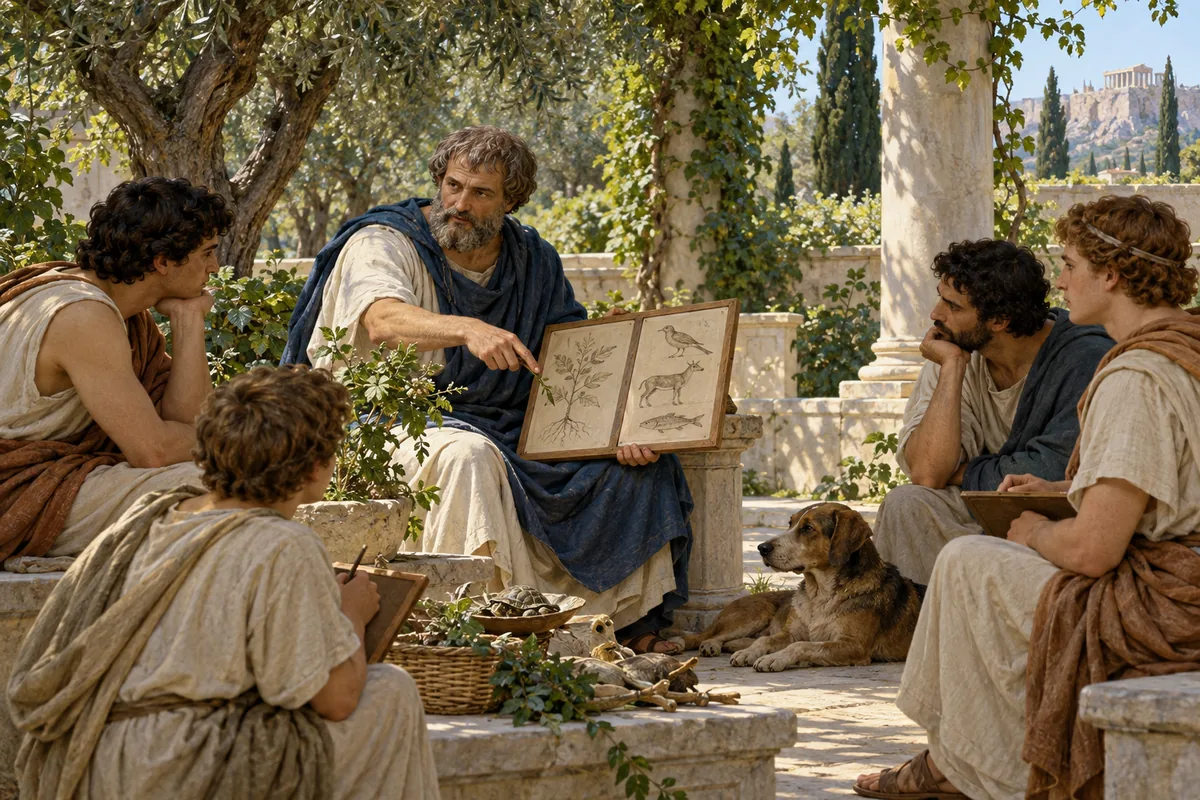
Eudaimonia: more than a good feeling
Aristotle begins the Ethica Nicomachea with eudaimonia, often translated as happiness, well-being or human bloom. It is the highest goal to which action ultimately strives. A pleasant moment counts, but it is not enough: the question is whether someone can develop their human abilities properly through life.
His famous function argument explores what is peculiar to people. Because people can reason, Aristotle connects a good life with activity according to reason and virtue. That doesn't mean that everyone has to follow the same course of life. It does mean that happiness is not separate from actions, relationships and the circumstances in which one lives.
Virtue as shaped posture
According to Aristotle, character virtues are created by custom. We become more righteous by acting righteously; more courageous by practicing brave acts. A virtue is not an automatic reflex, but a stable tendency to feel good and act in a concrete situation.
The midway line is not an arithmetic mean between two extremes. The right courage can vary from one situation to another; what is reckless for one person can be cowardly for another. Practical wisdom, phronesis, helps to see what these circumstances require. That makes Aristotle's ethics attentive to context without saying that everything is relative.
Friendship and politics
Aristotle spends a lot of space on friendship. People need each other for fun, utility and shared appreciation of character. The best friendship is not a contract that only benefits; friends wish each other the good for each other's sake. Friendship makes a good life possible and teaches us who we are.
Politics is also important. The policy exists not only to survive, but to live well. In this vision, laws and institutions form character, but they can also exclude people. Aristotle's historical limitations, such as his defence of hierarchies that we rightly reject, must be read in addition to his conceptual contributions.
View question
Choose a habit you want to develop. What concrete repeated action can it practice, and what practical circumstances make the choice difficult? Thus the middle way becomes an investigation into action, not an abstract point on a scale.
Sources and read on
- Aristotle, Ethica Nicomachea books 1–2, 6 and 8–9; Politica book 1.
- Internet Encyclopedia of Philosophy, "Ancient Greek Philosophy"