MYTHOLOGY & TRAGEDIA · DIVISION 28 / 40
The Oresteia: from blood vengeance to imperfect judgment
A family conflict turns into a court of law, but anger and inequality do not disappear automatically.
The Oresteia shows a family in which every retribution becomes the ground for new retribution. The lock moves the conflict to a court hearing, but doesn't know the past. Right does not arise here simply by making anger disappear.
A house that inherits its own violence
Aeschylus pygmy trilogy consists of Agamemnon, Offerplengsters and Eumeniden. The return of Agamemnon from Troy ends in his death by Klytaimnestra and her ally Aigisthos. Orestes then kills his mother to avenge his father. That's why he's dealing with the Erinyes, the powers that prosecute the violation of kinship and especially the murder of the mother.
The trilogy preserved for us was in 458 staged in BC. It makes the problem of retaliation palpable: an act can be defended if the answer to an earlier act and itself reappear as unacceptable violence. Those who look only at the last incident do not see why they can understand themselves both as victims and as the rightful performer of a duty.
The order doesn't release Orestes from the problem
Orestes relies on the assignment of Apollo. Nevertheless, the consequences of his act have not disappeared. The persecution makes it clear that divine support in the dramatic world does not mean automatic agreement between all the powers involved. There are competing obligations that are not simply resolved in one order.
For a modern interpretation, this is an important limitation of the appeal to authority. When someone says that he was only carrying out an assignment, the question remains what the assignment meant and what responsibility he himself bore. The piece does not deliver current legal doctrine, but can help to hide such different questions under one reassuring formula.
Athens changes the form of the conflict
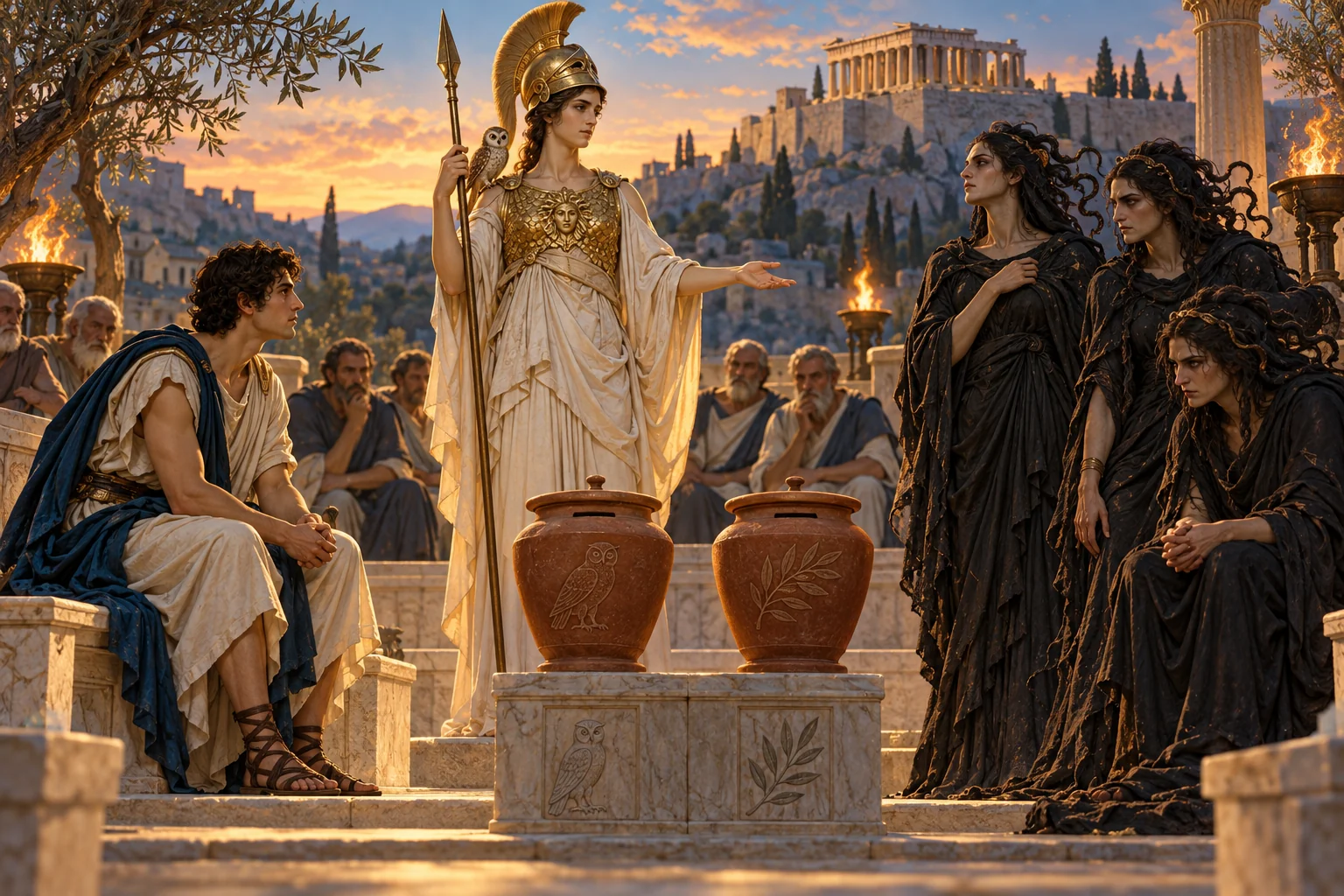
In the Eumeniden Athena organizes a judgment on the matter. Charges and defenses must be pronounced and the outcome linked to voting and a rule for equal standing. The case is therefore not decided because one party simply physically eliminates the other. There will be a procedure in which a community tries to form a binding judgment.
Yet this is not a record of the moment when mankind first invented justice. It's an Athenian tragedy that gives an institution a mythical past. The interests of the city, the status of the gods concerned and the way in which kinship is proposed remain part of the outcome. A procedure can mean progress without standing outside any relationship of power.
The difficult reasoning about motherhood
Apollo's defense contains a representation in which the mother is not treated as the child's actual producer. That reasoning supports the primacy of the fatherly bond. It is important to recognise her as an argument within the piece and not as a proper biological explanation.
It is precisely this part that disturbs an overly cheerful story in which an old, dark world of vengeance departs easily for pure reason. The new regulation also involves exclusion and inequality. A critical reading can therefore do two things at the same time: to appreciate the meaning of hearing and hearing again and to examine who gets less weight within the reasoning used.
Reconciliation demands a place for anger
After the verdict, the Erinyes are not immediately satisfied. Athena must offer them an honored place within the community. Their power is not simply denied. That makes the castle more than a victorious party: an order that only humiliates the losing party can threaten its own survival.
A contemporary comparison is the question of what is still necessary after a formal decision to be able to move forward with each other. Recognition, memory and a place in the joint story are something other than re-executing the same lawsuit. The trilogy does not write a reconciliation manual, but shows why a binding pronunciation and a living relationship are not exactly the same.
Think on for yourself
Draw the chain of transgressions and answers in three short sentences. Then identify which problem changes the court hearing and what problem it does not remove altogether. Compare this with Antigone: what happens when conflicting obligations do not receive a jointly recognised assessment space?
Sources and read on
- Aeschylus, Agamemnon
Primary text; first part of the Oresteia.
- Aeschylus, Saferplengsters
Primary text; second part of the trilogy.
- Aeschylus, Eumenides
Primary text; in particular the court hearing and the closing, approximately 566–1047. The dating rules of individual online editions are not always consistent; the trilogy is dated on 458 BC
Texts consulted on 29 October 2026. The Dutch explanation is new; the source links give access to ancient texts and scientific context.