GREEK PHILOSOPHOBIA · DIVISION
Platoubic Laws: Crete as an interlocutor
A political dialogue in Crete and not a direct description of Minoan society.
Plato... Plato... Wetten is a conversation between an Athenian visitor, the Spartan Megillos and the Cretan Kleinias. They run in Crete and investigate legislation, education and virtue. The island is at the same time a real place and a philosophical setting for designing a city.
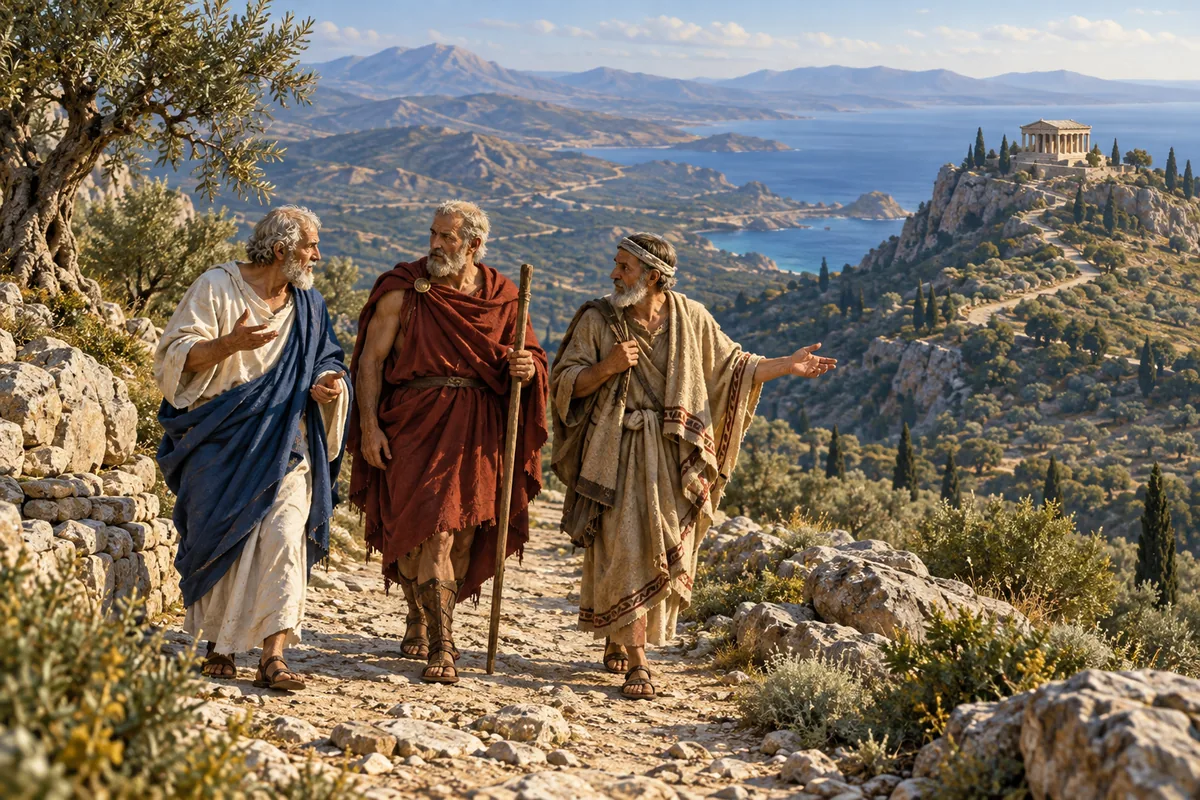
A dialogue during a walk
The Laws are made up of twelve books. The interlocutors walk to a sanctuary of Zeus and discuss why laws exist and what character they should be among citizens. Kleinias says that Cretan cities want to establish a new colony, Magnesia, and that they must cooperate in the legislation. The Athenian visitor helps develop the design.
Crete is in the text from the beginning: the Cretan laws are connected to Zeus, such as Spartan laws with Apollo. Plato thus investigates how divine legitimacy and human rules can work together. The question is not only what rules are efficient, but what kind of life they make possible.
From existing laws to a city of thought
Plato discusses real political examples from Crete, Sparta, Athens and other communities, but Magnesia is a designed city. The dialogue uses comparison to make the legislator learn. It is therefore not a neutral list of historical Cretan customs and certainly not a record of the Minoan palace culture, which existed centuries earlier.
The city is decorated around education, public rituals, possession, governance and character formation. Laws are sometimes given "forewords" that must convince citizens rather than only punish them. This idea makes the dialogue exceptional: legislation is not just an order, but an attempt to form reasons and habits.
Crete as a philosophical mirror
Plato & Athenian visitor speaks from a philosophical perspective, while Kleinias and Megillos represent their political traditions. Their conversation is not an equivalent modern panel; the Athenian figure leads much of the reasoning. Yet the setting forces comparison: how does a society justify its laws and who can change them?
The dialogue shows how a place in literature can function as a space of thought. Crete delivers recognizable traditions, but Plato uses them to ask questions about the ideal city. This makes the work valuable for political philosophy and at the same time dangerous as a historical source when literary construction is mistaken for direct description.
View question
Which parts of a society can according to Plato be formed by laws: behavior, character, conviction or happiness? Compare his proposal to interpret laws in advance with a contemporary law that citizens simply have to obey.
Sources and read on
- Plato, Law books 1–3 and 4–5; especially 624 acetone 626 e and 702 Bloated.
- Stanford Encyclopedia of Philosophy,.