MYTHOLOGY & TRAGEDIA · DIVISION 27 / 40
Antigone: conscience, burial and the border of command
Family duty, unwritten rules and the danger of authority that can't listen anymore.
Antigone refuses to obey the ban on burying her brother. Sophocles thus reveals a conflict in which family duty, divine order and political authority simultaneously claim to be human. The piece does not give easy victory of feeling on law.
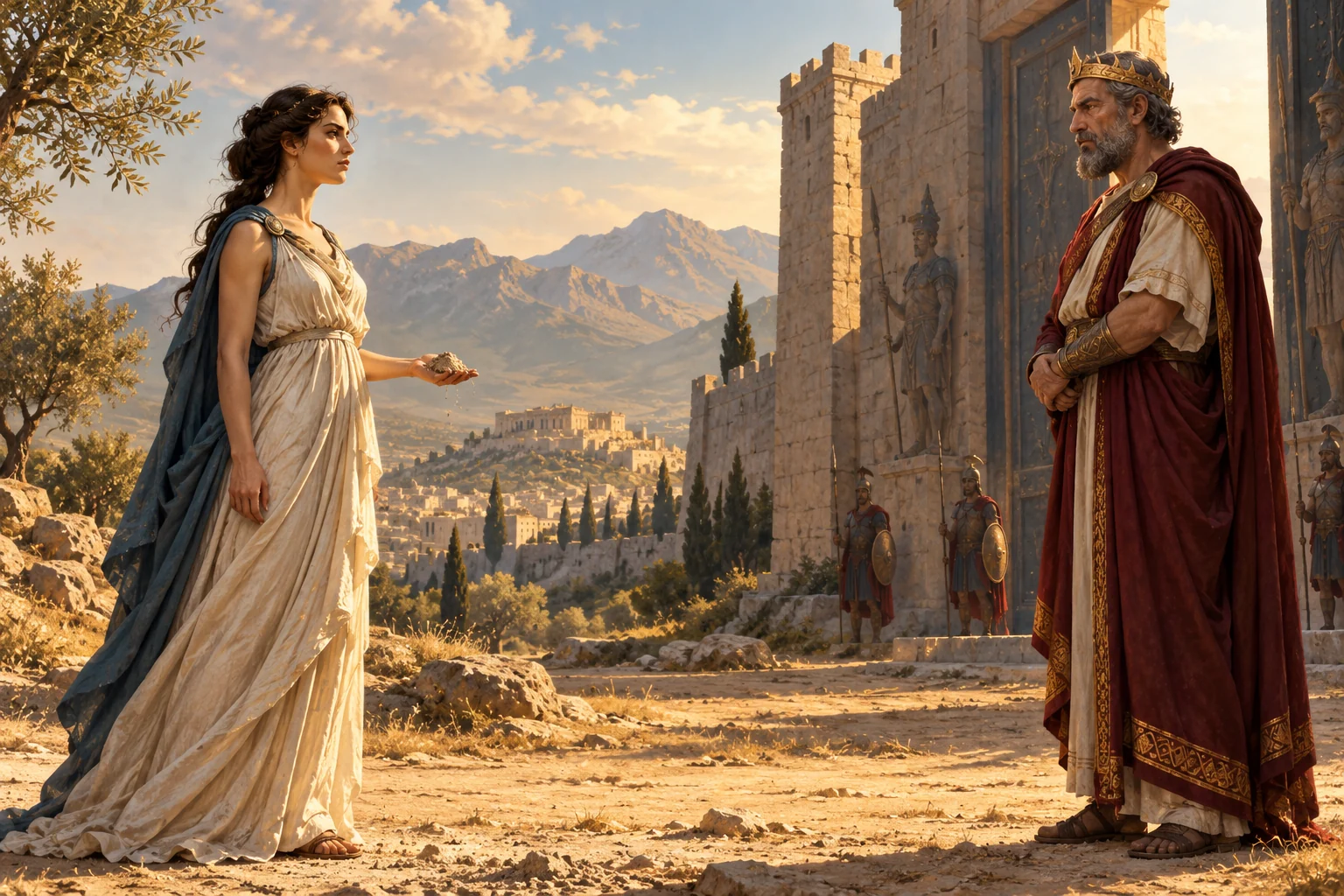
Two brothers, two treatments.
After the battle for Thebe, Eteokles and Polyneikes both died. Kreon lets one brother be treated with honor and forbids the burial of the other, who has risen up against the city. Antigone resists by still fulfilling the funeral obligation. She knows that the command exists; her defence is that it cannot be above the unwritten and lasting rules of the gods.
So the contradiction doesn't go between someone with rules and someone without rules. Both parties invoke a normative order. Kreon calls the safety and loyalty of the city; Antigone invokes obligations that the ruler has not made and therefore cannot simply lift. The collision becomes tragic because each party is difficult to limit its own principle.
A body remains more than a political sign
Kreon wants to use the dead man's treatment to make it clear what loyalty means. Antigone clings to the kinship that political enmity does not completely disappear. From that difference arises a question that goes far beyond one funeral: can someone by becoming an enemy lose any claim to human treatment?
A modern reader can recognize a demand for dignity. That is an interpretive connection, not a claim that Sophocles already formulated a modern human rights system. The strength of the scene lies in its concrete situation. A dead brother is not just an example in a debate. He is at the same time family member, opponent and someone for whom rituals should be performed.
Ismene makes the conflict more difficult
At first, Ismene was opposed to her sister's plan. Her restraint may seem cowardly when you place only courage against obedience. But it also points to powerlessness and what it means for women to turn against authority. By listening to her, it becomes apparent that a moral choice does not have the same risks and scope for action for everyone.
That insight doesn't make Antigone's act meaningless. It does prevent us from reading the piece as if every human being under every pressure can do exactly the same thing. A less heroic voice can also indicate a real problem. Tragedy gets richer when not only the one wearing the title gets full attention.
Haimon and the ability to listen
Haimon is trying to get Kreon to make room for other voices. The question then becomes not only what principle is correct, but how a ruler can achieve correction. Anyone who treats any contradiction as a violation of authority loses the ability to recognize an error before it has irreparable consequences.
This gives the tragedy an administrative dimension. Good decision-making requires more than determination. It also calls for access to unpleasant information and the willingness to review its own judgment. This is a contemporary conclusion from the dramatic situation, not a loose spell that could replace any scene in the piece.
Why the lock doesn't yield an easy winner
The outcome brings loss rather than an orderly debate. Kreon eventually changes course, but too late to prevent the disaster. The piece makes it feel that a late insight is something other than acting wisely in time. Anyone who understands afterwards why a choice was wrong cannot easily restore the lost life and the damaged proportions.
The connection with Platobian Laws and Aristotle's Politica enables a comparison between the organization of authority and the concrete human being who is confronted with it. The line to the Oresteia asks how a community prevents fundamental conflicts from being fought solely by force or mutual retribution.
Think on for yourself
Think of a situation where a rule and another obligation clash. First formulate both reasons as strongly as possible. Who can judge the exception? Who's gonna bear the consequences? And how can a decision be revised before persistence turns into irreparable?
Sources and read on
- Sophocles, Antigone
Primary tragedy text, including 450–460 about the unwritten rules and conversations with Ishmene and Haimon.
Texts consulted on 29 October 2026. The Dutch explanation is new; the source links give access to ancient texts and scientific context.