GREEK PHILOSOPHOBIA · DIVISION
Platove cave: knowledge as a reversal
An image of education, truth and the responsibility to return.
In book VII of the Republic Plato tells the story of people who see shadows on a wall their whole life. The cave is not a loose riddle with one solution, but a model for education: learning is a change in the direction in which the mind looks.
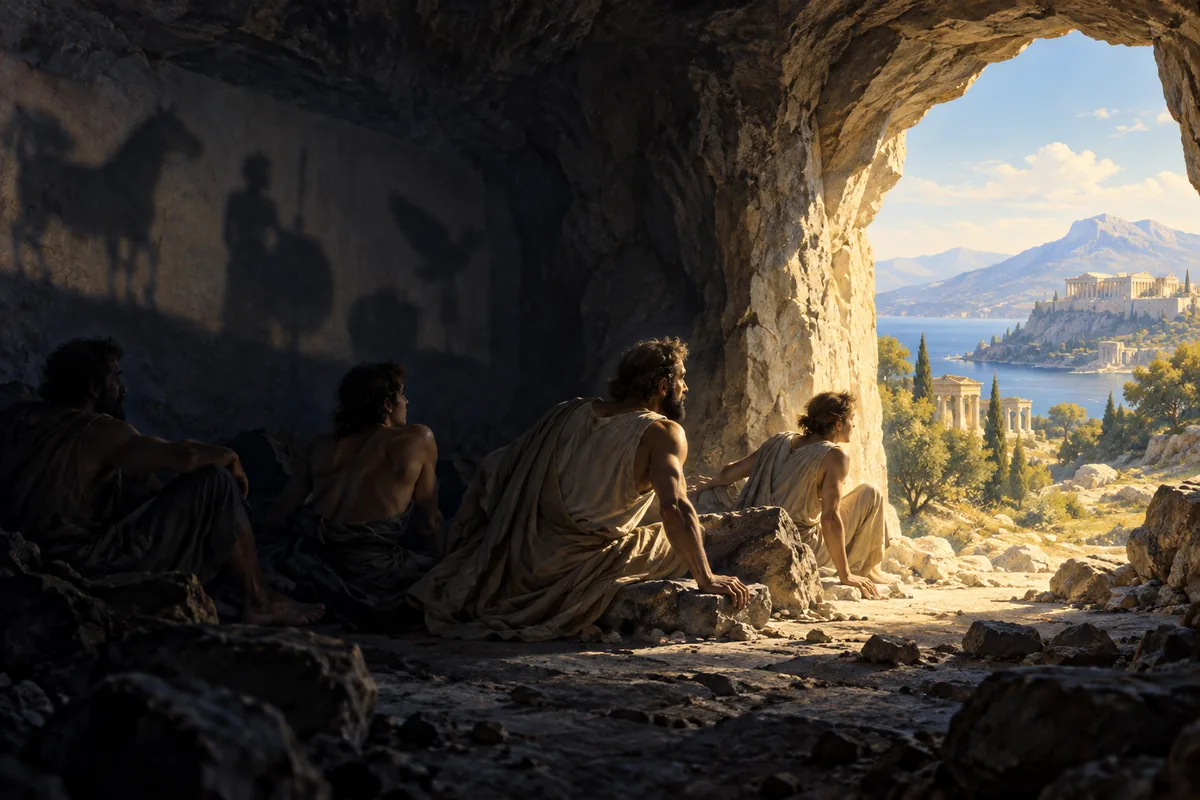
The cave step by step
Prisoners are trapped and looking at a wall. Behind them is a fire burning; between fire and prisoners are moving objects whose shadows become visible. Because the prisoners know nothing else, they call those shadows reality. When one person is liberated, the light hurts first. His first observations are not immediately clear or welcome.
Outside the cave, he finally sees the sun. Plato connects this image with the Good, which enables knowledge and truth. The allegory is in a philosophical conversation about education and governance. She is not a scientific diagram of the brain or a general statement that the senses are worthless.
Learning is not filling an empty mind
Plato says that education does not simply bring knowledge to the soul as if someone were giving eyes to those who are blind. The possibility of knowing is already there; education is turning the whole person in the right direction. That is a demanding idea: a lesson can be uncomfortable because it not only adds information but also changes the order of what seems important.
The equation gives teachers a lot of power. Those who claim to lead others out of the cave can present themselves as the only source of truth. Therefore, the allegory must be read critically: who determines what lies outside the cave, and how can a student control the guide? Plato's story requires not only confidence in insight, but also a review of the political role of knowledge.
Why go back?
The liberated prisoner returns to the cave and sees less well in the dark. The others can laugh at him or treat him hostilely. Still, according to Plato, he has a responsibility to help run the city. Knowledge does not automatically make someone loved or effective; it brings with it obligations.
This motive connects philosophy with politics. When the philosopher withdraws completely, he leaves the city to the shadows that the majority know. But when he forces others to accept his vision, he repeats the power of the chains. The allegory leaves that tension open.
View question
Who uses today's image of "waking up" or "seeing the truth"? What knowledge is offered, what sources support her, and what criticism would the speaker himself allow?
Sources and read on
- Plato, Republic 7.514 acetone 521 b; compare Phaedo 96 acetone 102 a.
- Internet Encyclopedia of Philosophy, "Ancient Greek Philosophy"