MYTHOLOGY & PHILOSOPHY · FLOOR
Pythagoras: mathematics, harmony and the search for order
Understand the theorem and distinguish the historical thinker from his later legend.
Added: · Extended: · approx. 13 minutes read · 16 chapters
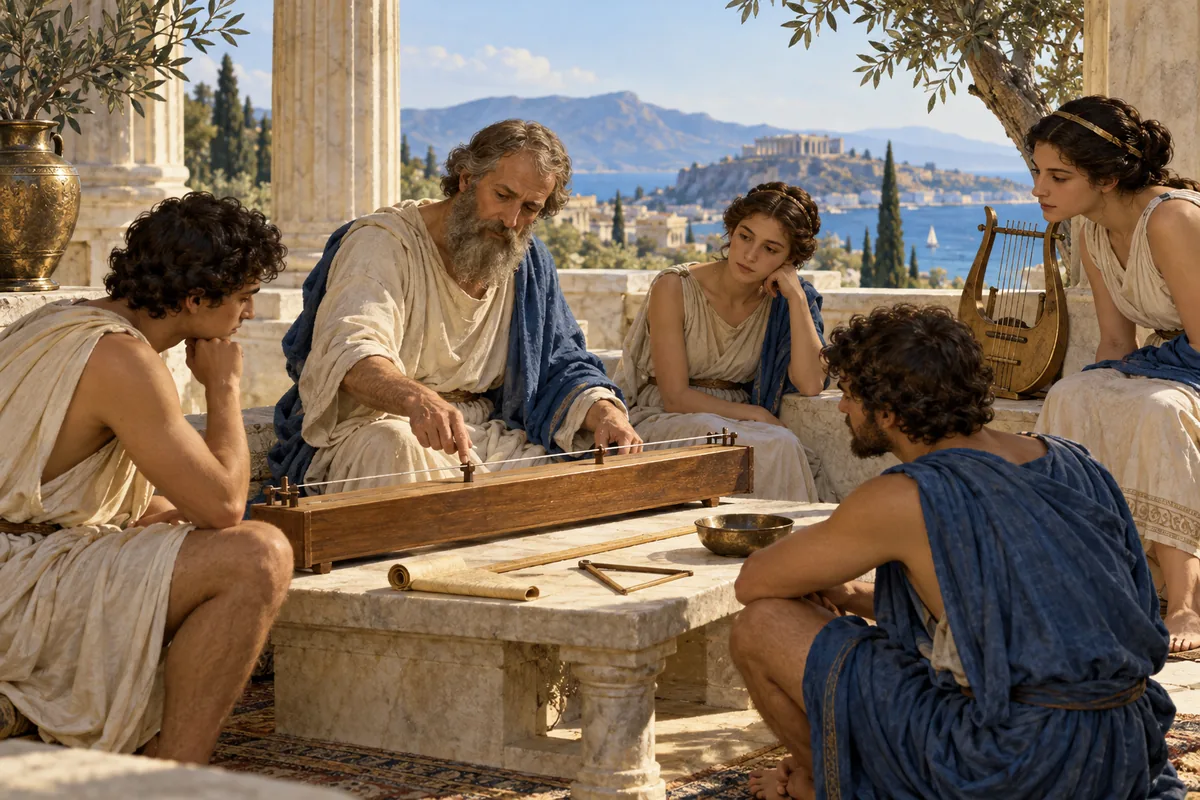
1. The name on the blackboard formula
Many people meet Pythagoras for the first time through a² + b² = c². That's a useful entrance, but an incomplete portrait. Behind the school formula is a Greek thinker with a later tradition of numbers, music, rules of life and stories about the soul.
Pythagoras lived about from 570 to 490 BC, came from Samos and was mostly connected to Kroton in southern Italy. There is no generally recognized own written oeuvre. The Stanford Encyclopedia of Philosophy therefore emphasizes the distinction between the historical person, his followers and the much later representation of an almost all-knowing master. [1]
This file brings together mathematics and philosophy, but separates their evidence. You can check a geometric theorem with proof. A story about what Pythagoras personally discovered requires historical sources.
2. Why the sources are tricky
Many detailed stories about Pythagoras were written centuries later. That time difference does not make them useless, but changes the question you can answer with it. They also tell how later groups imagined an ideal philosopher. [1]
The biography of Iamblichus is a recognizable example of this: a late-antique life story with education, discipline and admirable qualities of the master. Don't read such a text as a modern diary registration of the sixth century BC. [6]
A careful reader therefore notes three things: who writes, how much later and for what purpose? The same method helps with miracle stories, famous quotes and claims that one person invented almost all Greek science.
3. What the theorem really says
In a rectangular triangle the area of the square on the oblique side is equal to the sum of the surfaces of the squares on the two rectangle sides. That is the content of the theorem that Euclids in the Elements, book I, proposition 47, proves. [2]
The condition rectangular is essential. Name the sides that form the right angle a and b; name the opposite side c. Then a² + b² = c². So the formula adds up to areas. She's not saying a + b is equal to c.
A square with silk 3 has area 9. A square with silk 4 has area 16. Together, these areas are 25, the surface of a square with silk 5. That makes 3, 4 and 5 an easily verifiable example.
4. Calculating without changing sides
For rectangle sides of 6 and 8 find c² = 36 + 64 = 100. So the positive length of the oblique side is 10. You take after adding the square root; 100 is an area number, not the required length.
As the sloping side 13 is and one rectangle side 5, follows for the other side b² = 169 − 25 = 144, so b = 12. You're subtracting here because the biggest quadratic term is already known.
| Data | Calculation | Requested length |
|---|---|---|
| Rectangular sides 3 and 4 | c² = 9 + 16 = 25 | c = 5 |
| Rectangular sides 6 and 8 | c² = 36 + 64 = 100 | c = 10 |
| Slope silk 13 and rectangle side 5 | b² = 169 − 25 = 144 | b = 12 |
| Rectangular sides 1 and 1 | c² = 1 + 1 = 2 | c = √2 |
Use the same length unit everywhere. Quadrating centimeters and meters together doesn't provide a meaningful answer.
5. A surface proof you can follow.
Take four identical rectangular triangles with rectangle sides a and b and oblique side c. Place them along the edges of a large square with side a + b, leaving a twisted square with side c in the middle. The sharp angles of the triangles complement each other to a right angle; therefore, the middle figure is a square.
The area of the large square is (a + b)2. The four triangles have a surface 4 × ab/ 2 = 2 ab. The middle square has a surface c². So (a + b)2 = 2 ab + c².
Work the left side: a² + 2 ab + b² = 2 ab + c². Pull on both sides 2 ab off and there stays a² + b² = c² Over. This is an own didactic effect of a surface proof, not a claim that this was the personal proof of Pythagoras. It differs from the construction that Euclids in I. 47 is used.
6. The reverse question
Suppose you have three positive sides for which a² + b² = c². Is the angle opposite C straight? Euclid treats this reversal separately in book I, proposition 48. A theorem and its reversal are logical statements that each requires their own justification. [3]
By the sides 5, 12 and 13 the equation is correct: 25 + 144 = 169. It allows you to recognize the right angle. With 5, 6 and 7 does not match the equation for the largest side: 25 + 36 is not 49.
That control shows an important principle of thought. A formula isn't just a trick to find an unknown number. It connects a geometric property with an arithmetic relationship, and the reversal makes that relationship also useful as a test.
7. Was Pythagoras himself the first?
The name of a theorem is not a proof of ownership. The historical assessment of Pythagoras' own mathematical work is controversial; the consulted synthesis discusses how difficult it is to attribute a specific proof to him. The preserved Euclidean evidence is a more concrete source than a late story about one moment of discovery. [1][2]
That doesn't reduce the theorem. Mathematical validity depends on the reasoning, not the fame of a name. Historic attribution demands a different kind of control.
It is therefore good to use two sentences side by side: this is the theorem of Pythagoras, and we do not know with the same certainty what the historic Pythagoras has personally proven. The first one names a common name; the second one names the boundary of our knowledge.
8. Numbers that make a shape
With dots you can display numbers as patterns. Make four rows of four dots 16; three consecutive rows of one, two and three dots merge 6. Such representations make it visible that counting and form can be investigated together.
Aristotle discusses in Metaphysics A. 5 the so-called Pythagoreans, who connected principles of numbers with the principles of reality. He also mentions the interest in musical relations. That's a testimony about a tradition of thought, not a handwritten lesson from Pythagoras himself. [4]
The leap from pattern to world statement deserves attention. The fact that you can describe a form of numbers does not prove that every human attribute is literally a number. Here begins the philosophical conversation about the scope of a model.
9. Why isn't every length a fracture?
The diagonal of a square with side 1 has length 2. You can construct that length, but you can't write her as a fraction of two whole numbers. Here is a didactic effect of the standard proof of contradiction; it is not presented as a personal discovery of Pythagoras.
Suppose √2 = p/q, where p and q are positive integers and the fraction is in its lowest terms. Then p² = 2q². Thus p² is even, and p itself must be even: the square of an odd integer is odd.
Write p = 2 r. Then the 4 r² = 2 q², so q² = 2 r². That's why q is even. But if p and q are both even, we could have divided the fracture by two. This is contrary to the assumption that it was completely simplified. So the assumption of such a breach cannot be true.
The step is philosophically interesting: a simple geometric figure leads to a number that falls outside the normal fracture form. The evidence is about that mathematical trait; stories about who would be shocked by that discovery demand separate historical sources.
10. Make whole triples yourself
Not every rectangular triangle has whole sides, but there is a simple way to make many whole examples. Choose integers m and n with m greater than n and n greater than zero. Take a = m² − n², b = 2 mn and c = m² + n².
Check: (m² - n²)2 + ( 2 mn)2 = m⁴ − 2 m2n2 + n⁴ + 4 m2n2 = (m² + n²)2. The three lengths chosen thus comply with the equation. With m = 2 and n = 1 You'll get it 3, 4 and 5. With m = 3 and n = 2 You'll get it 5, 12 and 13.
This is a separate calculation to show the structure. It does not say that each chosen pair produces a new, indivisible threesome. For example, m = 3 and n = 1 the threesome 8, 6 and 10, a multiple 4, 3 and 5.
11. Music and measurable proportions
With an ideal tensioned string, the ground frequency is related to length, voltage and mass per unit length. If the other conditions remain the same, a half length gives a double ground frequency. OpenStax describes this relationship with standing waves on strings. [5]
With this you can practically understand the idea behind simple musical relationships. A frequency ratio of 2: 1 belongs to an octave. Relationships of 3: 2 and 4: 3 its recognizable starting points for a clean quint and quarter. These are idealized relationships, not the claim that every real instrument sounds perfectly according to one simple formula.
In an experiment, measure one thing at a time. Just change the effective string length and keep the tension as equal as possible. Then the connection between hearing and mathematics gets meaning without needing an unproven anecdote about a historical discovery.
12. Harmony and the order of the cosmos
The Pythagorean step towards an ordered world becomes visible at Aristotle in the connection of numbers, musical relations and heaven. An audible relationship thus became a model for thinking about coherence in the whole. [4]
A model can clarify and seduce. The success of maths on a string does not mean that a moral rule or celestial movement has been proven in the same way. Therefore, always ask where the analogy helps and where additional observation or argumentation is needed.
Modern readers also like to look for one principle behind different phenomena. That still makes the old question interesting: when do you really discover a connection and when do you make an attractive pattern?
13. The soul and a way of life
Pythagorean traditions are also linked to the soul, purification and rules of life. The late biography of Iamblichus offers detailed examples of a disciplined way of life. She shows how a philosophical community can be built up around a master and daily exercises in a later performance. [6]
For this theme Plato's Phaedo a useful source of comparison. There philosophy, body and soul are discussed in their own argumentative and dramatic context. The dialogue is not proof that every idea in it came directly from Pythagoras. [7]
The distinction makes history richer. An agreement may give rise to research into influence, but it does not replace that investigation. Pupils, followers and later admirers are different relationships.
14. Security, authority and evidence
In a tradition, a famous master can become the starting point of much knowledge. A risk arises for the reader: the name itself will function as an argument. That's exactly where mathematical evidence provides a useful counter-question. Can you also check the reasoning without relying on the authority of the speaker?
That attitude does not have to rule out historical admiration. You can appreciate a tradition and yet discern what is demonstrably, probably, late handed over or legendary. It is precisely the combination of curiosity and control that prevents the subject from becoming a collection of wonderful stories.
As a result, Pythagoras remains more than a formula. He is an access to the history of order search: in a triangle, in a melody, in the cosmos and in one's own life. Those different quests each deserve their own measure.
15. Try it yourself
Calculate the oblique side at rectangle sides 9 and 12. Then check that 8, 15 and 17 form a rectangular triangle. Write down at each step whether you're calculating a length or an area.
The answers are: 15 and yes: 81 + 144 = 225 and 64 + 225 = 289. Then make an example that doesn't add up and explain why. Thus you not only practice performing a formula, but also recognizing its conditions.
A second exercise is historical: read a passage by Aristotle and a passage from a later biography. Which text describes a school and which one a person? What information would you need to compare their statements about the early period?
16. Frequently asked questions
Can I use the formula for each triangle?
In this form it applies to a rectangular triangle. The right angle is a necessary condition.
Is c just the side that's at the top of the drawing?
No. c is the oblique side opposite the right angle, no matter how the drawing was turned.
Did Pythagoras write the preserved evidence of Euclid?
That hasn't been proven. The Euclidean text and claims about Pythagoras' own work must be distinguished.
Why is he part of philosophy, too?
Because the traditions associated with his name also deal with questions about reality, soul, harmony and lifestyle.
Are his numbers the same as modern physics?
No. Mathematical models, cosmological ideas and religious tradition have different functions and different requirements of evidence.
Sources and read on
Sources checked for this edition on 30 October 2026. Antique texts, later tradition, dictionaries and contemporary practical descriptions have different functions. Own calculation examples, listening questions and language examples are editorial effects.
- Carl Huffman · Pythagoras, Stanford Encyclopedia of Philosophy, revised 2024; source-critical synthesis
- Euclids · Elements I. 47, primary geometric text with commentary by David Joyce
- Euclids · Elements I. 48, the inverted theorem.
- Aristotle · Metaphysics A. 5, primary text in translation
- OpenStax, Rice University · University Physics 16.6: standing waves on strings
- Iamblichus · Life of Pythagoras, late biography in translation Thomas Taylor; no contemporary life description
- Plato · Phaedo, primary dialog text in translation; source of comparison