GREEK PHILOSOPHOBIA · DIVISION 39 / 40
Aristotle's Poetics: Why a imaginary tragedy really hits us
Mimesis, action, recognition and the controversial meaning of catharsis.
A tragedy shows events that are not happening for us and can still touch us deeply. In Poetica, Aristotle investigates how the organization of an act contributes to this. Not only an impressive character, but above all the coherence of choices and consequences counts.
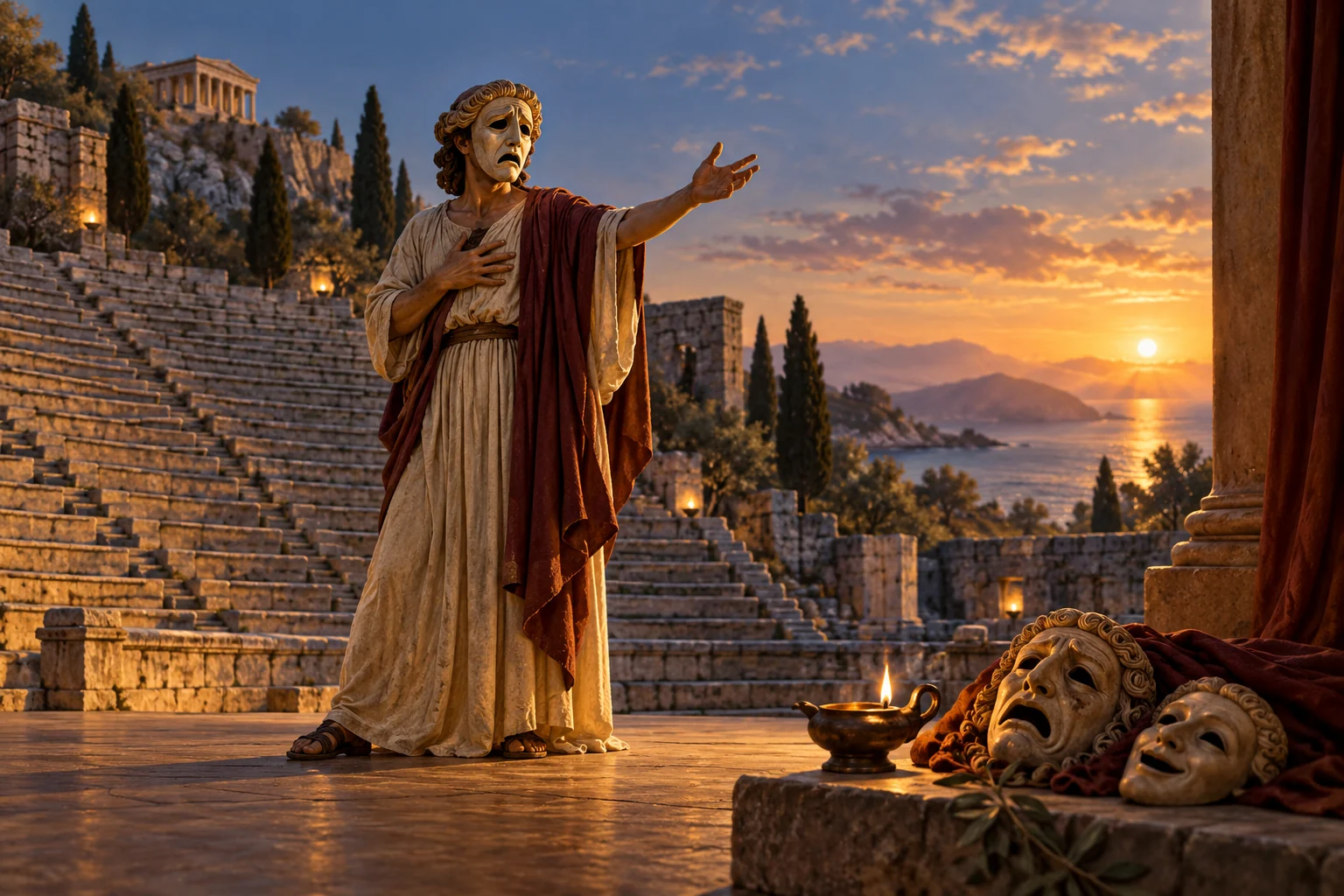
Mimesis is more than copying
Mimesis is often translated with imitation. As a result, it can sound as if art should above all be a copy of the outside world as accurately as possible. Aristotle, however, is also concerned with the presentation of a course of action. A play organizes events into something that is understandable, likely or necessary for each other.
That order helps explain why a fictional event can have meaning. We're not just looking for a decor to look like a real street. We follow how a decision makes something possible, how a mistake goes through and how someone recognizes something too late. A fabricated story can therefore make a real problem of action understandable without itself serving as a historical report.
The act bears the drama
Aristotle gives the composition of the act a central place. A collection of remarkable scenes does not form a good whole. A beginning, a middle and an end should not only be intertwined, but be meaningfully connected. Events gain strength when they emerge from the chosen structure instead of by chance ending up between two other scenes.
One example is the difference between a hero who is suddenly hit by an unknown disaster and someone whose previous choice has created the conditions for the disaster. The second course can confront us more strongly with responsibility. That doesn't mean that everyone is really deserved. This is the form of a work of art, not a justification for suffering outside the theatre.
Recognition and turnaround
Anagnōrisis indicates a transition to recognition or knowledge; peripeteia indicates a turnaround in the course. When these are well interwoven, insight can suddenly change the meaning of previous events. The public not only discovers a new fact, but also needs to change its understanding of the whole.
Such a structure helps to feel the difference between information and insight. Someone may have heard all the loose facts and only later understand how they relate. A play can make that process happen in time. The spectator does not need to be unknown in order to experience this effect; also a familiar myth can become penetrating again by its construction.
Hamartia is not automatically a character sin
The concept of hamartia is often linked to a tragic error. It's too easy to always explain it as one bad character trait of an otherwise large character. The nature of the error, the knowledge of the person acting and the specific situation must be examined at all times. A mistake and a consciously elected crime are not the same.
That distinction also allows for a more precise moral response. You can regret a result without denying that a decision was problematic. Or you can reject an act and yet understand why the person concerned considered it reasonable at that time. The power of tragedy can be in the diversity of what one wants, knows, does and causes.
Catharsis remains an interpretation question
Aristotle connects tragedy with pity and fear, using the concept of catharsis. The precise meaning is extensively discussed: purification, enlightenment and clarification are different directions in which readers try to understand it. The word is not an undisputed recipe in which an evening theatre simply removes a fixed amount of emotions from the body.
Therefore, it makes more sense to carefully examine your own viewing experience than to repeat one popular statement as an established fact. Did you feel mainly discharge, understanding, confusion or a greater focus on vulnerability? The Poetics are asking questions about that experience. It does not have to fully cover every possible working of every work of art.
Think on for yourself
Take a tragedy, movie or novel you know. Choose one decision that makes the outcome possible and one moment when the meaning changes. Would the story hit you as strong as the scenes were in a different order? Then compare Antigone or Medea with the concepts of action, recognition and turnaround.
Sources and read on
- Aristotle, Poetics
Primary text, including chapters 6, 9, 11 and 13. In the online edition divided into three parts.
- Aristotle, Poetica, first part
Direct access to the beginning, including the description of tragedy and catharsis.
Texts consulted on 29 October 2026. The Dutch explanation is new; the source links give access to ancient texts and scientific context.