KRETA · MYTHOLOGY · DIFFERENCE
Labyrinth and Minotauros: myth, palace and power
From a monster in a maze to questions about power, memory and archaeology.
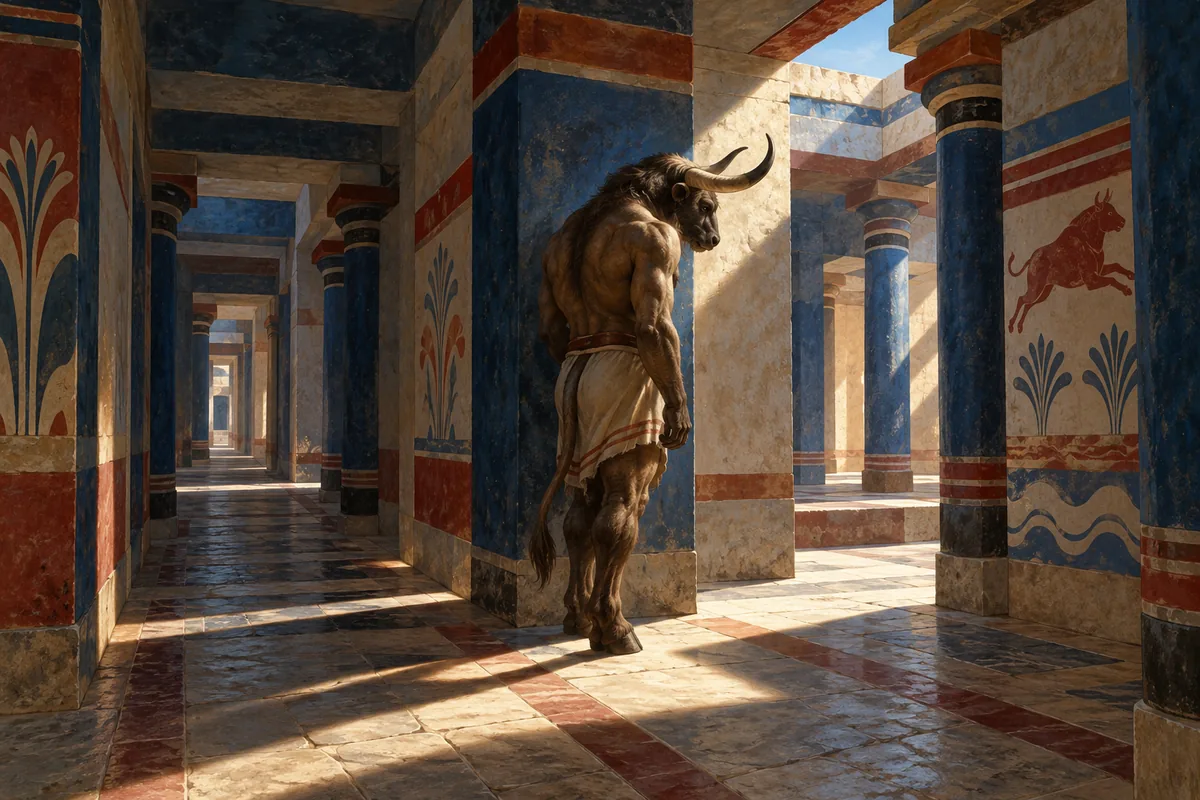
The story of Theseus and the Minotauros is one of the most famous Cretan myths. However, its parts have been changed by different authors and artists. The palace of Knossos can help us understand the image of a labyrinth, but does not provide any proof that the whole myth has taken place literally.
The core of the story
In the current version, King Minos' son Androgeos kills during events in Athens. Minos then makes a heavy estimate of the city: young men and women are sent to Crete and disappear into the Labyrinth. Theseus travels as a volunteer. With the help of Ariadne, he finds his way in, kills the Minotauros and returns.
Antique sources differ about the details: how many victims are sent, how often, what exactly happens in the Labyrinth and how Theseus escapes. Apollodorus gives a concise genealogical version; Plutarchus places the story in a life of Theseus; Attic vases show scenes that gave the myth meaning to their own audience.
Palace and labyrinth
Knossos was a large palace complex with corridors, stairs, inner courtyards and repeatedly converted spaces. For a visitor from another world, such a place could feel like a maze. The Greek word labyrinthos is often linked to the palace, but the exact etymology and the relationship between archaeological site and story remain the subject of research.
The double axe, the labry, is sometimes referred to as the origin of the word, but this connection is not generally proven. It's tempting to find a simple key that explains the Labyrinth. Archaeology reveals how later Greek stories Cretan palace architecture could incorporate into their own mythological world.
Sample, estimation and Athens
The Minotauros was born in Pasiphaë and the white bull in the family history of Minos. The monster makes political violence visible as a physical being that devours people. The estimate depicts a power relationship between Athens and Crete; Theseus' victory rewrites that relationship as liberation from Athenian dependence.
So the story isn't just an adventure. It also asks who is designated as a monster and who has the right to use violence. The hero kills the creature, but his return journey ends with the death of Aigeus due to a mistake with the sails. Victory does not solve all the consequences of action.
View question
Take a look at a map of Knossos and compare it with an image of the Labyrinth. Which parts come from archaeological observation, and which were later added to the ruins by artists and writers?
Sources and read on
- Apollodorus, Epitome 1.7–9; Plutarchus, Theseus 15–19.
- The Metropolitan Museum of Art, "Theseus, Hero of Athens"
- The Metropolitan Museum of Art, Attic column crater 56.171.46