THE LIVE KRETA · Material & craftsmanship
Crafts in Crete: knowledge of clay, wool, wood and metal
From utensils to living technology.
Added: · approx. 6 minutes read · 8 chapters
1. Learn to read an island by its objects
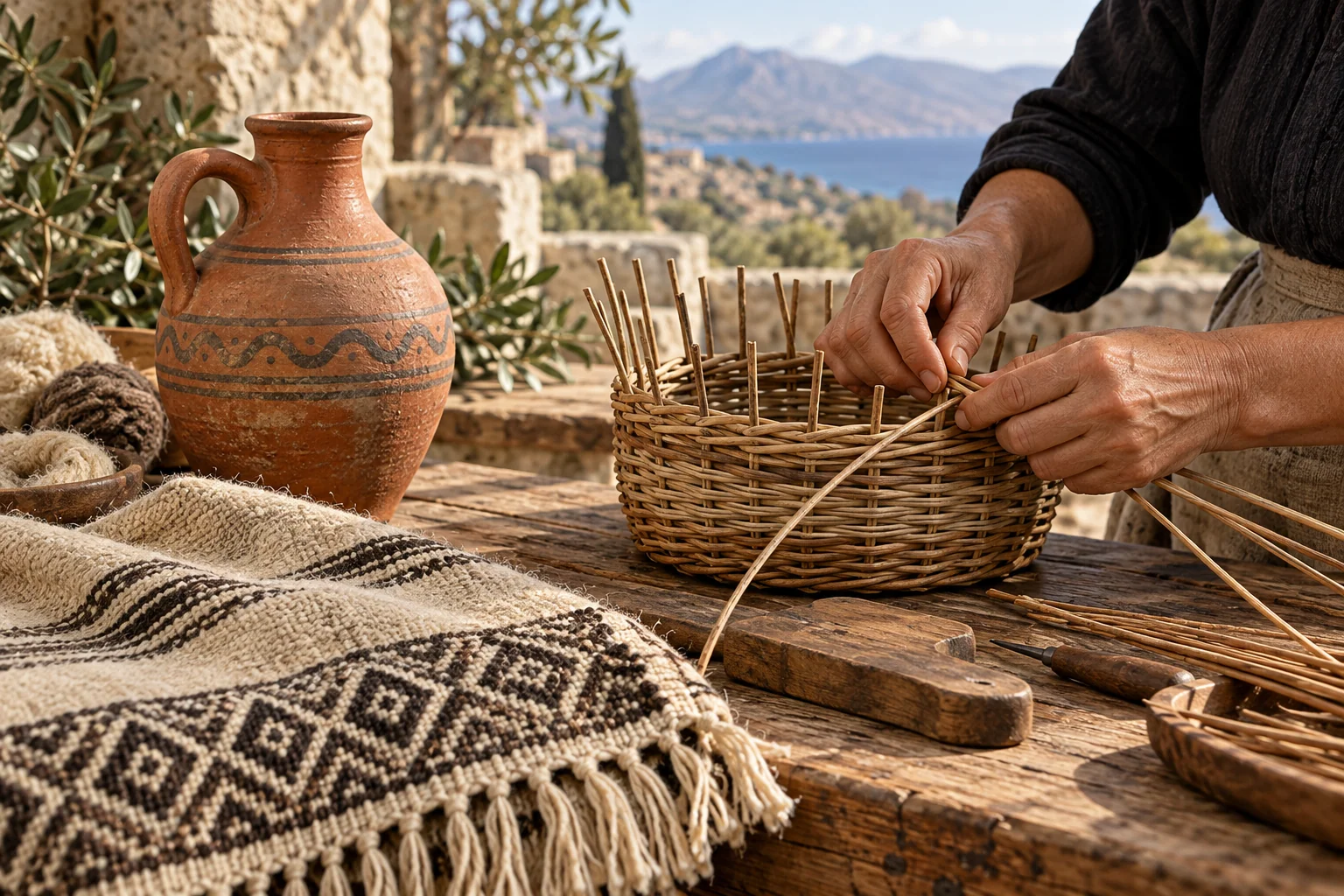
A basket, a woolen bag and a waterpot seem modest objects. Yet they tell something that makes a monument less easy: how people solved their daily problems. What was to be worn, kept cool, repaired or stored? Who possessed material, tools and time? Crafts begins with such concrete questions. In this file we therefore look at Crete through the hands of the creator, without imagining the past as a world in which everyone was self-sufficient.
The Museum of Cretan Ethnology approaches material culture through metalwork, furniture, weaving and ceramics. That layout helps to look beyond the loose souvenir. A door hinge is part of a house; a loom with sheep, yarn and household work; a store tank with agriculture and storage. The objects were parts of interrelated work. [1]
2. Clay: from raw material to utensils
A potter works with more than one shape. Clay shall be made suitable, sufficiently evenly dry and undergo an appropriate baking process. A thick bottom and a thin wall react differently to moisture loss. A handle that is turned on too late or too dry may loosen. Such general ceramic principles explain why simple pots require technical knowledge. A smooth surface is not the only measure for craftsmanship: also weight, balance, edge, spout and stability determine the use.
The ethnological museum describes how groups of potters from among others Margarites and Thrapsano used to work seasonally elsewhere. After all, heavy or vulnerable vessels on difficult roads were a logistical problem. This work organisation connects ceramics with transport and regional markets. We treat her as a historically documented practice, not as a description of every current studio. [2]
3. Wool: the long road before the loom
A woven cloth does not begin at the first stroke with the shooting coil. The museum describes a series of shaving, washing, carding, spinning and preparing wire. This shows how much work is already in the material before a pattern is created. The wire has a thickness and tension; the maker must take this into account. [3]
When weaving, shears and impact cross each other. Embroider decoration with needle and thread is applied to an existing substrate. Thus, a geometric pattern does not in itself prove which technique has been used. Look at the back, ask how the wire runs and let a maker point out the difference. This viewing method is more useful than the idea that each motif has a fixed, identical meaning for all villages.
4. A basket is a construction
Basket braids revolve around the combination of flexibility and carrying capacity. The bottom, raised wall, edge and handles must be able to handle the intended use together. A decorative basket and a basket for heavy harvest products make different demands. By studying the form you can ask questions about past labor, even if you do not know the name of a braid technique yet.
The museum collection shows that baskets had various functions and braids and that products were sometimes exchanged for agricultural products. We need to distinguish between a collection that documents historical diversity and an actual inventory of all still active makers. A museum page is not a live address book. [4]
5. Wood and metal: building, connecting, repairing
A wooden box becomes interesting when you look at how parts stay together. Are there pens, nails, hinges or repairs? Was an ornament cut or later applied? Wear around a lock may indicate frequent use. These are research questions, not automatic dating methods: a newly created object can be based on an old model.
Metalwork shows a similar connection between function and form. A tool shall be suitable for the hand that works with it and for the material that processes it. The Cretan ethnological museum treats metal objects in their context of use. Combine this angle with woodwork: a door or agricultural tool is often the result of different specialities. [5]
6. Compare Crafts
| Material | What you can look at | A good question to the maker |
|---|---|---|
| Clay | Wall thickness, foot, edge, glaze and baking traces | What's this barrel for? |
| Textiles | Sharpness, impact, stitches and finishing | Is the pattern woven or embroidered? |
| Braids | Soil, edge and connection of handles | What tax can this basket bear? |
| Wood | Connections, tool tracks and recovery | Which part is the hardest to make? |
| Metal | Wear, fixing and replaceable parts | How was this maintained or repaired? |
7. Visiting a studio without only looking at the end product
Start with permission: is work done, can you look around and can you photograph? Then ask for one edit instead of the complete history of the craft. How is this edge finished? Why is this fiber chosen? How does the maker know that a component is ready? A concrete answer makes knowledge visible without forcing a demonstration.
Ask in a purchase who made the work, which parts were carried out locally and how you maintain it. Locally sold, locally designed and completely locally manufactured mean different things. That doesn't automatically make an object better or worse, but it does give a fairer story. Usage ceramics also include a demand for suitability for food, heat and dishwasher; do not judge this by appearance.
8. Transfer, renewal and income
Craft lives when someone wants and can continue to practice the technique. A student needs practice time, a workshop space and a maker an income. A new design can therefore just as well be part of a living tradition as an accurate repetition. The word traditional does not have to mean a ban on change.
The agricultural museum of Piskopiano places textiles and tools next to a blacksmith, bakery and olive press. This creates a fruitful way of looking: follow not only the objects, but also the people and activities that connect them. Our files on Margarites and Kritsa work out two of those connections further. [6]
Sources and read on
Sources consulted for this edition on 30 October 2026. Historical publications and dated project descriptions are not a live state of affairs. The practical questions of viewing and research are our editorial reader.