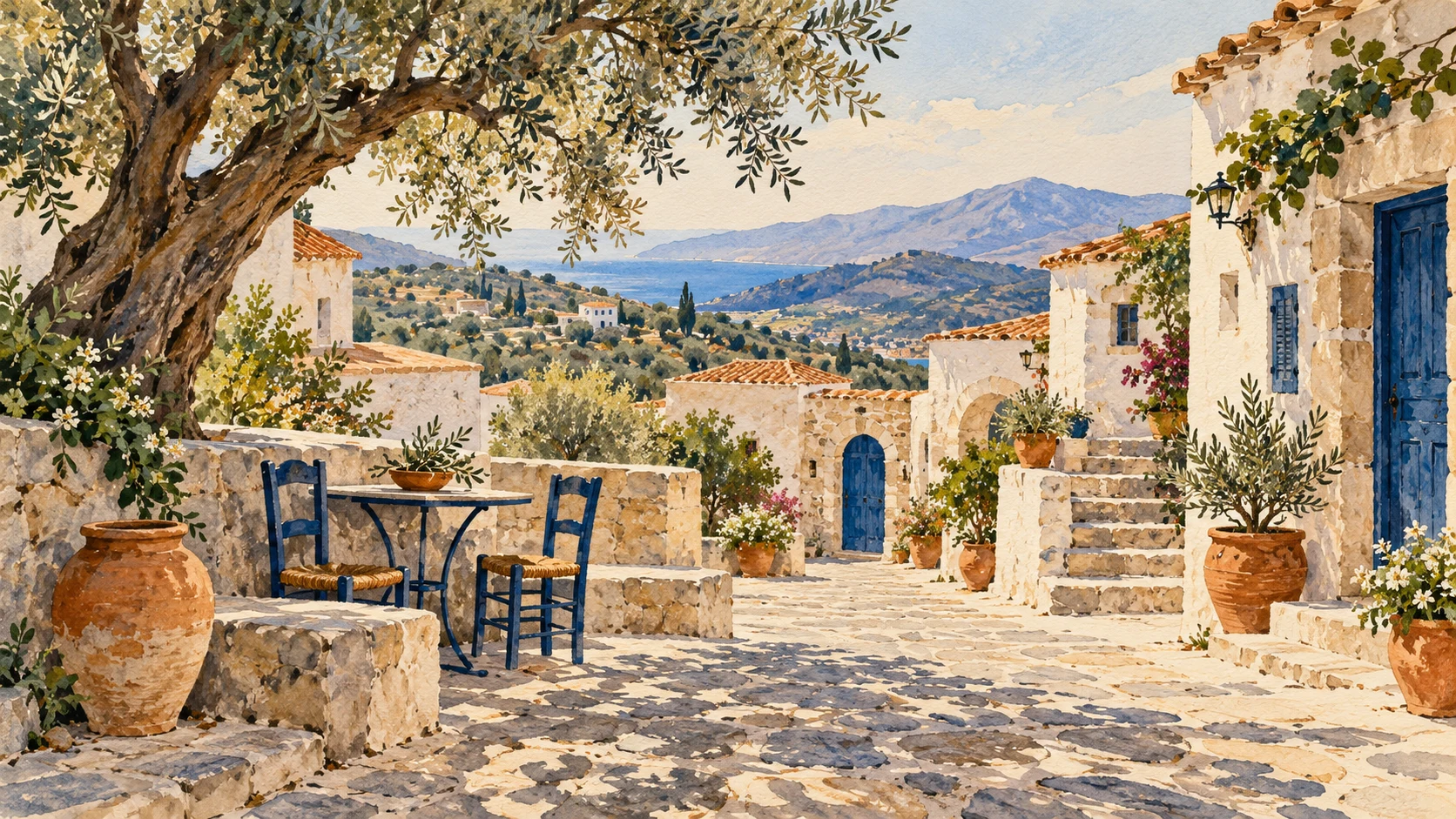
Kritsa, Anogeia, Archanes, Margarites and Loutro: crafts, music, agriculture and the sea in everyday life.
AI-Illustration · artistic impression, no exact representation of landscape, history or species.
01 · CRETE
Kritsa · stone, wire and painting
Κριτσά · Παναγία Κερά
Kritsa is located in the Lasithi region, above the surroundings of Agios Nikolaos. The settlement follows a slope: alleys, stairs and small heirs let you discover the village piece by piece. The surrounding olive land reminds you that a village is also connected to the ground outside its houses. Look at the transition between yard, shop, square and landscape.
Panagia Kera is located near the village. The three-storey church contains important murals from various phases, including the fourteenth century. The fresco pine trees were part of a religious space. Therefore, look at the place of a figure and the coherence of the stories on the walls, next to the individual details.
Textiles and handicrafts give rise to a conversation. Ask what was made on the spot, what material was used and who did the work. Not every item in a shop is automatically a local family product. You take craft seriously without making a picture of it.
Our proposal: a short walk in the village, Panagia Kera when it is open and then coffee or a meal. Park in an allowed place and leave narrow passages free. With limited mobility, it helps to choose a feasible part in advance; stairs and slopes vary by street.
Anogeia belongs to Rethymno and the mountain world of Psiloritis. The place is strongly linked to music and memory. Nikos Xylouris was born there; his story offers an entrance to a tradition in which songs also carry history, feelings and connectedness. Listen to a recording with text interpretation and then ask what the song means to the narrator.
The regional culture route calls his family home, Zominthos and the Ida cave. This does not make these places a short walk. Choose the village as the main destination and explore a mountain trip separately. The stories around Zeus remain mythological tradition.
Weaving offers a second entrance. Look at pattern, material and repetition. What function does a canvas have: daily use, protection or a special occasion? Ask a maker for technique and time. An workshop visit can request an appointment.
Take room for a meal and inform what is being prepared that day. Anogeia can also connect to the Skinakas guide. Add a public activity of the observatory only if date and location are officially confirmed.
Archanes is located near Heraklion, with Mount Giouchtas as recognizable landmark anchor. A contemporary place and an ancient archaeological environment intersect here. The streets remain living and working space, while finds make a much longer history visible.
The archaeological collection shows materials from Archanes and the surroundings. With this you can view the Minoan world on a local scale. Fourni and Vathypetro form possible floors, but each have their own access; investigate them separately.
The rural hinterland gives reason to talk about wine, agriculture and food. Ask which grapes are used in a wine and where the parcels are. Make an appointment where that is needed and arrange transport if you want to taste. A quiet village walk is also a full choice.
Start on a square, visit the collection when you can and then choose a meal. Compare Archanes later with Knossos: what do you recognize in material, organization and visual language? Such comparison does not have to mean that both places are finished in one day.
Margarites in Rethymno is known for a long tradition of pottery. The municipal guide also calls Byzantine churches and Venetian houses. Workshops and built history together give content to a walk through the village.
View ceramics first as an object of use: how does the center of gravity of a can, what does a spout do and how does the edge of a bowl feel? Twist marks, glaze and decoration tell different things. The shape connects an object with an action.
Ask in a workshop which parts are made locally and whether you can view the work process. Photograph people and workspaces after permission. Ask for the intended application when purchasing; a decorative object does not need to be suitable for food or a dishwasher. The maker can explain this.
A combination with Arkadi or Eleutherna can fit, but choose one addition. Getting to know one workshop well often results in more than a lot of doors rushing along. Afterwards, pay attention to the same forms of pots and jars in the establishment of a farm or café.
Loutro is located on the south coast of Chania, in Sfakia. The arrival by boat from Chora Sfakion gives a private perspective: buildings form a bow on the bay and the mountain slope rises behind it. The small space available brings houses, rooms, terraces and moorings close together.
ANENDYK publishes the sailing schedules for the south coast. Confirm to and back together, for your date. An older departure screen is not a current timetable. A coastal path to the village requires a separate hiking plan.
The program may remain small: walk along the water, eat and watch the light on the slope. Note the shared area of daily work and visit. A berth is also a work area for the crew.
Add a walk to another bay only as a route, weather and return pass. One day doesn't have to include Glyka Nera, Marmara and a mountain tour at the same time. With an overnight stay you can experience the transition to quieter hours; even then the departure connection remains part of the preparation.
A square, fountain, church, bakery or workshop shows where people meet. Ask first what a place does and then how old it is. A bench has a social function and a narrow street can still be a necessary work route.
Start with a greeting and one specific question. A conversation about today's clay or dish is often easier than a great demand for authenticity. Hospitality is not mandatory for visitors.
For your travel book: note a sound, a material and an action. What was made, worn, repaired or discussed? Such details keep a place recognizable without making a general statement about all Cretans.
The map shows the island. Open a place separately to view the location; these are search links, not controlled walking or car routes. External maps ask internet.
Editorial edition · 21 October 2026. Visit proposals and exercises are their own effects. Check current access, transport and local conditions with the official administrator.