LIVE KRETA · Language & culture
The Cretan dialect: words with a home
A bridge between Standard Greek, local variants and living stories.
Added: · approx. 7 minutes read · 10 chapters
1. Greek with a place, history and voice
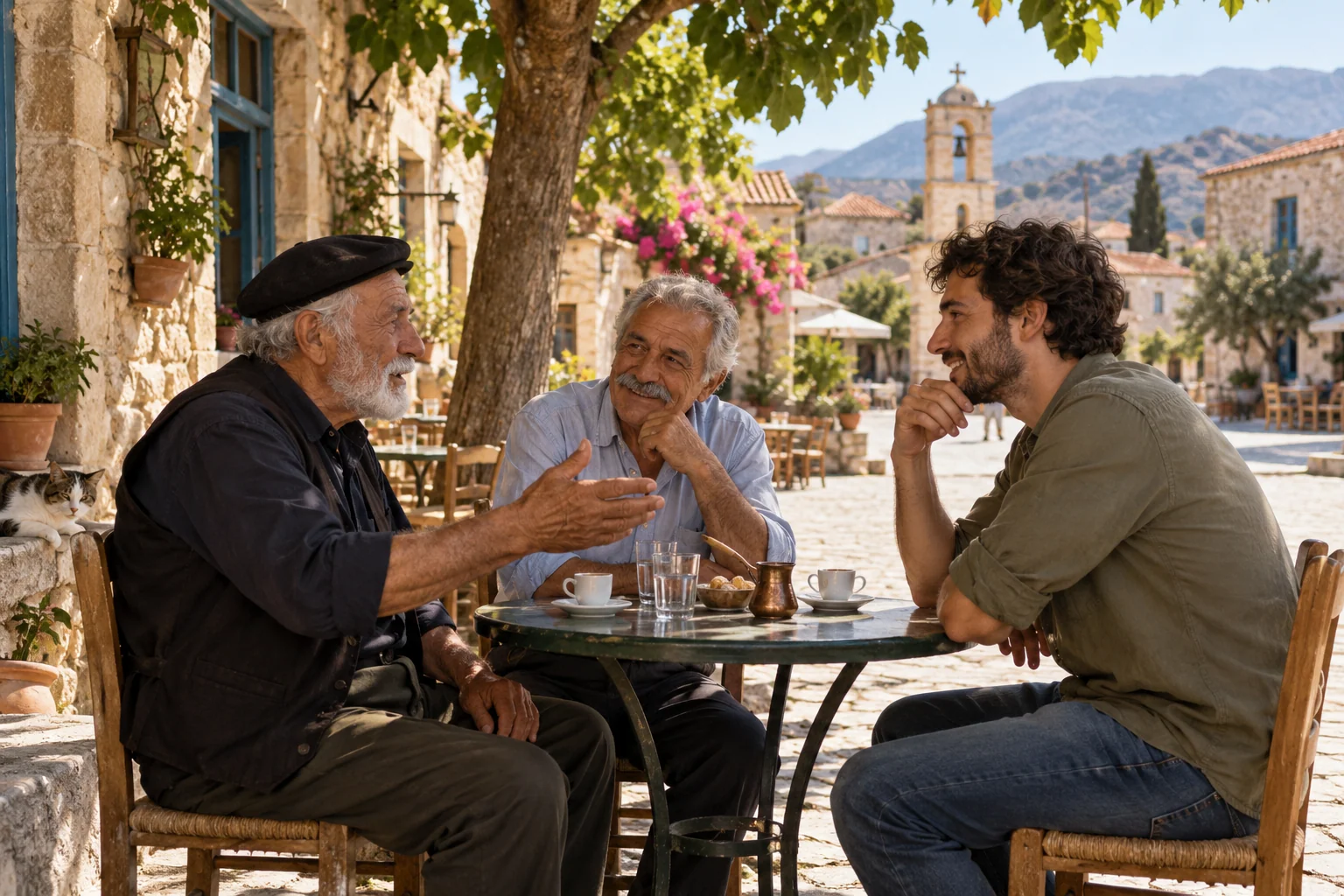
The Cretan dialect is not a collection of funny deviations from real Greek. It is a regional form of the New Greek with its own history and differences. Those who learn Standard Greek can hear recognizable words and grammatical patterns, but also form those explanations. This file is a bridge between our language lessons and the language that people use in different situations in Crete.
We don't treat dialect like a uniform island accent. A word can be used differently by region, generation or conversation. Also, someone can switch between more standard language and more local forms. Therefore, an isolated vocabulary never gets the status of full manual for how all Cretans speak.
2. What distinguishes dialect, accent and register
An accent relates to first of all to pronunciation. A dialect can also have its own word choice, inflections, verb forms and sentence constructions. Register is about the choice of language that suits a situation: for example informal conversation with family or careful explanation to an unknown person. In one conversation, those dimensions can come together.
For a teacher, this distinction is practical. If you hear a sound different than expected, the grammar doesn't have to have changed. If a word seems familiar but means something else, only slower listening can be insufficient. Then ask about the meaning in the sentence. The context helps more than an attempt to immediately secure any sound in a Dutch sound spell.
3. Written tradition and spoken diversity
Crete University Press emphasizes the long written tradition and special literary bloom in the sixteenth and seventeenth centuries. The publisher's file on the dictionary of the West Cretan idiom shows at the same time how rich the vocabulary of materials, work and daily life is. This is a valuable link between our dialect file and the crafts. [1]
However, a literary work is not a sound recording of a village conversation. An author chooses, organizes and stylizes. The Erotokritos can unlock language history and cultural significance, but those who read one verse do not automatically hear the pronunciation of a contemporary speaker. The existing Kornaros file helps to connect literature and the world of life without equalizing them.
4. Eight words as a read window
The following examples follow the description of the Centre for the Greek Language. They give a limited selection of reported meanings. It is not a question of universal replacement rules: use, grammar and emotional value depend on the context. [2]
| Cretan form | Standard Greek as a comparison | Dutch meaning in this context |
|---|---|---|
| κοπέλλι | παιδί | Child |
| κουζουλός | τρελός | Crazy; emotional value strongly depends on tone and relationship |
| κουράδι | κοπάδι | Mud |
| κουτσούνα | κούκλα | Pop |
| εδά | τώρα | Now |
| επαέ | εδώ | Here. |
| θέτω | πλαγιάζω | Lie down; sleep in the well |
| χτήμα | γάιδαρος | Donkey; not necessarily the standard meaning of a related word |
Use the filter above the vocabulary to search for Greek or Dutch. The comparison is meant to better understand a text or conversation. It is not a recommendation to use every word directly against an unknown person. Especially a qualification for a person can seem quite different outside of a trusted relationship.
5. Listening without making a caricature
A dialectaccent is not reliably taught from a few extra letters in Dutch sound support. What sound you hear is related to the speaker, the surrounding sounds and the local variation. For the general Greek our site has sound support and synthetic speech; a standard voice is not yet a dialect speaker.
We therefore do not add a button that would present synthetic standard pronunciation as authentic Cretan. A real recording must have a speaker, origin and context. For your own listening diary you can record with permission a short expression and have it explained. Keep the meaning and situation, rather than mimic a loose sound.
6. Grammar may differ in more places
The description of the Centre for the Greek Language mentions, among other things, verb forms with an extra consonant: χορεύγω next χορεύω. She also discusses differences in aspect formation, future constructions and the place of weak pronouns. This shows that dialect characteristics go beyond vocabulary. Not every form occurs in the same way in every situation or region. [2]
For an unknown sentence, therefore, look in steps. First find the verb, determine what happens and then look at time, aspect and participants. Only then will you investigate which part is possible dialectical. This way you use the knowledge from our grammar classes as a tool, without automatically improving a local form as an error.
7. Reading a dictionary as research
A dictionary gives more than a translation. A lemma may contain meanings, conditions of use, variants and etymological proposals. Choosing a translation without that information can distort a text. When a word has both a concrete and a figurative meaning, the sentence determines which direction is plausible.
The Western Cretan dictionary is explicitly regionally oriented. That is a force, not a shortcoming: precise knowledge of one area is something other than a claim across Crete. Our cursor therefore encourages us to keep source area and preview sentence with a note. A word from a song, an artisan explanation and a family conversation do not need to show the same usage. [1]
8. Mantinades: language in a meeting
A mantinada is interesting as text, but also as an act between people. Who speaks, who is responded to and what does the company already know? A literal translation can miss the situation and pun. That's why our musical file on mantinades is the next step after this language introduction.
When discussing a contemporary song or poem, we choose summary and explanation; we do not automatically place the full text. A short, carefully chosen passage can be enough to discuss a grammatical form. More importantly, the creator and the context remain recognizable and an own interpretation is presented as interpretation.
9. Gathering language with respect
Ask a speaker to write down an expression. Then ask not only what does this mean, but also when do you say this and to whom. An example situation can make the difference between friendly teasing, a common indication and an insult. If anyone doubts a form, note that doubt.
Don't publish a personal recording without permission. A local word that someone shares with you is not an unlimited permission to post their voice, name and family story online. You can make a useful learning note without sharing that information publicly.
10. A learning route for visitors
Start with the Standard Greek you need to ask questions and understand an explanation. Then add a small number of truly heard local words. Write down the phrase, meaning, place and source per word. Check later which parts are common Greek and which local or situational.
Link this file to the crafts, Kritsa and the missing professions. A word for a tool can be the entrance to a whole technique. This way you learn not only a different name, but also why a community needed precise vocabulary for that. Language and material culture then become two sides of the same research.
Sources and read on
Sources consulted for this edition on 30 October 2026. Historical publications and dated project descriptions are not a live state of affairs. The practical questions of viewing and research are our editorial reader.