LIVE KRETA · Villages & Reminder
Abandoned villages and disappeared professions
What remains when habitation and work change?
Added: · approx. 6 minutes read · 10 chapters
1. Empty isn't the same as missing
A homeless house can suggest a completely abandoned village. However, there can be property, a church maintained, agriculture taking place or family coming back on weekends. Leaving the word should therefore be used carefully. This file looks at settlements where habitation changed greatly and at occupations that disappeared from the daily street scene, without pretending to stop their history with the last permanent resident.
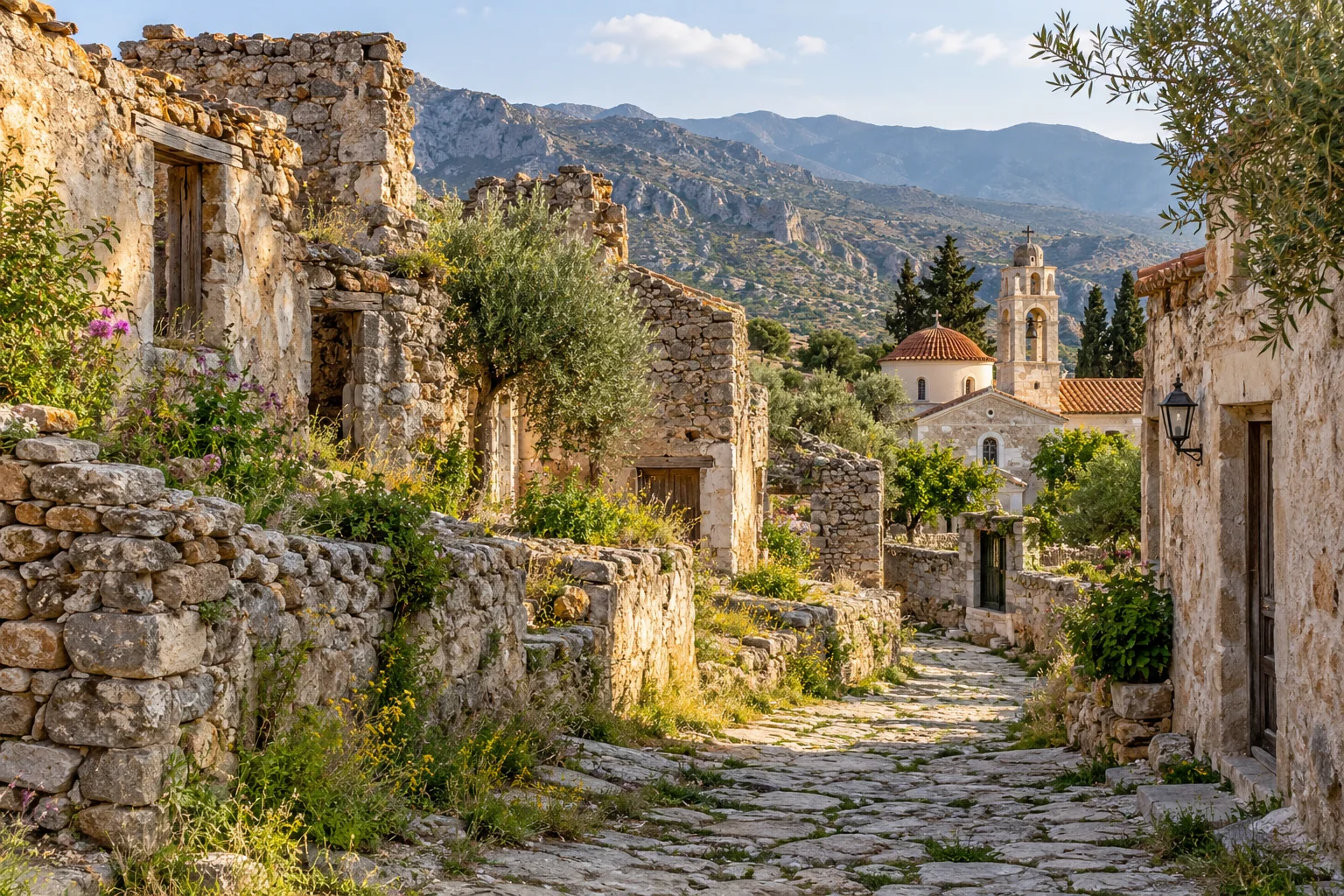
A ruin is not a free pass. Walls, vaults and floors can be unstable; a doorless opening does not make a building public. We focus on visible structures, documented stories and respect for residents and administrators. The hero-image is an imaginary village image, not an actual state of a said settlement.
2. Not one explanation for all villages
People can move because of work, accessibility, facilities, family conditions, conflict, destruction or major infrastructure intervention. Sometimes, over decades, causes interact with each other. A story that links one ruin to one dramatic event can be too simple.
Ask at each place for the source and scale. Is it one family, a neighborhood or the whole settlement? About permanent departure or seasonal use? Is the story based on a count, archive or oral memory? Those questions help to understand loss without turning the past into an attractive but uncontrolled story.
3. Aradena: a multilayer name
Aradena near the Lefka Ori is known for its gorge and ancient settlement. The municipal information portal of Sfakia links the depopulation in the fifties with a vendetta. This is shown as the local source description, not as a complete explanation of all later changes or as a characterisation of the region. [1]
The regional visitor information also connects the gap with the abandoned village building. However, a hiking area and a history of habitation are different subjects. The fact that a route passes by does not make homes unattended decor. A church, memorial or restored house can show that the relationship with a place continues. [2]
4. Voila: reading to a settlement
At Voila in East Crete, the official Sitia guide describes a settlement against a steep slope. The building and partial walling had a defensive character. That is a good start to looking spatially: which facades turn to the valley, how do houses connect together and how do access and relief relate to each other? [3]
The Waterways documentation puts the gradual decline and abandonment from the end of the nineteenth century into a longer history of habitation. Such a timeline is something other than a completely empty village at one exact moment. We use Voila to show that a settlement can change through different phases. A current visitor only sees part of it. [4]
5. Occupations do not all disappear in the same way
A saddlemaker, cockerel or shoemaker is part of a world of transportation, storage, maintenance and repair. Where items of use or means of transport change, the demand for expertise may also shift. That doesn't mean that every maker suddenly stopped or that the business no longer exists. Sometimes the work moves to another market or takes a different form.
The Historical and Popular Museum of Rethymno presents separate professional contexts, including shoemaker, metalwork and saddlemaker. The collection is an input to read tools in connection with customers and usage. Check by museum section which professional name and function are precisely meant. [5]
6. What a tool can tell
A tool is interesting when you understand what movement was made with it. Where was the hand? Which part hit the material? Could a worn part be replaced? Prefer to compare two utensils with different functions than just two about the same old objects.
The agricultural museum of Piskopiano combines agricultural tools, a blacksmith, a cockpit shop, a carpenter's workshop and textiles. This consistency shows that old professions did not form separate folklore. A barrel, car part or repaired shoe connected makers with the household and farm. [6]
7. Viewing a house as a workspace
| Visible element | Research question | Careful with the conclusion |
|---|---|---|
| A big opening | Could there be material or an animal through this? | Not every big opening is a stable |
| A solid container or niche | Storage, processing or anything else? | One photo does not determine the function |
| Different layers of stone | Remodeling or recovery? | Color alone doesn't date |
| A water point | For whom and in what period? | Not automatically the original village source |
| A repaired door | What care for the place goes on? | Few permanent residents means not ownerless |
8. Collecting Oral History
Ask in advance if anyone wants to tell you and if you can record or publish anything. Start with a concrete reminder: how did one go to school, what work was done in this house or where was water fetched? Leave room for doubt and for the fact that a memory is told from one person.
Write down the date of the conversation, the relationship of the narrator to the place and any restrictions for publication. Do not mix personal reminders with archive information unnoticed. If two stories are different, that could be the reason for further research. A knowledge guide does not need to smooth out differences in order to remain readable.
9. Photographing without directing the past
Do not move objects for a stronger composition. A chair, tool or earthenware bowl can have meaning through the place where it lies. An apparently modern object is also part of the history of a building. Taking away a timeless image changes the story.
In a picture, state what you know and what you don't. A recording of an abandoned street doesn't prove a permanent population. A closed workshop door doesn't prove that a craft has died out. Our files on old photos and maps learn how to read such images later as a source.
10. Reuse and reminder
A building can be re-used as a home, workshop or meeting place. This offers opportunities, but also raises questions about accessibility, maintenance, ownership and the recognition of older structures. The goal is not to freeze every village at an imaginary original moment.
Therefore connect this file with crafts and dialect. When a profession changes, the daily words and places where people meet also change. The question of what remains is not just about stones. She is also about skills, names, memories and the space a community gets to choose its own future.
Sources and read on
Sources consulted for this edition on 30 October 2026. Historical publications and dated project descriptions are not a live state of affairs. The practical questions of viewing and research are our editorial reader.