KRETA · MYTHOLOGY · DIFFERENCE
Talos: the bronze guard of Crete
A mythical vending machine between divine gift, defense work and fragile body.
Talos is in Argonautic tradition a bronze guard of Crete who keeps ships at bay. His body seems mechanical and indestructible, but he has a fragile life vein. The myth investigates where the boundary lies between living beings, created objects and political power.
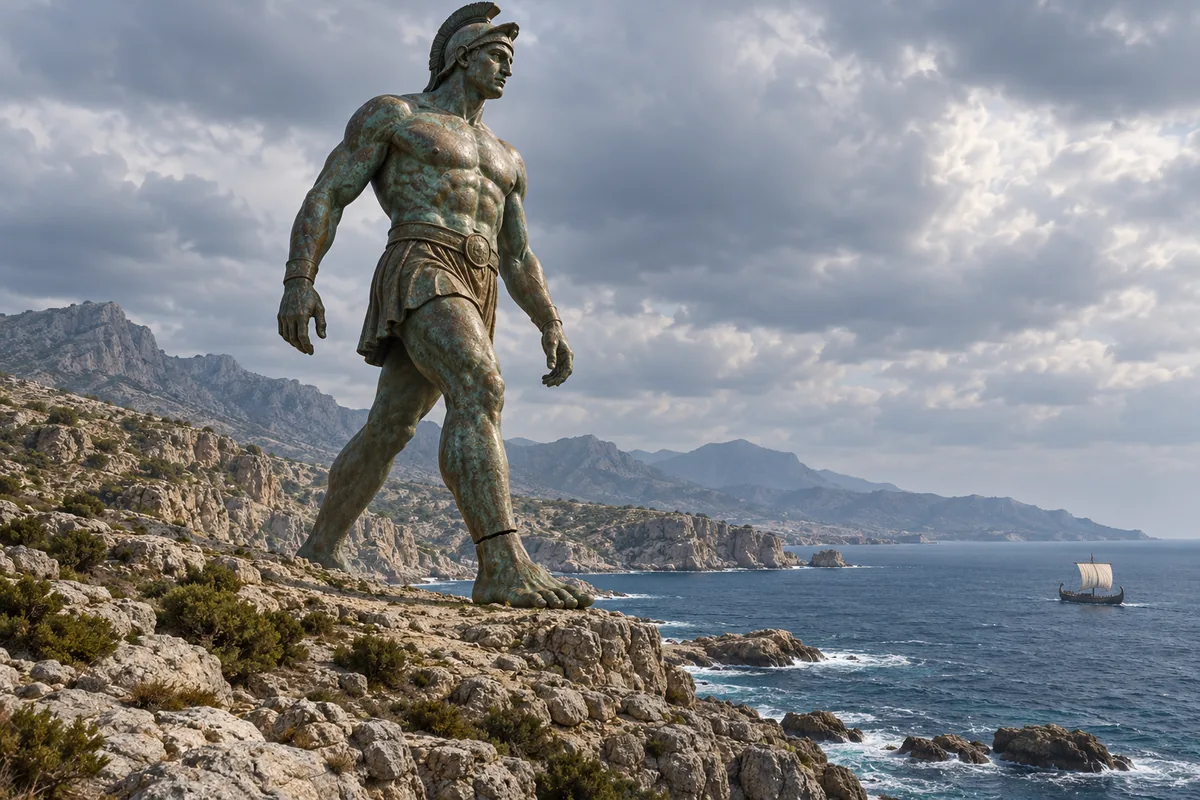
A body of bronze
In the most famous version Talos runs three times a day to Crete and drives strangers away by throwing stones at their ships. A vein runs from its neck to its ankle and is closed by a pin. When the pin disappears, his life fluid flows away and he dies. Antique authors differ about who made him and how exactly he was defeated.
Apollonius Rhodius tells how Medea Talos forgets his vulnerability by spell or ruse. Apollodorus gives another compact version. The variants are valuable: Talos is not a fixed robot with one manual, but a story in which different periods think about technique, defense and power.
Automat or living protector?
A vending machine is something that seems to move without constant direct control. Talos is not a machine in a modern sense; he is a mythical being of divine origin. Yet readers in him recognize an old idea of artificial life: a figure made gets a job, a route and a rule to ward off intruders.
His daily tour turns Crete into a guarded border. But the protection is violent and excludes outsiders. The myth shows that technology and security contain political choices: who is seen as a threat, who gets access and who can take out the guard?
The vulnerable place
Talos... only makes it visible that a powerful system can be dependent on one small component. The pin is both mechanical detail and dramatic opening. Once it is removed, it turns out that invincibility was never absolute.
Later on, Talos shows up as a bronze giant. Such representations can be linked to Minoan or Eastern motives, but iconographic similarity is not proof that the myth originates directly from one older cult. It's better to compare similarities than to come up with a straight line of origin.
View question
Which modern systems resemble Talos: a gate, algorithm, border surveillance or autonomous machine? Find the single point "One-way": the dependency that makes the system vulnerable and the decision that determines who is protected.
Sources and read on
- Apollonius Rhodius, Argonautica 4.1638–1688; Apollodorus, Epitome 1.9–10.
- The Metropolitan Museum of Art, "Minoan Crete"