KRETA · MYTHOLOGY · DIFFERENCE
Daidalos and Ikaros: craftsmanship and boundaries
A story about technique, transfer and the price of a warning.
Daidalos is the inventor who can even make a way out of a Labyrinth. His son Ikaros learns to fly with wings that lift human skill above her normal limits. The story is not simply a lesson about disobedience; it also investigates responsibility and the risk derivatives of knowledge.
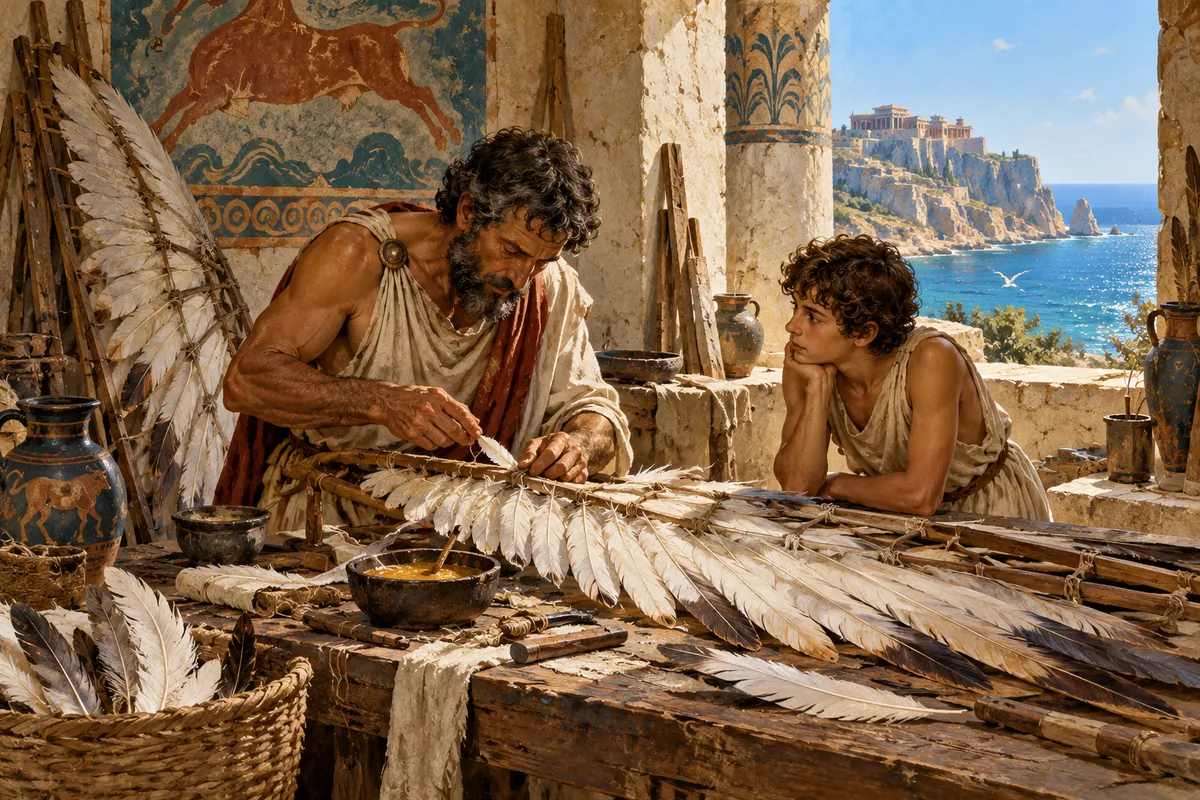
The creator in the Cretan story
Daidalos works for Minos and builds the Labyrinth according to the myth. When caught in Crete, he invents an escape that doesn't go by land or sea, but by air. He makes wings of feathers that are fixed with wax. The technique is ingenious, but depends on material, environment and careful use.
Daidalos appears in ancient texts as an exceptional craftsman. His knowledge can save, but also contribute to power and confinement. He builds the Labyrinth in which the Minotauros is secured and then designs a means of escape. Technology is never neutral here: the question is who controls the invention and who bears the consequences.
The warning and the fall
Daidalos warns Ikaros not to fly too low, where seawater makes the feathers heavy, and not too high, where the sun can soften the wax. Ikaros goes up too high, the wings fall apart, and he falls into the sea. Ovidius makes the scene an image of human ambition, but the details differ by narrator.
A simple morality is: listen to your father. But with that, the bigger problem disappears. Ikaros gets a dangerous new power and depends on instructions he has not tested himself. Daidalos is not only the warning parent; he is also the maker who exposes his son to an uncertain technique.
Proportional technique
The story asks what an invention requires of the user. The wings only work within a narrow margin: not too low, not too high. So knowledge is not omnipotence. A design contains conditions, materials aging and the user may not understand the limit until it is too late.
In later art, Ikaros often becomes small in front of the sea or sun. That image shifts the attention from an individual error to the world that goes on indifferently. The trap is visible, but bystanders can spare her. The story invites us to assess not only the ambition, but also the systems that distribute risk derivatives.
View question
What warnings about modern technology describe real design boundaries, and what blames the user in particular? Use Daidalos and Ikaros to find out the difference.
Sources and read on
- Apollodorus, Epitome 1.12–15; Ovidius, Metamorphosen 8.183–235.
- Pliny the Elder, Naturalis Historia 7.198–199 (later tradition of Daidalos).