GREEK MUSIC · DIVISION 8 / 20
Siganos: Coherence in the slow movement
The little tuning that holds a quiet dance together.
Slow dancing requires attention. A small hesitation is palpable to the people next to you and a shift of weight becomes a joint decision. The siganos offers an entrance to look at the quiet organization of a party, before all attention goes to speed and jumps.
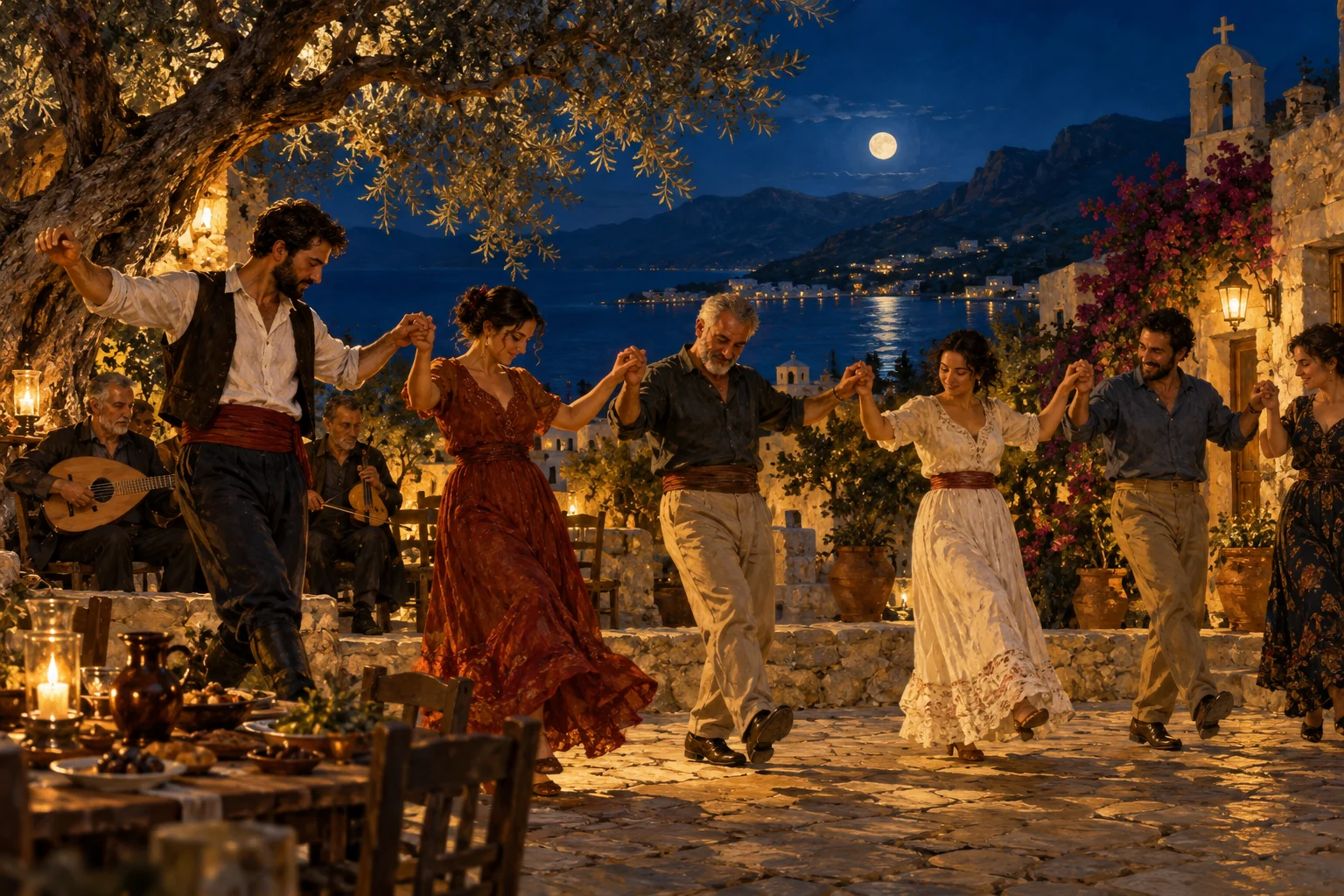
Start with an appointed performance
In the West-Kreta reportage of Domna Samiou from 1976 is a fragment with siganos and pentozali. Aspasia Papadaki plays lyra and a group of girls dance. This file uses this concrete archive example as a starting point. Thus statements about participants and occupation remain verifiable. The name of a dance does not have to mean that every local version has the same fitting pattern, pace or gradient. If you are looking for a second example yourself, please note the location, the performer and the occasion, as far as those data are available.
Slowness increases the gap
When movements are further apart, you notice what happens between them. Is the music still tense, does a string tone make the next step palpable or does a little rest arise? Try not to count with all visible feet immediately. Choose one participant and follow only moving its weight. Then listen to me without a visual. At what moments do you expect a new movement? You distinguish between a tempo that you can measure and the way in which a performance can feel slow or dynamic.
The connection is also a skill
A connected row does not allow for unlimited individual timing. Each participant must feel what people are doing next. Therefore look at the poor and the distance between them. Is a difference gently absorbed or is the connection just under tension? It doesn't have to be a mistake if not everyone moves the same thing mechanically. Joint movement can consist of constant small differences. This attention is difficult to capture in one still image; a full phrase tells more about the collaboration than a picture of a striking attitude.
From a quiet to a faster part
A fragment in which siganos and pentozali stand side by side makes comparison possible. Find the transition and first ask what you really hear changing. Does the pulse get faster, changes the melody, increases the emphasis, or do you especially see other movements? Several changes can occur at the same time, but they don't have to. Write them down separately. This way you prevent the general word build-up covering all the details. The source shows how this version has been designed. A general description of local dance habits requires additional documentation or explanations from an experienced teacher.
Who makes the tradition visible
The mention of a female lyra player and female dancers is also a reminder to look closely at the source. Tradition is often told with a limited number of recognizable images. An archive can broaden that image by bringing back concrete people and events. Don't make that a reverse absolute rule: one film fragment doesn't tell you anything about participation in all of Crete. It does show why it is important to ask who selects recordings, who gets a name in the explanatory notes and who stays in the picture only as a background.
Listen further: small difference, big effect
Watch for 20 seconds at normal speed and describe one movement as precisely as possible. Look at the same passage again while listening exclusively to the lyra. Note what musical moment the movement supports for you. Next, put a question next to which the recording does not answer, for example how the dancers learned this version. That combination of perception and open question keeps looking honest. The siganos thus become more than a quiet beginning: an opportunity to see how music and people together maintain a shared time.
Sources & Listen inputs
- Domna Samiou West Crete
Audiovisual fieldwork report, 1976. With Syrtos Dance of Chania and Siganos & Pentozali Dance; names and garrisons per fragment.
Sources checked for 29 October 2026. The listening questions are newly written exercises; they do not attribute a predetermined result to a recording. The external archive pages contain where available their own audio or video.