GREEK MUSIC · DIVISION 1 / 20
The Cretan lyra: a voice between bow and nail
How bow, nail and phrasing form a recognizable voice.
A small bow can move a whole company. The Cretan lyra derives its power of expression from the interplay of sound, gesture and attention. Anyone who only listens to the melody misses the way the player negotiates with a singer, companion or dance circle.
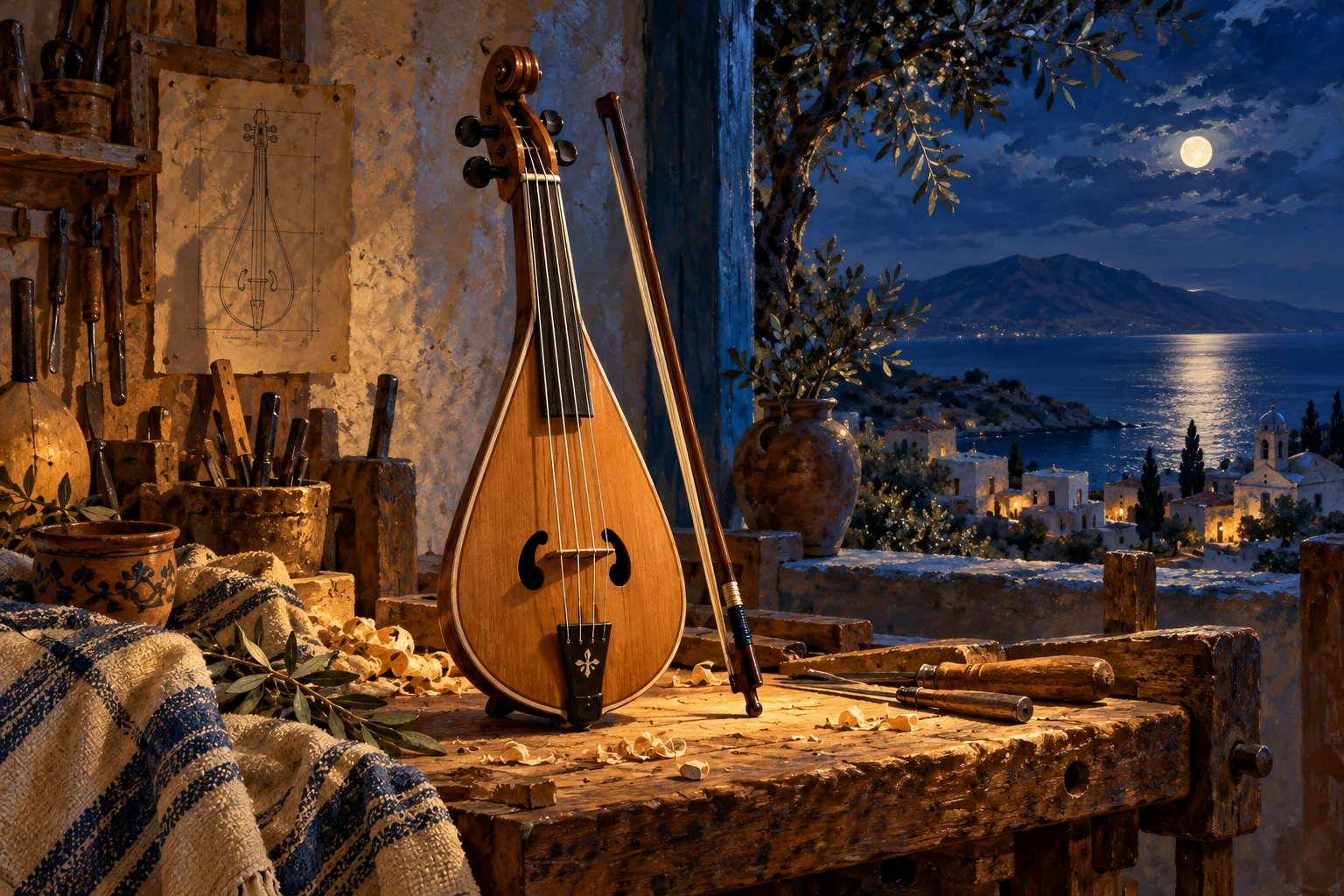
A string instrument with its own name
The pear-shaped Cretan lyra is one of the string instruments. The name may cause confusion: the plucked winch from images of Greek antiquity is another instrument. An agreement in name does not prove unchanged construction or play method. The Amargianakis archive of the University of Crete documents the lyra alongside other island instruments. This offers a useful starting point: view the instrument as part of a local music practice, with different players and performances, before making it the symbol of an entire island.
The left hand colors the tone
In the characteristic playing mode fingernails touch the strings sideways. The right hand moves the bow. Show height, arc pressure and timing work together. During listening you can try to distinguish between a continuous tone and the small movements around it. Does a decoration sound like an acceleration, a glitch or an extra emphasis? Those words are listeners. They do not replace a player's technical description, but help you hear more accurately where the expression comes from and why two versions of a melody can feel different.
A tune doesn't have to be a straight line
Take a short phrase as starting point and hum only the main resting points. Then listen again to the curves between those points. Sometimes the core seems simple while the execution is particularly mobile. A note sequence on paper could capture part of that movement, but not necessarily the full sound, phrasing and interaction. So don't just ask which notes someone plays. Also ask how a tone starts, how long it gets weight and when the next musical thought is used.
Conversation with the laouto
In a duo you can consciously move your attention to the supervisor. Hear how the laouto makes space under the lyra and at the same time marks progress. Then you return to the melody. Are both players always running exactly together, or is tension caused by the fact that one party seems to wait for a while? Describe what you hear in this recording without immediately making a general rule. The musical role distribution is visible by the performance; it is more than a fixed schedule in which one instrument does something important and the other is only present.
A recording has an environment
A studio recording gives other information than a registration with talking guests and dancing feet. The second can sound more messy and yet show more clearly how the music works. Watch who makes a start and the reaction after a phrase. Applause, shouting or an deployed verse are not random interference when they are part of the event. At the same time, take into account what the microphone leaves out. The loudest party on a recording does not have to have been the main participant in the original space.
Listen further: three points of interest
Choose a lyra recording with the listed performer in the university archive. First write down the form of one recurring phrase. During the second listening, you only focus on the bow: where do you hear a new start? Follow the third time the other attendees. Then compare with a performance on violin or a voice. What parts do you recognize despite the other sound body? Thus, the lyra becomes an access to musical action in Crete, and there remains room for the variety behind the familiar image of the instrument.
Sources & Listen inputs
- University of Crete instrument archive
Description and archive entries for the instruments of Crete; refer to performer and date when recording.
- Domna Samiou List of instruments
Instrument names and descriptions; access to the documentation of its own fieldwork and execution archive.
Sources checked for 29 October 2026. The listening questions are newly written exercises; they do not attribute a predetermined result to a recording. The external archive pages contain where available their own audio or video.