GREEK MUSIC · DIVISION 6 / 20
Pentozali: energy, precision and space for the dance
Beyond the jump: a two-part musical pulse and the collaboration in line.
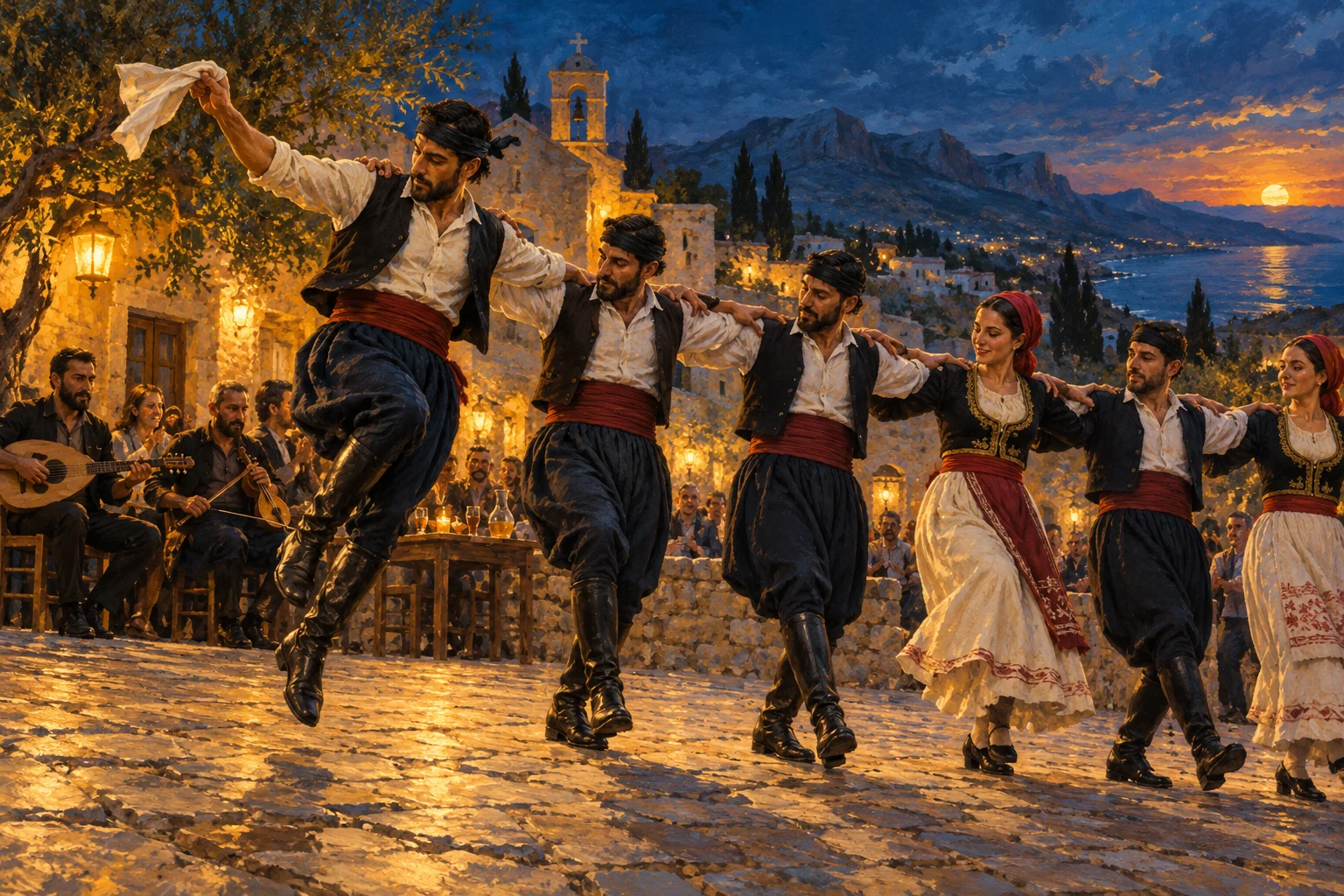
A powerful leap draws the attention, but the pentozali starts for the listener earlier. The support under the feet, the repeating melody and the collaboration in the queue make the movement possible. Here we look and listen to that joint organization.
A name is not a size
The name pentozali invites you to think of five. It doesn't follow that the music is in five seconds. The documented examples of Domna Samiou have been described as a two-part rhythm; the explanatory notes to Slow Pentozalis refer to 2 / 4. This distinction prevents a common confusion between name, fitting pattern and musical size. First count the repetition of the accompaniment and then look at a complete dance phrase. The number of visible movements does not have to be equal to the number of counting within one measure. Music and choreography each have their own format.
Precision makes speed readable
A quick execution can be seen as an uninterrupted flow. Therefore, focus on one recurring musical beginning. When you recognize that, the movements around it become more clear. Then look for the moment when the dancer seems to come out of that place again. The goal is not a dance lesson from a screen, but an insight into the collaboration between phrase and movement. What seemed to be wild energy at first, may prove to be a carefully maintained structure when looking again. Small precise steps then contribute as much to the tension as the striking leap you first saw.
The line carries the front dancer
Whoever follows the leader alone sees part of the event. Look at the people next door a second time. How do they keep distance, direction and coherence? In a connected dance form, the space for an individual gesture depends on others. You can also hear this as a question of listening: does the accompaniment stay firmly equal when someone does something striking, or does she react with an accent? Describe the specific implementation. Without conversation with the participants, you cannot always determine whether a movement was spontaneous, agreed or belongs to their trusted repertoire.
Older descriptions have a perspective
Historical explanations often connect the pentozali with masculinity, struggle and regional pride. Read such texts as sources from their own time. The same Samiou archive also shows girls dancing siganos and pentozali in a reportage from West Crete. This shows why an old firm description does not automatically capture the whole practice. A dance can be performed by different groups and get new meanings. Also stories about a direct continuous descent from antiquity demand independent proof; a parable or proud tradition alone does not close that historical question.
Listen to another occupation
The archive recording Pentozalis Dance, based on a registration in Chania from 1965, uses laouto and wooden spoons. Put it next to a lyra version. Is the sound colour especially changing, or do you also hear a different distribution between melody and rhythmic emphasis? The comparison allows to separate the recognizable character of the dance from one standard ensemble. Keep an eye on the different recording situations. An instrument close to the microphone can get more emphasis than it had in the original space.
Watch and listen in two rounds
Start with sound only and mark three recurring bets. Then look at the image and first follow someone's feet in the middle of a row. Finally, look at the leader. What movements coincide with the bets you've already noted? Where does anyone seem to be moving across a musical boundary? Compare with the slow archive example. The question of how a group makes time together often yields more than just looking for the highest jump or the fastest version of the pentozali.
Sources & Listen inputs
- Domna Samiou. Pentozalis Dance
Fieldwork Chania, 1965; documented two-part rhythm and an occupation with laouto and spoons.
- Domna Samiou Slow pentozalis
Remarks Markos Dragoumis, 1974; explicit mention of 2 / 4.
- Domna Samiou West Crete
Audiovisual fieldwork report, 1976. With Syrtos Dance of Chania and Siganos & Pentozali Dance; names and garrisons per fragment.
Sources checked for 29 October 2026. The listening questions are newly written exercises; they do not attribute a predetermined result to a recording. The external archive pages contain where available their own audio or video.