GREEK MUSIC · DIVISION 7 / 20
The Cretan syrtos: melody that holds a circle
A documented example from Chania as an entrance to phrase and connected movement.
The syrtos can sound inviting: a melodic movement returns, the circle stays connected and a new musical gesture arises within familiar time. To hear that, you don't have to be able to do the dance already. Start with what makes the repetition possible for the group.
One word, different versions
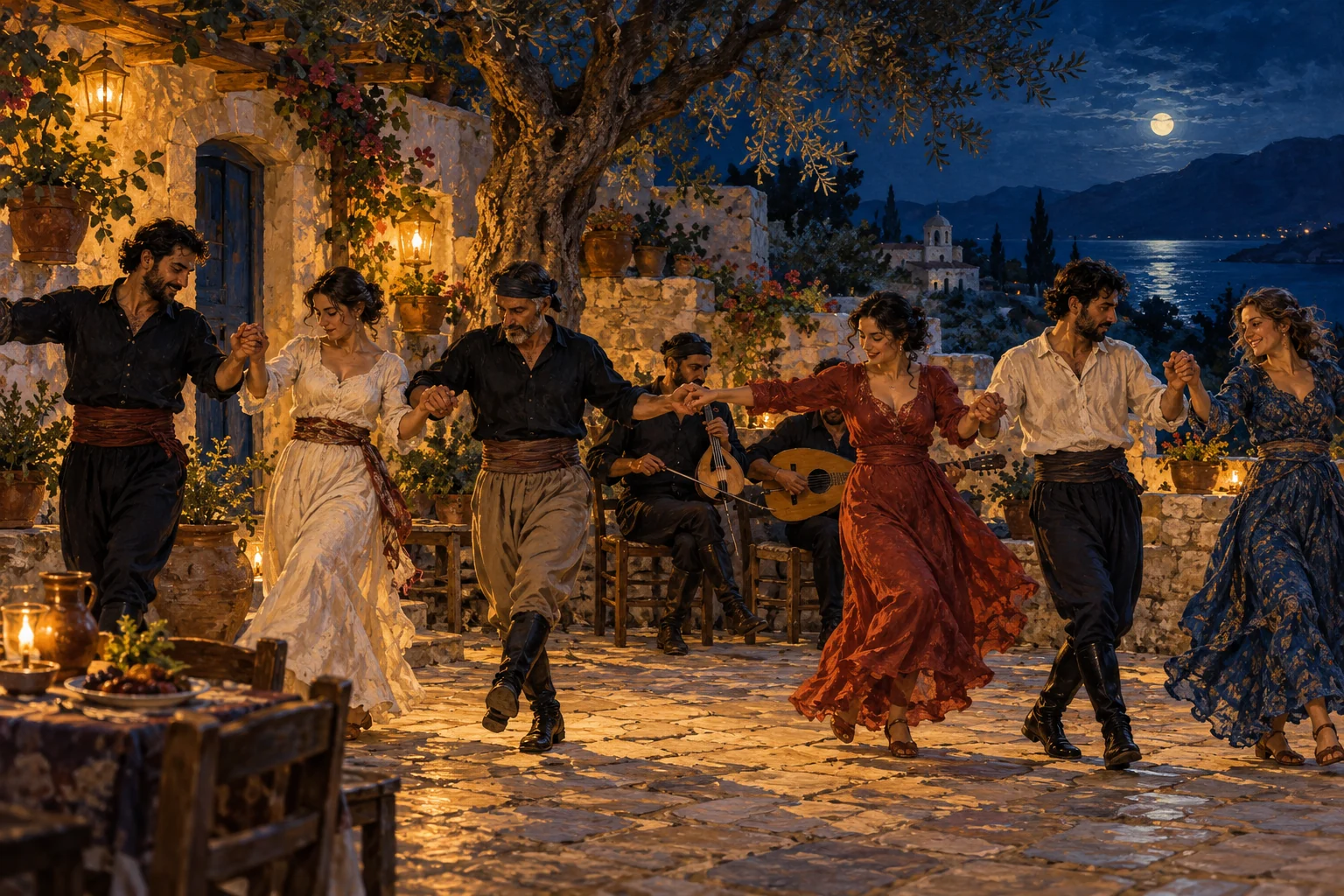
Syrtos is not a name for one identical recording or choreography everywhere. For this dossier we take a concrete Cretan example as entrance: Syrtos Dance of Chania in the West-Kreta-reportage of Domna Samiou. There's Ross Daly playing lyra and Stelios Sergakis on laouto. The registration gives people, places and instruments a name. That's more fruitful than putting all Greek syrtos on the same page from any Internet video. Also a documented execution remains an example with its own choices, not an exhaustive definition of every local custom.
Recognize the musical sentence first
Try humming a piece of melody and stop at the point where it sounds finished for you. Then listen whether the instrument really takes a rest there or immediately put in a new movement. Does the same sentence repeat itself exactly? A short change at the end may be enough to shift expectations. So you develop your own map of the piece without having to name every detail. The card can remain simple: start, continue movement, return. Then it becomes easier to distinguish an ornament from a larger change in the melodic structure.
Follow the attached hands
In a circle or line, the connection between dancers is also information. See how people keep their distance and what happens when the direction changes. A quiet top can go hand in hand with careful footwork. Therefore, do not judge the music solely on the visible effort of one participant. A small movement can fit exactly with a musical emphasis. The dance also tells you where joint security is needed: everyone must be able to expect a recognizable next step. That certainty can create space for personal nuances within the connected form.
The guidance keeps expectations open
At the second listen your attention on the laouto. Find the attacks that mark a starting point for you. Hold that pattern while you listen to the lyra again. Do you hear how the melody leans against the accompaniment, or do you get the feeling she's pulling forward? Such impressions are useful questions for an accurate comparison. They do not need to be immediately transformed into a universal technical rule. The same duo can play in another room or at another time with a different relationship between rest and progress.
Musical placenames are entries
A reference to Chania connects music with a region, but does not make an area a closed box. Players, recordings and melodies travel. Use a place name to search for documentation: who played where, when and with whom? Then watch how a melody is named or performed elsewhere. A map of such concrete data is more reliable than the assumption that each style remains neatly within an administrative limit. In the knowledge universe we therefore connect this file with the landscape and other instruments as a reading route, without making an exclusive origin claim.
An exercise with return
Choose about a minute from the archive example. Write down every time you recognize the beginning of the same musical sentence. Then see what the dancers do at those moments. Do musical and visible return always coincide? Then listen to a pentozali and describe the difference in the words you find most obvious. Maybe it's about tension, length of gestures or the way the guidance makes room. By linking your impression to an audible moment, listening becomes more concrete than a general judgment as cheerful or typically Greek.
Sources & Listen inputs
- Domna Samiou West Crete
Audiovisual fieldwork report, 1976. With Syrtos Dance of Chania and Siganos & Pentozali Dance; names and garrisons per fragment.
- University of Crete traditional melodies and songs
Overview of Cretan singing and dance forms. Historical equations in the source are not independent evidence of continuous pedigree.
Sources checked for 29 October 2026. The listening questions are newly written exercises; they do not attribute a predetermined result to a recording. The external archive pages contain where available their own audio or video.