GREEK PHILOSOPHOBIA · DIVISION
Heraclitus and Parmenides:
An influential contrast that only works when we release the slogans.
Heracletus is often traced back to "alles flowing" and Parmenides to "change" does not exist. Those slogans make a complicated discussion clear, but also misleading. Their texts ask how change, order, perception and thinking relate to each other.
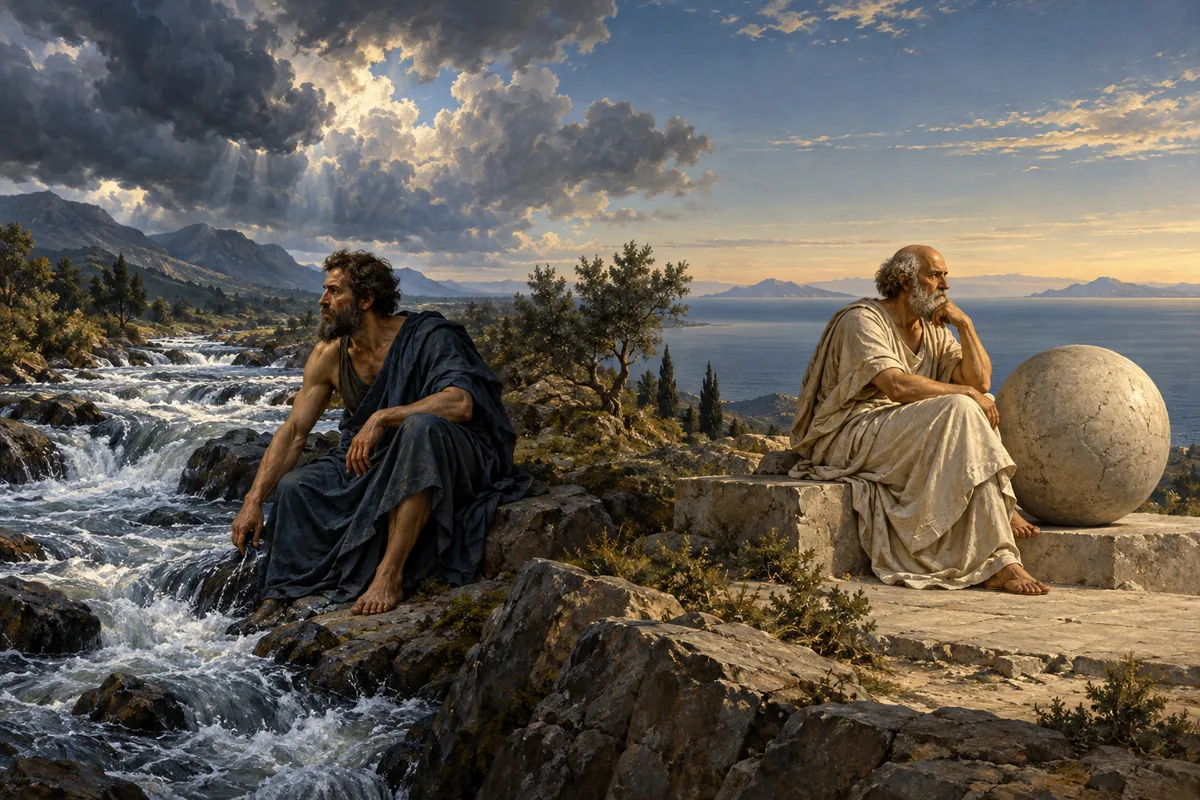
Heraclitus: change with structure
Heraclitus uses images of fire, river and contradictions. His fragments suggest that change is not random: opposites and tensions belong to one order. The word logos can mean reason, pronunciation or coherence; the precise meaning shifts by fragment. Therefore, it is better to read the text rules separately than to attribute one complete theory to them.
The well-known statement that you do not step twice in the same river is handed over in different forms and partly through later authors. She doesn't necessarily mean nothing's stable. A river remains recognizable precisely because water is constantly moving. Heraclitus lets think about identity as a pattern that lasts through change.
Parmenides: what can really be thought?
Parmenide's poem describes a journey and then distinguishes between the path of truth and mortal opinions. The central reasoning sets limits to what can be said about being and not being. If something is real, it cannot simply emerge from nothing or disappear into nothing.
The poem also contains an extensive cosmology, making it too simple to say that Parmenides rejected all perception. His challenge is methodical: let your thinking be guided by what makes an argument necessary, even when sensory experience seems to show something else. Later philosophers had to explain how change can fit that requirement.
A contrast with consequences
Plato and Aristotle later discuss the early thinkers from their own projects. For example, Heraclitus and Parmenides were often placed as opposites: are opposite his, current versus standstill. That contrast has philosophical value, but it is partly a later arrangement of texts that are fragmentary.
The discussion influenced questions about knowledge and reality: is what changes less real? Can a term describe fixed identity? How do senses relate to evidence? Instead of choosing a winner, we can use their tension to explore what kind of change can explain a theory.
View question
Is a person who changes over time the same person? Try to give an answer first with a river-to-water-to-water model and then with a reef-tower-to-water-proof model. What experience explains each model well, and which doesn't?
Sources and read on
- Heraclitus, fragments B 12, B 30, B 50 and B 91; Parmenides, About nature, fragments B 2, B 6, B 8 and B 19.
- Internet Encyclopedia of Philosophy, "Presocratics"