MYTHOLOGY & TRAGEDIA · DIVISION 22 / 40
Prometheus: fire, technology and the responsibility of the maker
Fire as a gift, power demand and reason to think about the responsibility of creators.
Prometheus makes man less defenseless, but his gift reveals a conflict over authority and boundaries. The myth becomes more interesting when we keep different antique versions apart and don't treat technique as progress by itself.
A gift within a battle for power
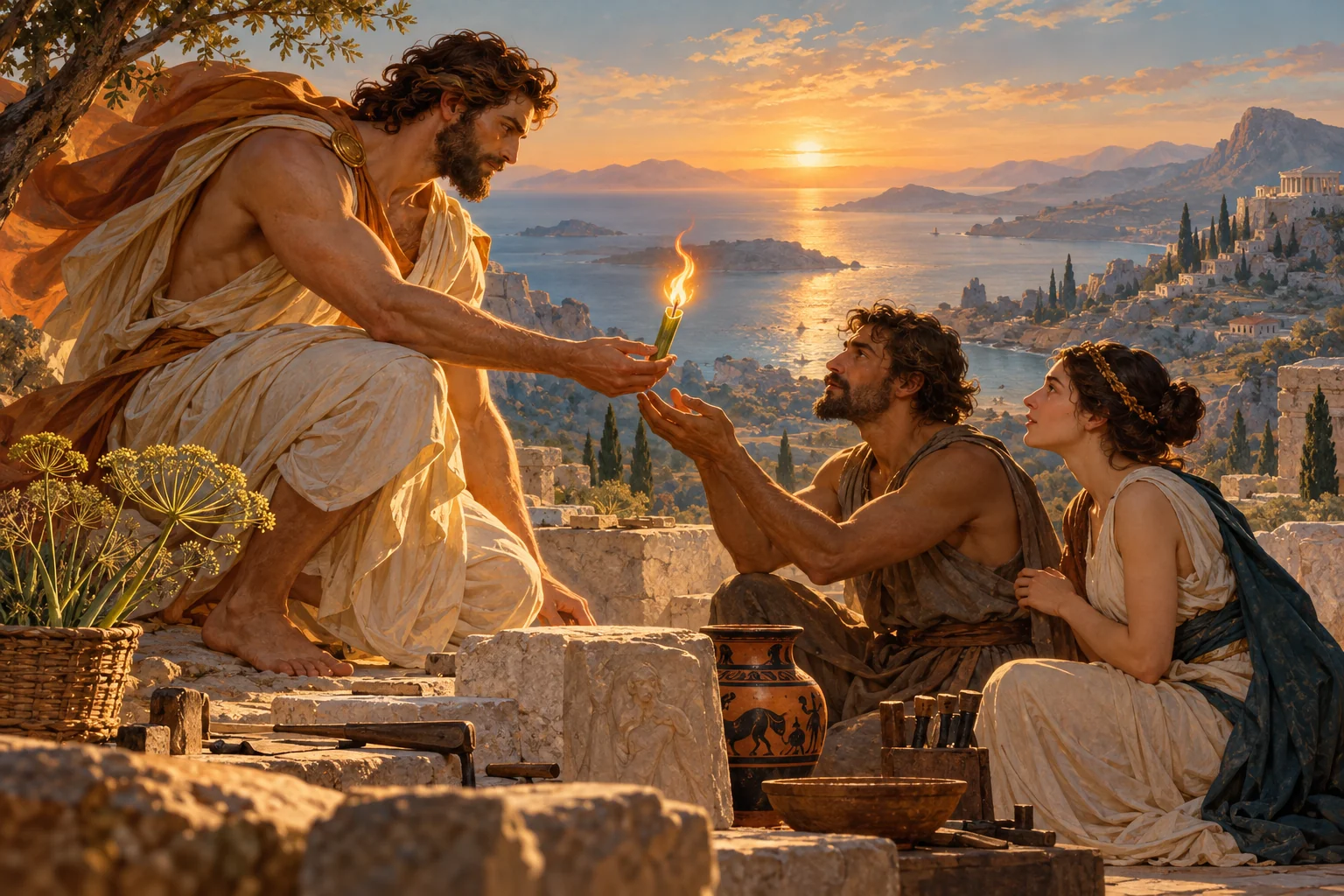
Prometheus and Zeus are involved in a conflict over the distribution of a sacrificial animal. Then follows the remembrance and the stealing of fire. The fire is carried in a hollow plant stem. The punishment of Prometheus and the burden for the people are part of a story in which Zeus' order ultimately prevails. The smart helper there is not simply the undisputed hero of a modern liberation history.
Another emphasis can be found in the tragedy of Prometheus, traditionally attributed to Aeschylus, although authorship is subject to discussion. There Prometheus presents himself as the benefactor who has given people skills and insight. His knowledge not only makes him useful, but also dangerous for a new ruler. When you compare the texts, not only does the amount of information change; also the moral perspective shift.
Which makes the Greek technē visible
The Greek technē includes craftsmanship and skillful, purposeful action. That is wider than what we usually mean by devices or digital technology. Fire can be a useful starting point for thinking about cooking, working and building, but a skill also includes knowledge of materials, conditions and consequences. Anyone who looks only at the object misses the human practice in which it works.
Imagine a tool that performs a task faster. The technical improvement is then clearly measurable. But once you ask who owns it, who can serve it, and who carries the risk derivatives, the discussion changes. The Prometheus-myth does not provide ready-made answers to such contemporary questions. It does deliver a scene in which a wealth is divided and someone else decides whether that division is lawful.
The benefactor is also a narrator
In the tragedy, we hear Prometheus explain his own meaning. That makes his story convincing, but it is also a dramatic voice with interests. A character who says that humanity has learned everything does not automatically speak on behalf of the author. The other voices and the course of the piece also count.
This is a useful exercise in source criticism: distinguish an event, the explanation given by a person concerned and the judgment of a reader. An inventor can honestly say that he helps people, while his invention creates new dependencies at the same time. Testing that tension is not a rejection of craftsmanship. It is a way of taking its responsibility seriously.
Who decides which border is justified?
Crossing a line can be liberating or destructive. Therefore it is too easy to make Prometheus a general rule that resistance is always good or that divine authority is always right. The interesting question is what reasons a ban has. Does it protect vulnerable beings, preserve a monopoly of power, or does it do both?
Read the same scene from three positions. For the people, it counts new power. For the ruler, breaking his decree counts. For the giver, the accuracy of his act counts. This analysis is a contemporary reading proposal. It makes it clear that one act can have different consequences and descriptions without all descriptions being equally strong.
A comparison with Talos and Daidalos
Talos asks which rules a made guard follows; Daidalos shows that craftsmanship creates opportunities and vulnerabilities. Prometheus adds the problem of access. A wealth can free, but who determines the conditions under which others get it? Together, the files form a reading route through technology, artificial life and responsibility.
It is tempting to see a prophecy of artificial intelligence. That would be too much. The ancient texts do not describe modern algorithms. What remains is a philosophical point of comparison: an invention is also a change in the relationship between people, rules and power.
Think on for yourself
Choose one technique you use every day. First, describe the concrete power it adds. Then write down who becomes dependent on who, who can refuse access and who can fix an error. Does your judgment on the gift change when you put that second description next to it?
Sources and read on
- Hesiodus, Theogony
Primary text, 507–616 The offering, the fire and the punishment.
- Prometheus cuffed
Primary tragedy text, traditionally attributed to Aeschylus, including 436–506 about human skills.
Texts consulted on 29 October 2026. The Dutch explanation is new; the source links give access to ancient texts and scientific context.