GREEK MUSIC · DIVISION 13 / 20
Zeibekiko: the space around one dancer
A solo dancer, a musical cycle and the company that makes room.
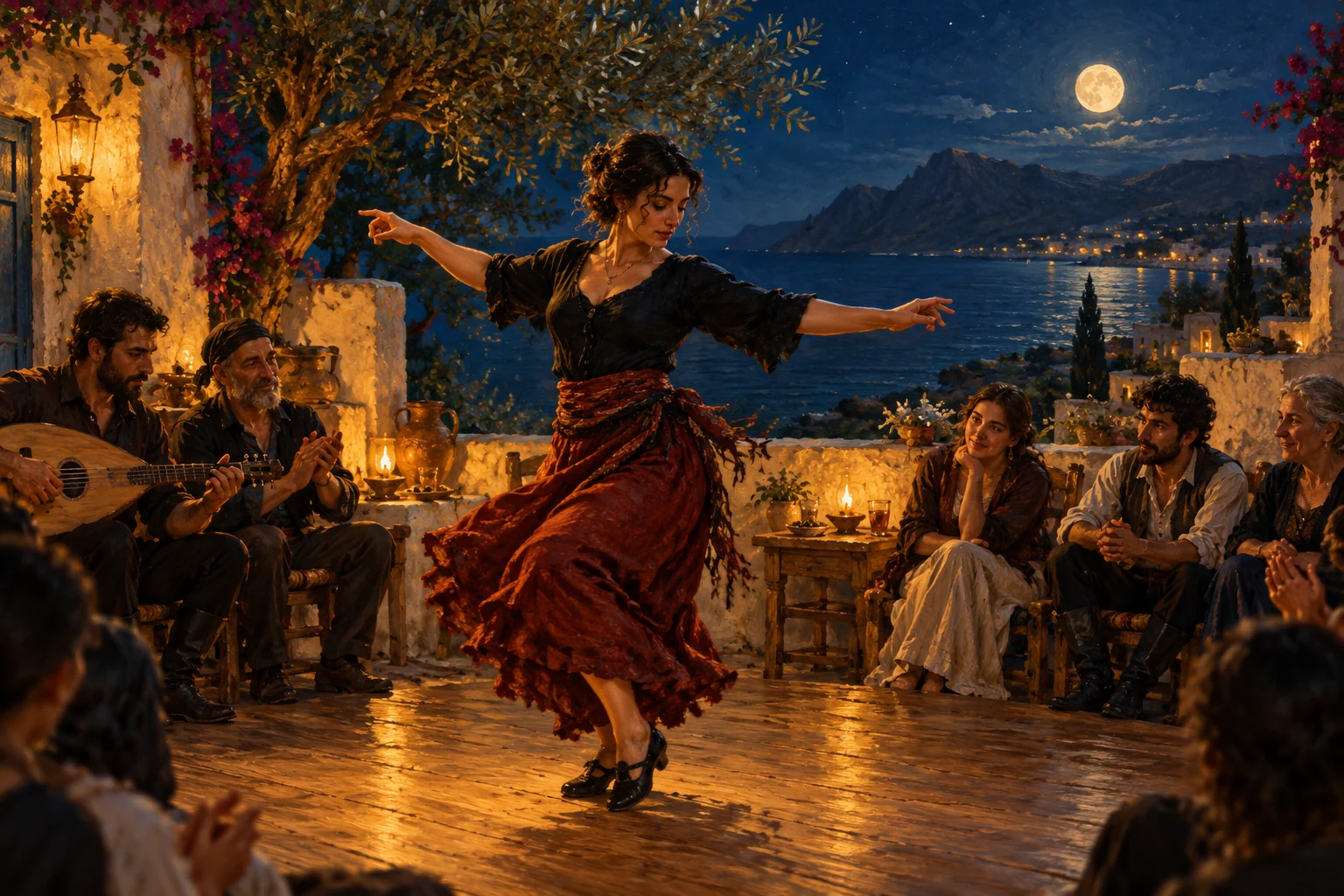
A single dancer can shut up a space. The music gives time, the movement seeks its own relationship and the people around it make room. At zebekiko it is therefore useful not only to look at feet, but also at the attention that surrounds a performance.
A documented family of performances
The Samiou archive contains several zebekiko examples, including material from the musical world of Smyrna. The reportage on Asia Minor shows an old traditional dance style and also documents a performance on a rotating organ. This already makes it clear that one modern stage scene does not exhaust the possibilities. Use a specific recording as starting point and record the specified location and occupation. This file describes listening and viewing questions, no complete dance instruction or universal prescription for how everyone should behave in any Greek entertainment venue.
Learning to hear an uneven cycle
A lot of zebekiko repertoire is described in a nine-eighth measure. For a first round of listens it is more useful to recognize the complete return than to immediately place one count distribution on each example. Look for the accompaniment pattern and tap gently until you hear the same beginning. Where do you experience more weight within that orbit? Compare that to another fragment. The number alone does not yet say how a specific execution is grouped, how heavy the accents are or how the dancer relates to them. These details call for attention over and over again.
The dancer does not have to show every count
A movement can follow, delay or bridge a musical emphasis. Therefore, first look at a whole phrase without constantly counting the feet. Where does the posture change, where is stopped and where does a small gesture take up much space? A pause can have as much tension for a spectator as a great movement. That's an interpretation of what you see, no evidence of what the dancer himself experiences. Keep your description close to the image and leave room for the meaning that the participant would give to it.
The circle of attention
Follow the bystanders a second time. What distance do they leave, when do they react and change their attention during the play? The environment is part of the implementation. A solo doesn't mean the event is separate from other people. At the same time, a filmed situation is not a complete code of conduct. As a visitor, it is better to look at what is happening at the time and follow instructions from the attendees than act on the basis of a list of absolute Internet rules. Respect begins with attention to the concrete people and their shared space.
Another occupation, another look
Compare a recording with strings and cannon with a version in which a bouzouki or other instrument comes forward. First, look for what you recognize as a recurring musical organization. Then describe the difference in sound and emphasis. The instrumentation can strongly guide your first impression, but it is not the only one who determines the social meaning of an execution. Therefore, the names and context remain important in the archive. An unexpected source, such as a spinning organ recording, can also help to investigate familiar assumptions about the obvious occupation of a dance.
Continue listening: sound, body and environment
Make three short notes on one fragment: a musical return, a clear change in attitude and a reaction from someone around it. Do they fall together or do they happen in succession? Then listen to me without a visual. Are you expecting movement in the same place now? Put the fragment next to a Cretan circle dance. Compare how the shared time becomes visible in a connected row and around one dancer. Both situations show that music organises more than just a series of individual steps: the way people give each other space becomes audible and visible.
Sources & Listen inputs
- Domna Samiou, Asia Minor
Own audiovisual archive, with appointed performers, instruments, songs and dance examples from the Lesser Asian music traditions.
- Domna Samiou Ohio My Emigrated Bird
Album documentation and explanation of various dance forms, including zebekiko as solodans.
- University of Adelaide
Research on execution and repertoire; the rhythm table distinguishes for ziebekiko 9 / 4 and 9 / 8. A measure does not in itself determine the execution.
Sources checked for 29 October 2026. The listening questions are newly written exercises; they do not attribute a predetermined result to a recording. The external archive pages contain where available their own audio or video.