KRETA · MYTHOLOGY · DIFFERENCE
De Koureten: dance, shield and protection
Why rhythm in the myth gets a protective force.
The Koureten appear in stories around the young Zeus as protectors making noise with their weapons. But they are more than extras in a birth scene: their dance connects rhythm, community, transition and sacred space.
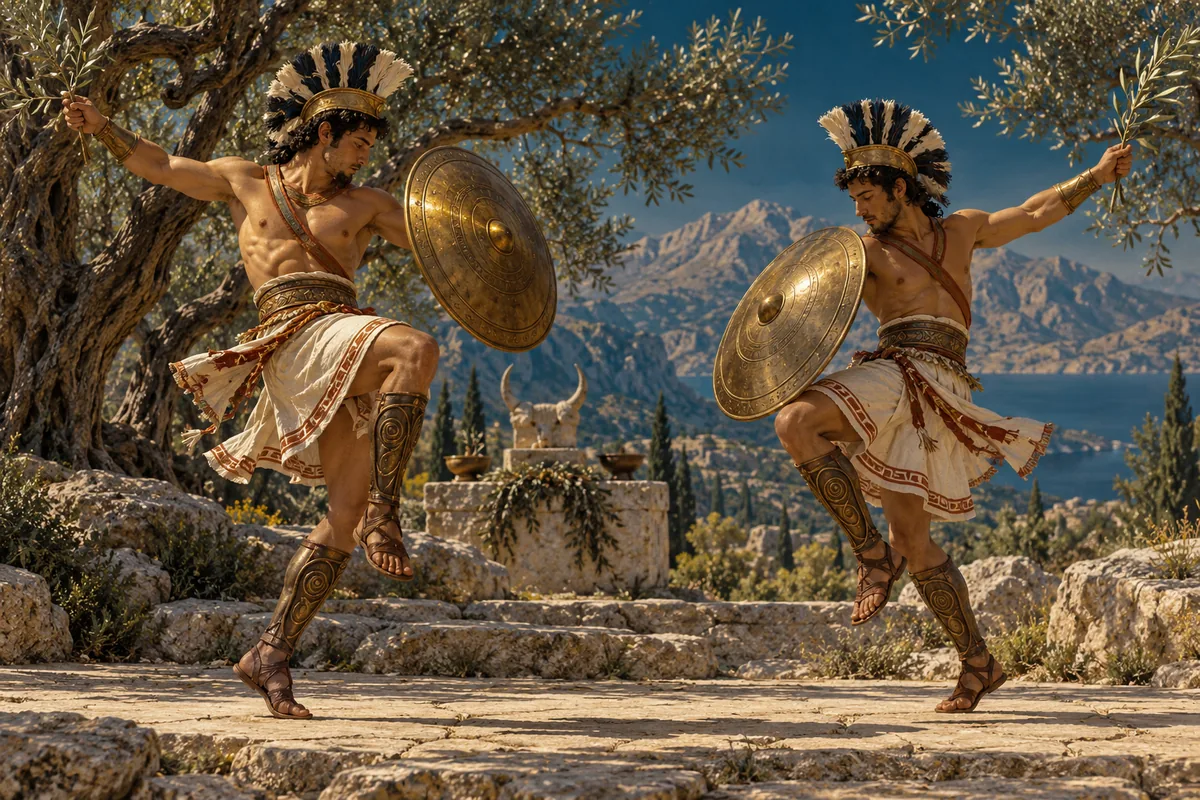
The noise that protects a child
According to a well-known version, the Koureten guarded the cave where Zeus was hidden. They beat with their spears on their shields or danced in circles, so that Kronos could not hear the crying of the baby. The story makes noise into an act with consequences: rhythm creates a protective boundary around fragile life.
Antique authors use different names and traditions for Koureten, Korybanten and other armed dancers. These groups are regularly linked in later literature, but are not identical everywhere. Anyone who explains all the names as one fixed ritual erases local differences and historical changes.
Ritual as joint technique
A group dance requires repetition, size and mutual attention. In myth, this coordination is a kind of collective technique: the dancers together make a sound that guards a limit. Their individual movement gets meaning because others answer the same rhythm.
On the Ida cave bronze objects were found that were linked to the Koureten and the protection of Zeus in later traditions. A museum object shows how myth, cult and image can affect each other. However, an image on an object is not automatically an exact recording of a historical ritual.
Dance, maturity and identity
In broader Greek traditions armed dances could be linked to masculinity, military training or transition to adulthood. The precise interpretation varies from place to time. It is therefore better to speak about possible functions than to give one universal explanation for all Kouret rituals.
The myth of Zeus' protection shows a political thought at the same time: a community protects its future by acting together. The king becomes powerful later, but as a child he depends on others. The dancers make it clear that authority is not only from divine origin, but also from care, organization and shared effort.
View question
What sounds and rhythms form a community today? Compare a ritual dance with a choir, march or sports gallery and pay attention to what makes it possible to move together and what limits it draws.
Sources and read on
- Callimachus, Hymne to Zeus 46–55; Diodorus Siculus 5.70.
- Heraklion Archaeological Museum,.