THE LIVE KRETA · Village & ceramics
Margarites: the village behind the pottery
From clay mass and rotary disc to storage vessel and village history.
Added: · approx. 6 minutes read · 8 chapters
1. Viewing a village from the studio
Margarites gets the label potter village easily in tourist descriptions. That is a useful start, but a rich file asks more: what work lies behind the vases displayed, how do consumer goods and decoration relate to each other and what do the workshops tell about the surrounding countryside? Instead of a list of stores, we follow the path from material to object and object to household.
Visit Greece describes Margarites as a traditional ceramic centre in the Mylopotamos region. The village is therefore a concrete starting point for the wider craft file. A visit to a workshop can shift the focus from a general image of Crete to a specific action: centering, pulling, cutting, drying or finishing. [1]
2. No simple straight line from the Minors to today
Old and new earthenware shapes can resemble one another. A container will benefit from sufficient content and a stable soil. However, agreement in form is not the same as proof that a family workplace exists continuously for thousands of years. Techniques, industrial relations, furnaces, raw materials and markets can change while some functions remain recognizable.
The Cretan Ethnological Museum documents both the diversity of pottery and the former organization of pottery. That's a better basis than the loose claim that everything here is unchanged Minoan. In a historical story, always ask: are these archaeological finds, a documented professional practice or the current interpretation of a creator? All three of them may be interesting, but they provide different evidence. [2]
3. The journey of a piece of clay
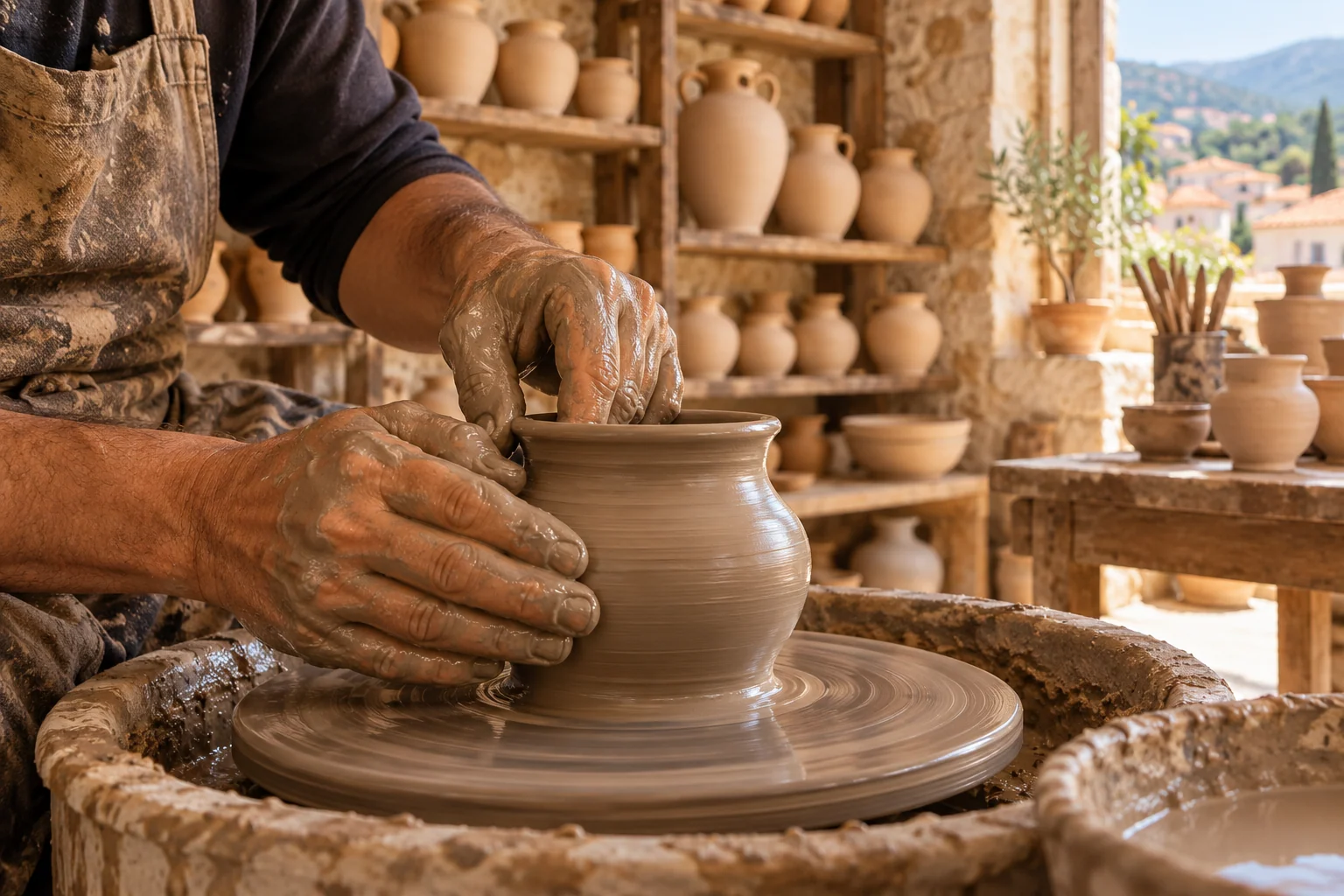
A general ceramic work order begins with a suitable clay mass. Air, humidity and composition influence the processing. Afterwards, the object takes shape, for example on a rotary disc or by building it. After forming follow drying time and any post-processing. Only when the material is suitable can it be baked. Depending on technique and finishing, more than one baking tray may be required.
This order is a bookmark for a demonstration, not a recipe for a particular Margaritian clay. Oven temperatures and working methods differ. It's just these differences that are good conversational. Ask why a maker lets a part stiffen first or makes a handle separately. The answer shows how experience supports an apparently simple movement.
4. Turning is also listening to the material
On a rotary disc you see extraordinary speed: a low mass becomes a bowl, a neck becomes narrower and an edge gets a lip. Still, it's not just about manual skill. The clay offers resistance and can deform due to too much water or uneven pressure. A maker anticipates that. Therefore look at the rhythm of an action: when is stopped, moistened or just waiting?
A finished object hides many of those decisions. The difference between a demonstration and daily production work is also relevant. A visitor may see one small object emerge, while the normal work consists of a series of similar parts. An honest studio story can show both without setting the one form of work as less authentic.
5. Pitharia and household
A large container, often referred to as pithari, makes the connection with agriculture visible. With a barrel, you want to know what was kept in it, how it was sealed off, whether it was moved and how the contents were removed. Shape and use are part of each other. A narrow opening is something other than a wide ridge; a heavy foot has an impact on transport and layout.
The museum describes a historical practice in which groups of creators moved from Margarites and Thrapsano to other places on a seasonal basis. This limited the problems of transporting large pottery. We take this example because it makes the craft an economic and geographical story, rather than just a decorative image. [2]
6. Workshop and landscape
Information from the UNESCO Sites network in Crete connects pottery practice in Margarites with the availability of clay and water. That link shows why a material history is also a landscape story. It doesn't mean that every modern studio uses only raw materials from the immediate environment; you have to ask each maker. [3]
During a walk, also look at building materials, storage space and the transition between street and workshop. Where is vulnerable work, where can visitors come and where is rest needed? These are editorial observation questions. They do not give a right to enter private areas, but help to view a public street image more carefully.
7. Judging a bowl without playing judge
| Component | What you can explore | Which doesn't just distract you from appearances. |
|---|---|---|
| Soil | Stability, foot and finish | Suitability for a given heat source |
| Border | Drinking comfort or direction | Food safety of the glaze |
| Wall | Weight and evenness | The exact baking temperature |
| Decoration | Technique, repetition and handwriting | An exact age or family line |
Ask about the intended use and maintenance instructions for use. A decorative can not be a drinking water can. An oven-proof dish is not a self-evident cooking pan. The maker can usually explain these differences much better than a visual inspection by a visitor.
8. A quiet reading route through Mylopotamos
Combine the file with the general story about crafts and the existing village page. The official tourism portal also mentions connections with Eleutherna and Arkadi. These are substantive points of reference, not a promise that all locations can be combined quietly in one day. Opening, distance, interest and travel time deserve their own consideration. [1]
The core of the visit remains small: understanding one technique, asking one material question and learning to read one object. This gives Margarites more depth than a street full of ceramics. It will be a place where you can see how knowledge is stored in hands, tools and made things at the same time.
Sources and read on
Sources consulted for this edition on 30 October 2026. Historical publications and dated project descriptions are not a live state of affairs. The practical questions of viewing and research are our editorial reader.