KRETA · MYTHOLOGY · DIFFERENCE
Ariadne: thread, choice and different endings
Why the woman pointing the way out is left behind herself.
Ariadne helps Theseus leave the Labyrinth, but her story doesn't end when the hero escapes. Antique versions give her different destinations. Ariadne becomes a figure in questions about knowledge, loyalty, being abandoned and the right to a life of her own.
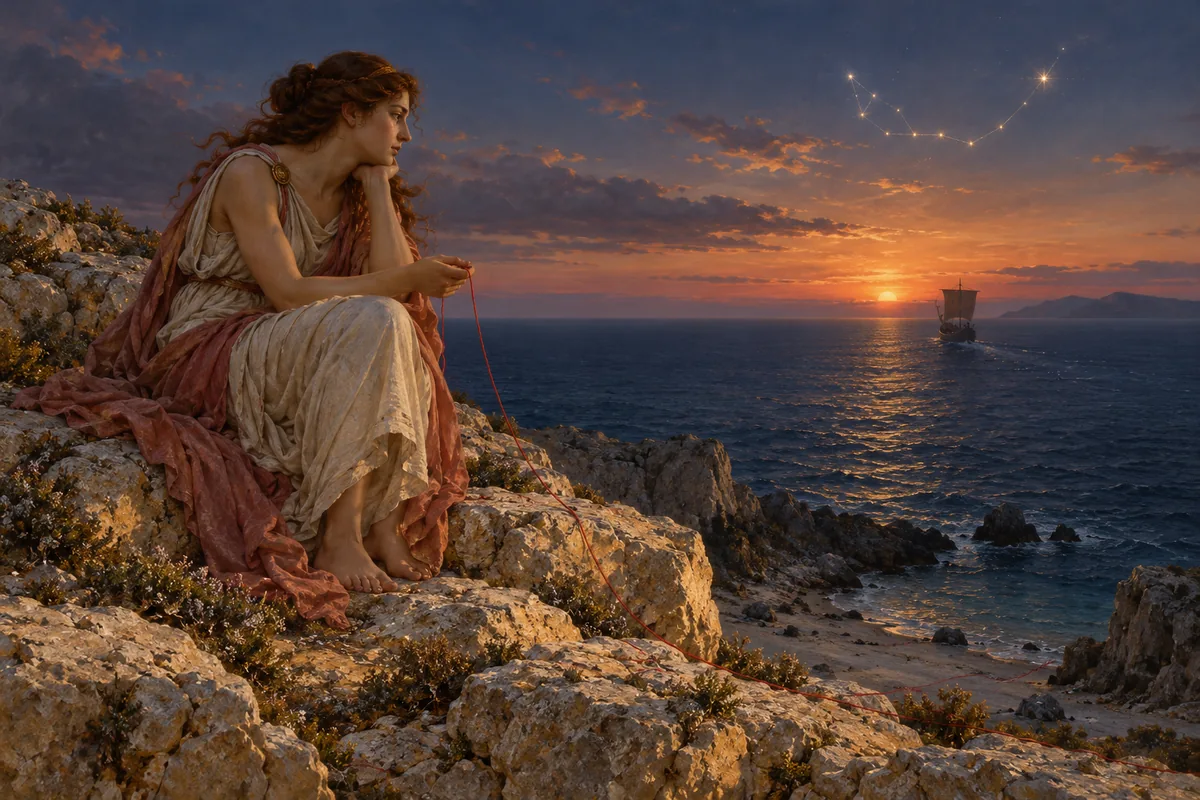
The thread as knowledge
Ariadne gives Theseus in the best known version a wire or claws with which he can find the exit after killing the Minotauros. The object does little without a plan: someone must remember the starting point, carefully celebrate the line and dare to follow the way back. The wire represents knowledge that remains usable during a risky journey.
The story divides the roles unequally. Theseus often gets the title hero, while Ariadne delivers the information and the practical solution. In modern retelling, her ability to act becomes more central. However, we must be careful not to treat the old text as if it had already formulated a modern plea for individual autonomy.
Naxos and the different versions
After the flight from Crete, Ariadne is left behind on Naxos in many well-known versions. Some authors make theseus... departure a betrayal or oblivion; others tell a sacrifice or divine decree. Then Dionysos appears, who marries her or takes her in another way into his divine atmosphere.
In the Odyssey, Ariadne occurs in the underworld, while later poetry depicts her desertion. The stories don't necessarily collide because there has to be one original version that we can find. Mythen lived through singing, theatre, image and local narrative, and different audiences could know different endings.
From Princess to Constellation
In some later traditions, Ariadne's crown is placed in the sky. That image turns desertion into cosmic memory: a personal destiny takes a place in the stars. On Roman sarcophagus the sleeping Ariadne appears next to scenes from the story of Theseus; the image can simultaneously refer to love, death and change.
In every medium, the accent shifts. The vase painting emphasizes the moment of giving, the tragedy can work out the conflict, and the Roman sarcophagus connects the story with mortality. The myth is therefore not only a series of events, but also a history of reinterpreting.
View question
When someone delivers the solution but then disappears from the story, who gets the credit? Read Ariadne's help alongside the versions in which Theseus leaves her and ask what action a narrator appoints as heroic act.
Sources and read on
- Homer, Odyssey 11.321–325; Catullus, Carmen 64; Ovidius, Metamorphosen 8 and 10.
- The Metropolitan Museum of Art, sarcophagus with Theseus and Ariadne