NARRATOR CHARGE · DIFFERENCE
The Kri-kri: the agrimi of Crete
Bergland, genetic history and protection of a special island animal.
Added: · approx. 9 minutes read · 11 chapters
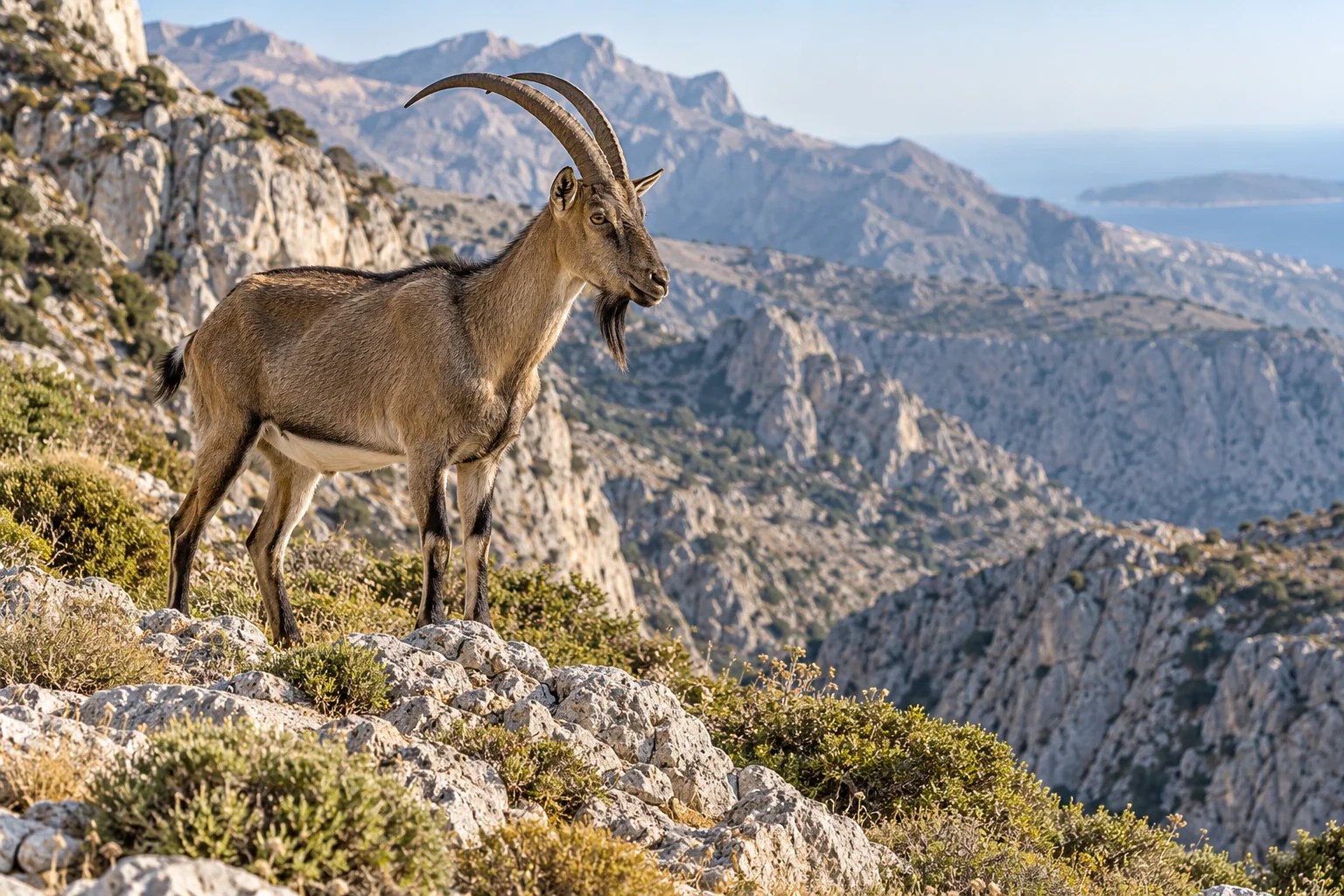
1. An animal belonging to the mountain land
Between the light rocks of the Lefka Ori, a movement can begin almost invisible: a head rotates, a dark backline appears and a goat steps over a ledge that seems impenetrable to a hiker. The kri-kri is one of the most recognizable animals in Crete. The names agrimi and Cretan wild goat are also used for it. The mountain land of West Crete, with the Samaria gorge, is at the heart of the well-known range. [1]
The animal deserves more attention than a quick mention as an island mascot. His history is about human migration, animals traveling with humans, the emergence of island populations and the question of what exactly we want to preserve. A name on a sign seems definitive; biological research can show just how many questions behind that name are hidden.
Moreover, anyone who sees the animal during a walk does not meet a set piece. It's looking for food, guarding distance and responding to people. A good perception therefore begins with standing still and giving space. The most beautiful meeting is not necessarily the closest.
2. Capra aegagrus cretica: a name with history
The common scientific indication is Capra aegagrus cretica. Capra is the genus of goats; the combination with aegagrus traditionally places the animal in the wild bezoargeit. The name cretica refers to Crete. In older natural historic descriptions, the agrimi appears as a subspecies of a wild goat. [2]
That classification is not undisputed. Bar-Gal and colleagues investigated mitochondrial DNA and published in 2002 evidence that the agrimi was genetically closer to domestic goats than to the investigated Asian wild bezoar goats. The researchers advocated revision of the taxonomic classification. The research is about pedigree; it does not mean that a kri-kri on a mountain wall behaves like a contemporary milk goat. [2]
A careful description uses the known name as a landmark and at the same time tells that origin and classification are subject of research. Italic writing of a Latin name does not reduce uncertainty.
3. Wild, wild and yet safe
The IUCN discusses the goats of different Mediterranean islands as populations with a history of human introduction and wildlife. This calls for restraint when proposing the kri-kri as a directly remaining, never domesticated wild subspecies. Moreover, the assessment of Capra aegagrus as a whole is not a separate census or current threat assessment of only the Cretan animals. [3]
For nature management, descent and value are different questions. A population can have an old relationship with people and yet have a special local history, genetic composition and ecological significance. The answer to a taxonomic question does not, therefore, determine which management is desirable.
The word native also requires precision. Do we mean to arrive without human help, present for thousands of years or culturally inseparable from the island? Those are different statements. In the case of kri-kri, it makes more sense to explain the history in question than to close the conversation with a single label.
4. How do you recognize an agrimi?
The historical parkbook describes a brown to grey-brown coat, dark drawing and backwards curved horns. Both sexes can wear horns; in adult males they are usually heavier and more striking. Age, gender and season influence the appearance. Only a picture of the coat is therefore not conclusive evidence of genetic identity. [4]
Look at the whole animal: physique, posture, horn shape and movement. An animal in the distance may seem smaller by perspective, while bright sunlight makes dark stripes disappear. Rather take a quiet overview photo than climb closer to see one detail.
The cover on this file is an AI atmosphere illustration. She depicts a goat in a Cretan mountain landscape and is not a determination plate, geometrically correct reconstruction or proof of a real perception.
5. Living between rocks and vegetation
A mountain wall is more than stone. Richels, shrubs, sheltered areas and transitions between open and overgrown terrain together form a habitat. For a visitor especially the spectacular climb seems important; for the animal also count peace and accessibility of food.
The historical management book describes seasonal reproduction, with mating in autumn and births in spring. Young animals and lactating females have different needs than a single moving adult male. A picture of a group in one morning therefore tells little about the entire annual cycle. [4]
Avoid human explanations such as stubbornness or bravado. An animal that stays standing can observe, hesitate or assess an escape route. His behavior is not an invitation to a selfie.
6. Samaria and other populations
The agrimi is strongly linked to Samaria, but there are also island populations with their own introduction and management history. A scientific discussion of island goats shows that such groups cannot simply be treated as identical copies of one original population. Origin and exchange between groups are relevant for interpretation. [5]
A reserve on a small island can offer protection while raising new questions: how much space is available, which animals have been reproduced and how much genetic variation remains? The number of visible animals alone does not answer that.
For visitors, this means that the location matters. An observation at a hiking trail, on an island reserve or behind a fence has a different context. Note that context when sharing photos and avoid moving animal locations to a more beautiful sounding destination.
7. Why genetic research remains necessary
Research by the Natural History Museum of Crete focuses on genetic differences between wild, domestic and mixed goat populations. The project described uses genetic techniques to better understand kinship, potential hybridization and population structure. A project description tells what is being studied; it is not yet a finished result for every animal in Crete. [6]
That distinction is important for headlines on purity. Management is not about a simple appearance label. Genetic variation, pedigree and the choice of comparative material require expert interpretation. A goat with impressive horns cannot be declared genetically pure.
New research can refine the description. That is not an attack on the meaning of the agrimi, but a way to better understand its history.
8. Threats without false precision
Historical park documentation mentions, among other things, illegal hunting, crossing with domestic goats, fragmentation and problems associated with small populations. Those factors explain why protection means more than drawing a park border. [4]
This file deliberately does not give a seemingly up-to-date population figure based on an old book. A reliable estimate requires a date, demarcation and method. Is it the Lefka Ori, all the free living groups or also animals in managed reserves? Without that information, two numbers are difficult to compare.
The same applies to success stories. More observations along a pressure path need not mean growth of the total population. Animals can become more visible, observers more numerous or routes distributed differently.
9. That's how you look with attention.
Stay on permitted routes and use distance as a starting point. A binocular often makes more difference than an extra step. Do not feed, try not to lure animals and let them choose their own direction. A young animal requires extra restraint: an invisible mother can be nearby.
Come an animal to a resting place, keep food stored away. It shouldn't be taught that hikers are a predictable source of food. Also avoid blocking a narrow passage to take a photo. You have a travel plan; the animal has a habitat.
Before visiting, check the current information from the management organisation. The former Samaria website is a valuable archive, but current access and security information belong to the current administrator NECCA. The conditions of a mountain route can change. [7]
10. A symbol with a living future
The agrimi can be an entrance to a larger story about Crete: islands are not closed time capsules, but landscapes formed by nature and human movements. The special is not only in alleged immutability. A complicated history also deserves protection and curiosity.
Anyone who looks further after a meeting with the kri-kri might see more: the shrub on a ledge, a damaged path, the distance between a herd of domestic goats and a protected area. Natural knowledge often starts with one striking animal and grows through attention to the environment.
11. Frequently asked questions
Is the kri-kri the same as every goat in Crete?
No. The name refers to specific populations with a special history. In Crete there are also domestic goats and free-running goats. An observation alone proves no pedigree.
Is Capra aegagrus cretica the undisputed division?
No. It is the well-known traditional term, but genetic research makes the relationship with domesticated goats an important part of the story. [2]
Do you see them guaranteed in Samaria?
No. Visiting a habitat does not guarantee an observation. Access, route and conditions must also be checked separately.
Why not a current number of animals?
Because the historical numbers consulted do not count reliably for 2026 Forms. An exact number without a recent source would give an incorrect assurance.
Sources and read on
Consulted for this edition on 30 October 2026. Historical descriptions, scientific research and current public sector information have different functions. Practical home recipes and editorial advice are where indicated own effects.
- Samaria · Fauna (historical management archive)
- Bar-Gal and Others ( 2002 ) · Genetic evidence for the origin of the agrimi goat
- IUCN ( 2020 ) · Capra aegagrus: assessment and taxonomical comments
- Samaria National Park · English-language parkbook, historical backdrop
- Human Evolution ( 2006 ) · Genetic history of island goats
- Natural History Museum Crete · Research project genetic diversity and hybridization.
- NECCA · Current management unit Samaria and western Crete