THE LIVE KRETA · Nature up close
Small animals, big stories
Geckos, lizards, insects and the nature of a stone wall.
Added: · approx. 8 minutes read · 11 chapters
1. Nature at the eye level of a wall
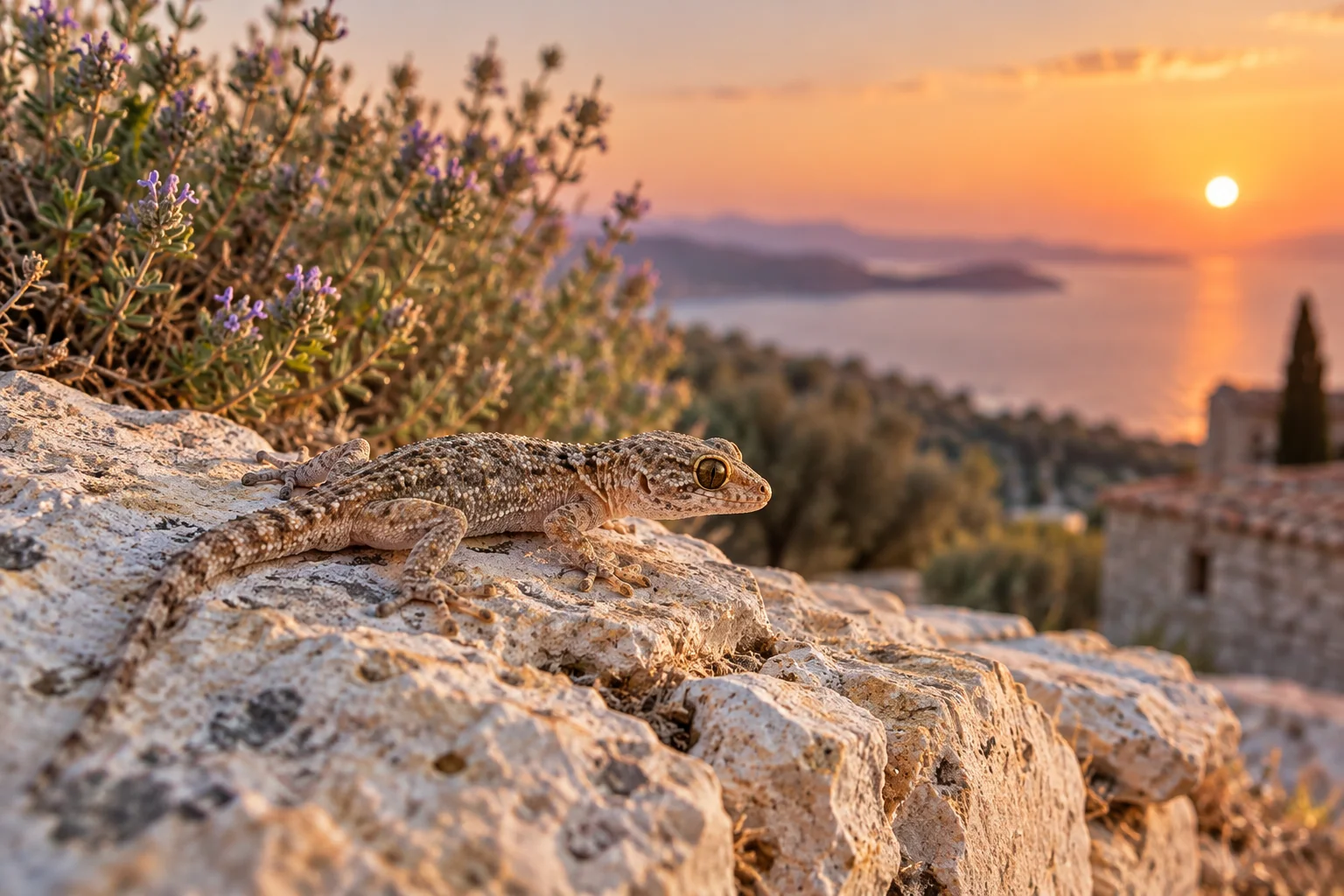
A gecko by a lamp, a beetle on a path and a snail in a damp niche show a different side of Crete than the large landscapes. This file focuses on small animals and the worlds in which they live. It is an introduction to groups, habitats and responsible observation, not a complete determination key and not a guide that declares unknown animals harmless.
The image above the article is an illustrative gecko, not a controlled type photograph. For recognition we refer to the Natural History Museum of Crete and other documented sources. Especially in small animals, related species can be very similar; a striking colour is rarely sufficient for a certain name.
2. Endemic means place bound
An endemic species occurs naturally only in a limited area. That area could be an island, but it could also be part of a mountain massif. The concept itself does not say that an animal is general everywhere within that area. Conversely, a much seen animal can also occur outside Crete and thus not be endemic.
The regional nature portal emphasises that many of Crete's special species are invertebrates. If you only look at the largest or most photogenic animals, you will miss an important part of the island story. In this file we do not use undated total figures as current species inventory; taxonomy and knowledge of dissemination change. [1]
3. Gekko, lizard or something?
A first award can be based on body shape, movement and place. An animal that climbs on a wall requires different attention than an animal that shoots low over a sunny bottom. But behavior is not a waterproof dividing line. Take a remote photo and describe what you really see: toes, tail, back drawing and construction of the head.
The museum archive documents the Cretan wall lizard, Podarcis cretensis, as an endemic species. That's a good source to study a real photo with reliable naming. The name is not a label for every little lizard on the island. Distribution and species characteristics must be compatible. [2]
4. Names to compare with real source photos
The fauna information of Psiloritis mentions several reptiles, while the museum shows the Cretan wall lizard with documented photos. The table gives a limited name window; it does not make a complete list of all species on Crete and is not a recognition key. Use appearance, location and specialist resources together. [2] [4]
| Animal or group | Scientific name in the source | What you need to remember |
|---|---|---|
| Cretan wall lizard | Podarcis cretensis | Islandsdemic; not every small lizard is this species |
| Mediterranean house gecko | Hemidactylus turcicus | Compare with real source photos; the hero is illustrative |
| Snakes | Multiple species | A remote name requires more than one colour characteristic |
| Bats | Chiroptera, an order | Do not disturb caves and shelters |
These scientific names help to retrieve information. They do not give permission to handle animals and do not say anything about their presence on one yard or walking path without additional information.
5. An example of changing biodiversity
IUCN SOS describes a project of the University of Crete around the Italian wall lizard, Podarcis siculus, in Chania. The project page mentions location next to the native Cretan wall lizard and research into origin and possible consequences. The above project period is: 2026–2027; this is a dated project description, not a today's distribution card that we have confirmed. [3]
This example shows that the animal world is not a closed historical scene. Transport and other human activities can create new contacts. A visitor can handle this very carefully by not catching, moving or releasing animals elsewhere. Professional measures require expertise and permission; a photo with location data is something other than self intervention.
6. Insects: first look at construction and behaviour
With an insect you can start with the body parts, the legs and the way wings are worn. An animal on a flower can seek food, rest or hunt for something else. You can't always derive that from one still image. And not every little flying animal that visits a flower is a bee.
Take your time to follow an action. Does the animal stay in one place, touch multiple flowers or disappear under a leaf? Such observations tell us something about relationships in the habitat, even when a species name is missing. The aim is to combine curiosity with accuracy, not to produce a list of certain names as long as possible.
7. Snails and other small soil dwellers
A damp shade can accommodate animals other than an open, dry wall. The folded leaf edge, a crack in stone or a bottom layer with plant residues forms a living environment on a small scale. The fauna information of Psiloritis includes snails, beetles and other invertebrates, including locally limited forms. This illustrates why micro-living areas deserve protection. [4]
Don't loosen rocks and bark for a photo. That's exactly how you change the shelter you want to investigate. Also empty houses can be part of ecological and scientific processes; there is no need to take them with you to keep an observation. A photo of cottage and surroundings often tells more than a separate object without a location context.
8. Amphibians: water in the small-animal story
The municipality of Sfakia describes, among other things, the Cretan frog, Pelophylax cretensis, as an island demographic. A species connected to water shows why sources and wet spots have a different nature story than dry slopes. In addition, an artificial water point can have a different function and accessibility than a natural pool. [5]
Do not transfer animals from one water to another and do not go through vegetation along shores to get closer. Looking from an existing access often gets enough. Write down if you saw an animal, only heard a sound or just suspected it was present. That difference prevents a personal report from being read later as a certain type of notification.
9. Underground is small often exceptional
Caves are not only geological spaces but also habitats. Sitia's geopark information highlights research into underground nature and the protection of caves. Darkness, humidity and food availability constitute conditions that can be very different from the outside world. A visible opening therefore does not mean that walking freely or additional lighting is without consequences. [6]
For the visitor, the most important step is to choose an official, permitted form of visit. A photo of an unknown cave gives no reason to go further into an unfurnished cave. Our existing file on the caves at Pefki offers a geographical connection; current access and guidance should be checked separately.
10. A little field guide for your own notes
| Observation | Capture | Avoid |
|---|---|---|
| Animal on a wall | Global size, posture, place and time | Catch to view the bottom |
| Bug on a flower | Flower, behavior and multiple viewing angles | A generic name by color only |
| Snail or cottage | Context and shape on a photo | Take it without need |
| Animal by water | Range of observation and habitat | Move to another pool |
| Unknown animal | Uncertainty and a safe distance | Touch to test if it's dangerous |
11. The Value of Slow Watching
A square, olive grove or garden can suddenly become richer when you shift attention to a smaller scale. That doesn't require any special means of capture. A quiet posture, a camera and a note are enough for an initial research question.
Connect the small animals to our files on birds, geoparks and water. A stone wall is both geology and hiding place; a wet niche is both hydrology and habitat. Thus, the island does not appear as a collection of loose species, but as a network of conditions in which living beings seek their own place.
Sources and read on
Sources consulted for this edition on 30 October 2026. Historical publications and dated project descriptions are not a live state of affairs. The practical questions of viewing and research are our editorial reader.