THE LIVE KRETA · Nature & birds
Birds above Crete: from vultures to migratory birds
Air currents, habitats and the art of looking carefully.
Added: · approx. 8 minutes read · 11 chapters
1. Seeing an island through the sky above
Those who look at a mountain wall in Crete sometimes see nothing at first and then suddenly a dark form that wins height without visible effort. Birds make air currents, food areas and seasons visible. This dossier offers an entrance to that landscape: large gliders, smaller birds of prey, waterbirds and migratory birds. It is not a complete species list and no guarantee that a species can be seen in one place on a particular day.
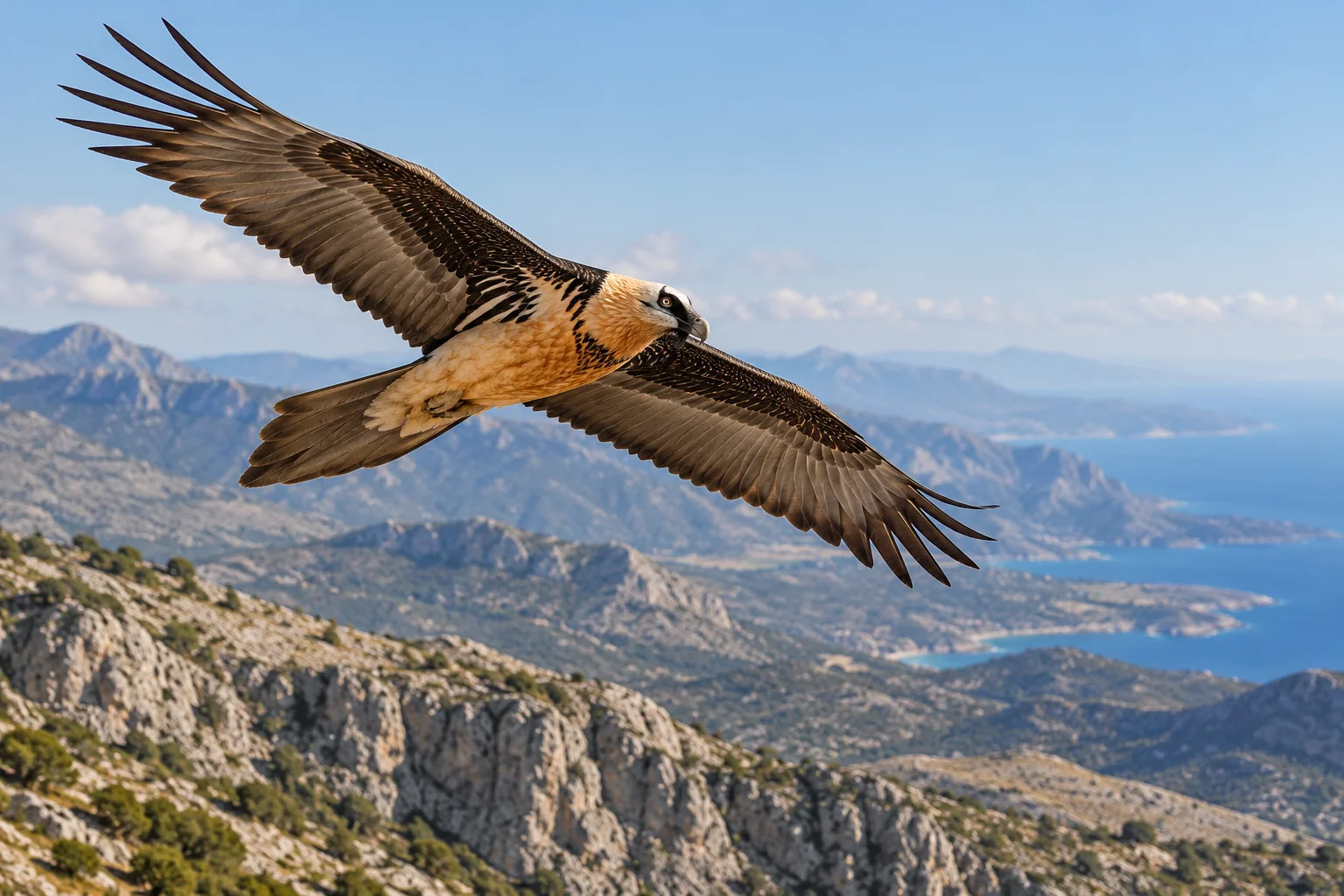
The starting point is to observe before naming. Note how a bird flies, what shape the wings and tail have and in what environment it occurs. A certain description without generic name is more valuable than a definite name based mainly on wishful thinking. The AI illustration above this file is atmospheric; use real field guides and documented photos for determination.
2. Vale vulture and lamb vulture are different birds
The vale vulture, Gyps fulvus, and the lamb vulture, Gypaetus barbatus, are easily mixed up when only the size stands out. In general, a vulture has wide wings and a relatively short tail; the adult vulture has a remarkably longer diamond-shaped tail. However, age, angle of view, distance and light can greatly change the image. Use multiple attributes together. [1]
The ornithological guide of the region is a useful beginning for species and habitats. Publication figures have their own reference date. We're not taking them over as a current population gauge. For protection, it is more important to understand that fixed nesting sites, sufficient food and a safe foraging area must function together than one undated number. [1]
3. Floating is a way of traveling
A large bird can use rising air to gain altitude and then glide further. That's why you sometimes see circling groups. That doesn't automatically mean there's a nest or cadaver underneath that place. The air can simply be beneficial there. A bird that flies long above a slope can also use air forced up by the relief.
Therefore look not only at the bird but also at the landscape. Where are steep walls, open slopes and sheltered valleys? How does the wind change direction? These are general observation questions; they do not replace local weather assessment. A good bird's view can be in an unsafe place. Stay on accessible paths and keep your attention to terrain and traffic.
4. The mountain land as a coherent habitat
The geopark Psiloritis describes a bird world with vultures and several birds of prey. The value of such an area is not only in the nest wall. A bird can use other parts of the landscape for food. This helps to understand why an apparently small intervention outside a breeding site can be ecologically relevant. [2]
Do not record exact nesting locations in a public travel report. An attractive photo can unintentionally send extra visits to a vulnerable place. Binoculars often make more possible than walking closer. If birds change their behavior because of your presence, distance is the meaningful response; the photo is not the measure of a successful encounter.
5. Not every bird of prey is an eagle
With a fast passing bird, size is difficult to estimate. Without a fixed comparison, a small bird can seem larger than a large far away. Therefore, pay attention to proportions: tail length relative to the wings, shape of the wing tips, variation of glide and wing strokes, and posture during circling.
If in doubt, make a sketch or a short description before opening a guide. Otherwise, there's a chance you're gonna unknowingly remember characteristics that fit an chosen species. The best field notes also contain uncertainty: backlight, seen only a few seconds or only from below. Uncertainty is part of quality here.
6. More birds of prey in the source description
In addition to the two vultures, the fauna information of Psiloritis also mentions the species below. The table is a name and observation help. It does not contain any exact nesting sites, and presence in the area description guarantees no observation on a chosen route. [2]
| Dutch name | Scientific name | First observation question |
|---|---|---|
| Stone eagle | Aquila chrysaetos | What is the ratio between wing width and tail? |
| Havikaring | Aquila fasciata | What characteristics do I really see, apart from the expected name? |
| Bad falcon | Falco peregrinus | How sharp are the wings and how does the flight go? |
| Buzzard | Buteo buteo | Does the bird alternate circling, glide and wing strokes? |
| Tower falcon | Falco tinnunculus | Does the bird remain in approximately the same position in the sky for a short time? |
A behavior such as prayer is not a conclusive characteristic in itself. A useful determination combines form, size, feather dress, behavior and spread. If in doubt, keep an uncertain perception as uncertain.
7. Water, reeds and open shores
A watery place attracts a group of birds other than a dry mountain slope. Study several zones separately: open water, shallow edge, reeds, muddy shore and adjacent scrubs. A bird can switch zones to rest or forage. The place where you see him doesn't tell itself where he nests.
A checklist for Crete helps to link observations to a controlled species name. It describes the bird world of a larger area and is not a guarantee of presence per more or per season. Connect this landscape reading with our water file: not every supply for drinking water is at the same time a freely accessible bird observation site. [3]
8. Trekking birds and the problem of one snapshot
An island visit of a week shows only a small part of the year. An empty bank on one afternoon says little about its meaning during another season. Wind, tranquility, food supply and the timing of passage can influence observations. So write down what you saw rather than call a place poor for birds after one visit.
To compare years, you need repeated counts and a consistent method. That's why it matters who counted, how long, from what location and with what range. Our article refers to monitoring projects rather than presenting isolated social media messages as a trend. A special observation and population development are different types of information. [4]
9. A compact observation form
| Note | Why it helps |
|---|---|
| Date and local time | Place observations in their season |
| Landscape and global location | Describe the habitat without revealing nests |
| Number and behaviour | Distinguish rest, flight and foraging |
| Wing and tail shape | Key a name later |
| Distance, light and viewing time | Assessing the security of observation |
| Photo or own sketch | Store characteristics verifiable |
10. Protection and the limits of aid
Poisoning and other human risks play a role in protecting vultures. The LIFE nature conservation project describes, among other things, the strengthening of mainland populations with birds from Crete. Such a measure is based on a professional programme; it is not an invitation to move or feed animals themselves. [5]
Anima also reports that young vultures in Crete are sometimes exhausted. A bird that sits on the ground is not automatically an animal that a visitor should pick up. Keep away, record the location and ask an approved reception organisation or competent service for advice in case of suspected problem. Don't put yourself in danger to get closer. [6]
11. A reading route with open eyes
Start with the shape of the landscape, then read about the geoparks and then return to an observation. The relationship between bird and rock is different from that between bird and olive grove or waterfront. By looking at these differences, the nature of Crete becomes more coherent.
A successful bird's day does not have to produce a long species list. It can be enough to understand one bird longer and better: where it wins height, how the tail cooperates in a curve and why a steep wall offers something different than a flat field. That is knowledge that lingers even without a spectacular photo.
Sources and read on
Sources consulted for this edition on 30 October 2026. Historical publications and dated project descriptions are not a live state of affairs. The practical questions of viewing and research are our editorial reader.
- Region of Crete: Ornithological Guide (historical publication; figures not currently proposed)
- Psiloritis Geopark fauna and habitats
- Avibase / Birds Canada...
- LIFE-IP 4 NATURA Summary of vultures monitoring 2022 ↗
- LIFE-IP 4 NATURA protection programme with vultures from Crete
- ANIMA reception and problems of young vultures