10 chapters · Greek words, practical explanations and connected reading routes.
01 · FLOOR
The coffeehouse as a space between
A kafeneio is a good place to have no next destination for a while. Look at the pace of a square, listen to conversations and let a cup of coffee become a break. That's a way of travelling: you collect less stops, but notice more.
Not every coffeehouse has the same atmosphere. A busy modern café and a simple village café can both be part of everyday life. Do not just choose an old-fashioned look; take a place where you are welcome and take into account the people who spend their normal day there.
02 · FLOOR
Ellinikos: coffee from the briki
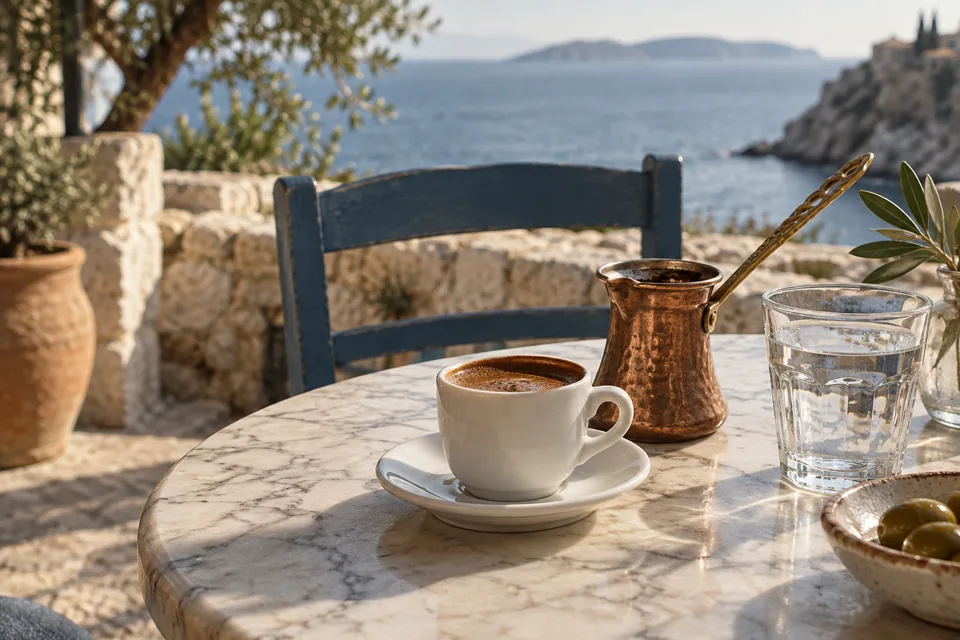
Ellinikos is prepared with very finely ground coffee in a small pan, the briki. Unlike filter coffee, the coffee remains in the cup. Leave it after pouring for a while and drink quietly; the last layer you do not have to drink.
For your own first test, use about 60.070 ml of water per small cup and one full teaspoon of suitable coffee. Add desired sugar before heating, stir initially and warm gently until the foam rises. Remove the pan from the heat before overboiling. Adjust the ratio with a subsequent cup.
03 · FLOOR
Foam, sediment and the first sip
The foam, kaimaki, is part of the appearance and feeling of the mouth. The taste comes from the coffee, ratio, grinding and preparation. A thick foam layer alone does not prove that you will like the cup.
Smell first. Then take a small sip and compare smell, bitterness and texture. The glass of water that is often next to the coffee is a pleasant variety. Do not stir the sediment after serving every time you want a brighter sip.
04 · FLOOR
Frappé is not a freddo
A frappé is usually made with soluble coffee that is foamed with some water, then supplemented with ice and water. A freddo espresso comes from espresso. They are various drinks, even when both are served cold, foamy and in a high glass.
Taste them at different moments without mentioning one better. Note the kind of bitterness, the firmness of the foam and what happens when the ice melts. A coffee that tastes immediately good can be in balance after twenty minutes.
05 · FLOOR
Freddo cappuccino and milk
A freddo cappuccino comes cold foamed milk at the cold espresso base. Ask in advance which milk is available if you want a particular type. Not every café makes a vegetable variant or uses the same method.
Milk changes not only the colour, but also the mouth feeling and the impression of bitterness. If you want to know the difference between the drinks, you can first order a freddo espresso and at another time the cappuccino version. So you know which part of your preference comes from the coffee.
06 · FLOOR
Order with the desired sweetness
Sketos means without sugar, metrios on average sweet and glykos sweet. The exact amount may vary per café. Tell the desired sweetness when you order, especially when sugar is dissolved during preparation.
Useful phrase: Έναν ελληνικό μέτριο, παρακαλώA Greek coffee, medium-sweetened, please, for cold: Έναν φρέντο εσπρέσο σκέτο, παρακαλώ. A freddo espresso without sugar, please. The most important thing is that the maker understands what drink and sweetness you want.
07 · FLOOR
A little coffee tasting at home
Make a small cup with the same coffee at two moments, but change only one thing: the ratio of water and coffee or the amount of sugar. Write down one word about the smell and one about the feeling of the mouth. You build your own reference.
Do not compare five very different drinks at the same time if you want to understand the preparation. A simple trial with the same cups makes it easier to remember what you really changed. Clean material and fresh water help to keep unwanted tastes out of comparison.
08 · FLOOR
What do you eat?
A small piece of sweet pastry can accompany a cup, but does not need to be a full meal. Try a small portion next to an unsweetened coffee and decide whether you want sugar in the drink afterwards. You can taste the combination instead of just two sweet parts.
For a savoury breakfast a piece of pie or bread fits. Keep the portion small when you plan a walk or lunch afterwards. The baker and the café together form a nice morning route: first choose what you like, then sit quietly.
09 · FLOOR
Reading the square
Note shadow, seats and the view people choose. A chair facing the street tells something other than a terrace that looks completely at the sea. You don't have to make a big theory of it: just note three things that you see change during 15 minutes.
Ask for permission before photographing people recognizable. A lively conversation is not a performance for visitors. A friendly one καλημέρα may be a good start; give the other room to leave it at a short greeting.
10 · FLOOR
Words to take with you
Καφές Coffee. Ελληνικός Greek coffee. Νερό Water. Ζάχαρη Oat sugar. Γάλα Oh, uh, uh, uh, uh, uh, uh, uh, uh, uh, uh, uh, uh, uh, uh, uh, milk. Χωρίς γάλα For two coffees you can say: Δύο καφέδες, παρακαλώ.
From this guide continue to the village portraits or to bread and philosophies. Try to order one drink on purpose. Faith often arises precisely by repeating: the same cup, another morning, a small new detail.