KRETA · MYTHOLOGY · DIFFERENCE
Dionysos and Ariadne: a commitment to the sea
A god, an abandoned princess and the changing language of ecstasy and rebirth.
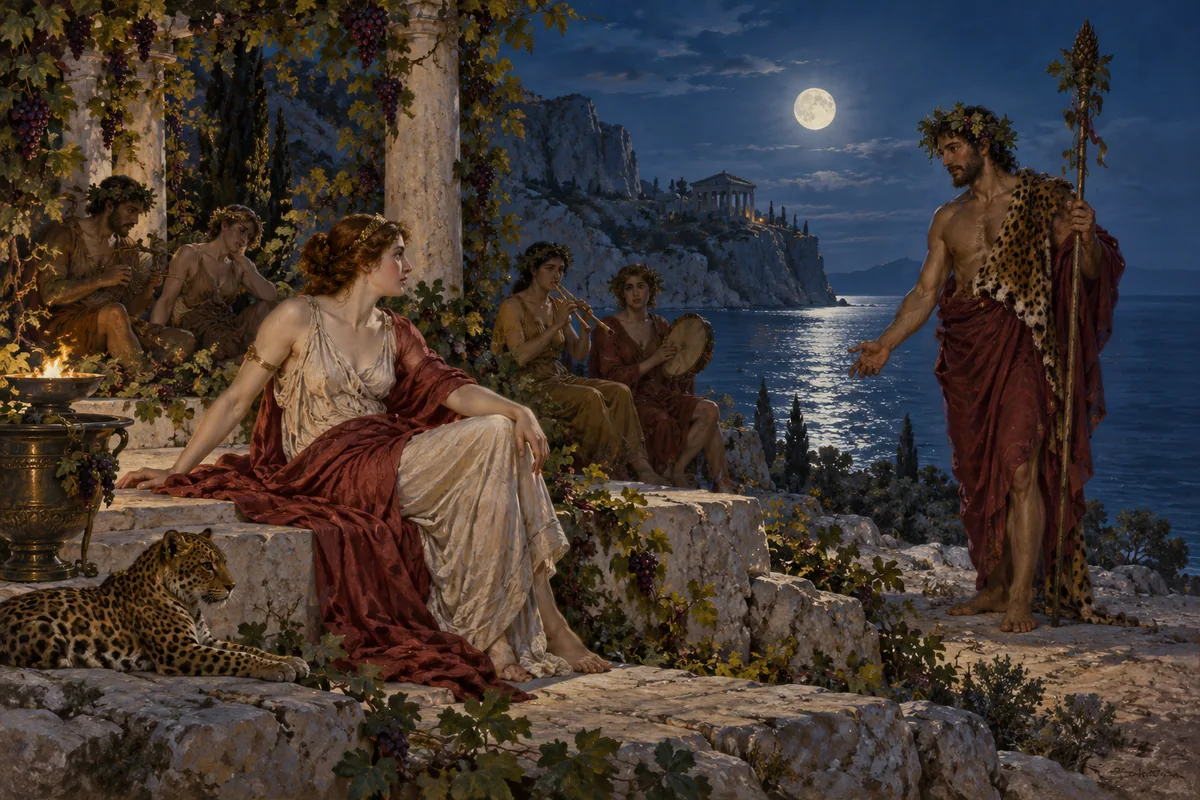
When Theseus leaves Naxos, Dionysos appears in many later versions as Ariadne's new partner. That encounter rewrites her destiny: forsakenness becomes a transition to a divine union. The story connects wine, theatre, ecstasy and the limits of human control.
The story gets a new ending
Dionysos' marriage to Ariadne appears in several ancient traditions, but not always in the same way. Sometimes she is found on Naxos; sometimes their union gets a cosmic ending when her crown is placed as a constellation in the sky. The god doesn't simply take her out of the story: he changes the status of her story.
The link with Dionysos gives Ariadne a different association than her relationship with Theseus. The hero seeks order in the Labyrinth; Dionysos is connected to wine, theatre, roar and crossing ordinary borders. This contrast is not an absolute scheme, but helps to see why artists found the meeting attractive.
Dionysos: presence that shifts rules
Dionysos isn't just the god of wine. His cults and stories connect joy, danger, theatre, community and change of identity. In the Bacchant of Euripides, King Pentheus collides with a god who does not fit into his administrative categories. The tragedy shows that a community can lose something essential when it only treats any form of ecstasy as a threat.
Marriage with Ariadne can therefore be read as a transition from earthly status to a life beyond ordinary mortality. But that is an interpretation of the literary tradition, not a reconstruction of one historic wedding rite in Crete. Telling the lyrics about gods; archaeology asks about objects, places and ritual behavior.
Crete and the wider Greek world
Ariadne's Cretan origin connects the Dionysian imagination with the island, but Dionysos was honored in many parts of the Greek world. A story that takes place on Naxos or Crete doesn't make a god exclusive local. It shows how regional characters could travel in broader cult and theatre traditions.
Artists have depicted the encounter as a party, a rescue or an erotic scene. The same combination can therefore carry different values. When reading it helps to ask who made the work of art, for which place it was intended and which parts of the myth probably already knew the audience.
View question
Is Dionysos' arrival mainly rescue, marriage or change of Ariadne's identity? Choose one interpretation and support it with a specific text or image; then find another source that complicates the choice.
Sources and read on
- Hesiodus, Theogony 947–949; Euripides, Bacchanten; Nonnus, Dionysiaca (late antiquity).
- The Metropolitan Museum of Art, sarcophagus with Theseus, Ariadne and Dionysos