MYTHOLOGY & TRAGEDIA · DIVISION 21 / 40
Demeter and Persephone: loss, return and price of fertility
A mother, a daughter and the power to stop the fertile world.
Demeter and Persephone link the growth of grain with a story about kidnapping, mourning and negotiations between gods. Anyone seeking only an explanation for the seasons misses the sharpness of a mother who stops the existing world order.
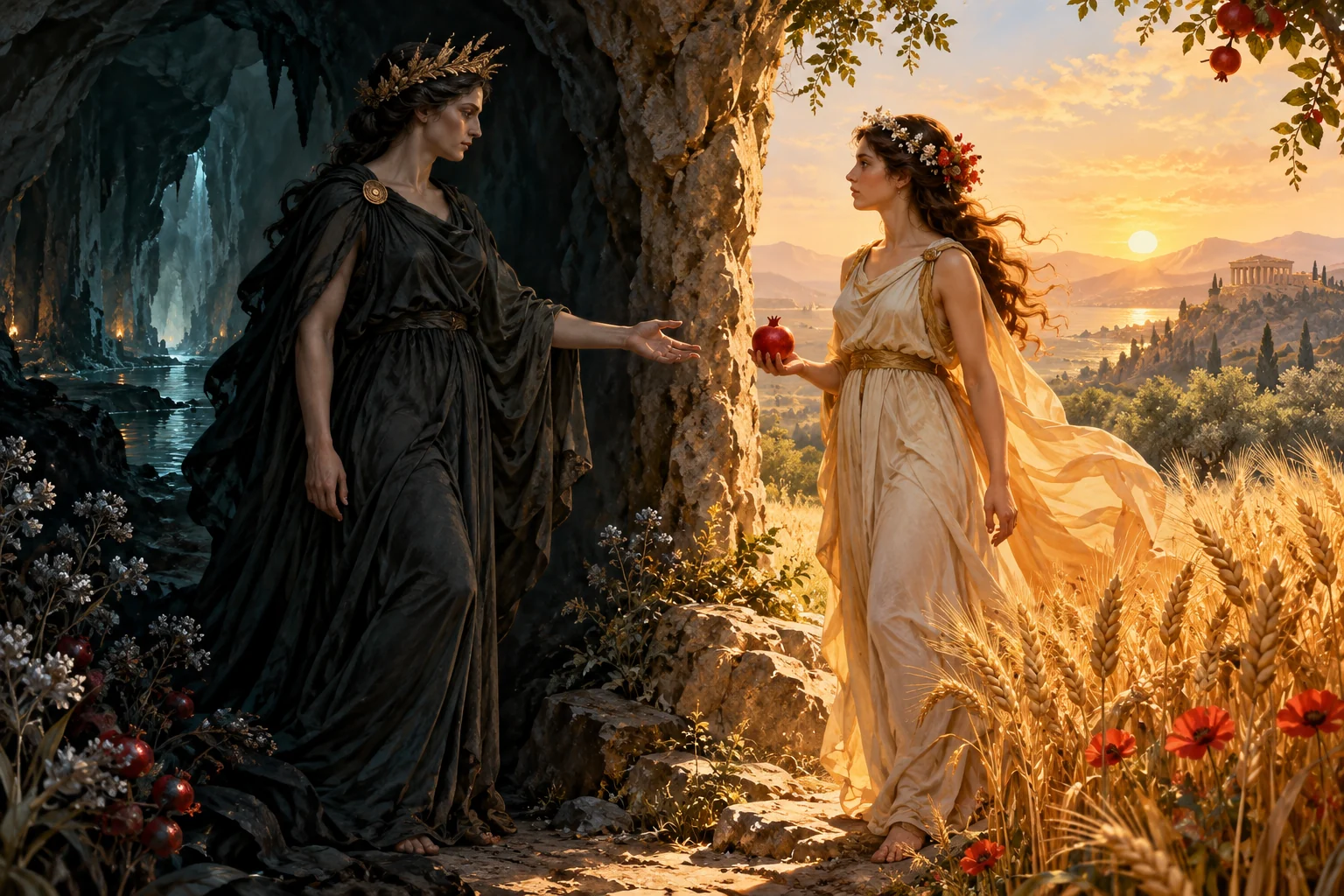
The anthem begins with a broken relationship
In the long Homerian hymn on Demeter, Persephone is taken by Hades, with the agreement of Zeus and without her mother's knowledge. Demeter is looking for her daughter and ends up in Eleusis as an elderly woman in disguise. When it has revealed itself to the people, it refuses to grow the crops. Hunger threatens both human existence and the sacrifices to which the gods claim. This gives her grief political strength: it is no longer a private matter.
The scheme that eventually follows does not fully restore the original situation. Persephone ate a pomegranate in the underworld. She will stay with Hades part of the year and another part with her mother and the other gods. In this hymn it is a third versus two thirds of the year, not the often told division into two equal halves. The difference shows why a specific antique text yields more than one standardised version of the myth.
No simple calendar for spring and winter
The daughter's return invites a connection with renewed growth. Yet you cannot simply put the story on a Northern European calendar. In Mediterranean agriculture, the dry summer is often a period in which growth stops. The anthem does not provide a universal table in which every month and every weather change is fixed. She also talks about human dependence, the power of marriage and the restoration of relationships after injustice.
Therefore, a fruitful reading question is not only when the grain rises, but who has it. Zeus can allow a marriage, but he doesn't seem to control all the consequences. Demeter has another power: the ability to withdraw necessary care and production. Thus it becomes apparent that formal authority and de facto dependence may vary. That is an interpretive approach, not proof of a specific political message from all antique counters.
Eleusis and the boundary of our knowledge
The hymn connects Demeter with Eleusis and with the foundation of rituals. The Eleusinian mysteries initiated a special religious expectation, but the secret acts are not entirely at our disposal. The story about the goddesses and the actual rituals are also different kinds of sources. An anthem is not a playbook that allows every detail of a ceremony to be reconstructed.
For the reader an important boundary arises. You can explore what hope a cult expressed without pretending to be able to recount all the experiences of participants. Also confidentiality is historically significant: it determines who shares knowledge and which community is created by it. The unknown parts do not need to be filled with spectacular modern fantasies to be interesting.
Two goddesses, more than two rolls
Demeter is easily reduced to mother and Persephone to daughter. Within the mythical order, Persephone is also queen of the underworld. Her return doesn't remove that other position. The myth therefore retains several realities at once: loss is not forgotten, connectedness returns, and the daughter does not exist exclusively in the relationship in which the story began.
That makes the narration useful to think about mourning without treating her as a psychological manual. Restoration doesn't mean that everything is going to be exactly as before. One possible lecture is that sometimes people learn to live with a permanent absence. At the same time, we must continue to name the original kidnapping; a beautiful nature metaphor must not make the violence with which the separation began invisible.
Crete in context
In the knowledge universe, this subject connects to the culinary calendar, grain and bread, but also to Minoan sanctuaries. The latter is an invitation to compare, not the claim that the Eleusinian cult originated directly from one demonstrable Minoan origin. The connection with Orpheus asks another question: can someone from the world of the dead really be brought back, and under what conditions?
Think on for yourself
Compare a literal agriculturalist and a relational reading of the same scene. What explains every perspective well, and what disappears from the picture? Pay particular attention to the difference between a recurring cycle and an irreversible event. A season can come back; with that an experienced loss has not been erased.
Sources and read on
- Homerian hymn to Demeter
Primary text, in particular 1–89, 305–333 and 398–489. Translation and explanation of the Center for Hellenic Studies.
Texts consulted on 29 October 2026. The Dutch explanation is new; the source links give access to ancient texts and scientific context.