GREEK MUSIC · DIVISION 14 / 20
Smyrneïka: listening to a musical world around a port
An archive route along performers, instruments and musical memory of Asia Minor.
A port brings people, languages and sounds together. The music connected to Smyrna therefore requires more than a single label. Through documented performances we explore how a melody, an ensemble and a remembered place can give each other meaning.
Save and Select Place Names
Smyrna, now Izmir, is an important place in the history of Greek-language music from Asia Minor. However, a repertoire designation as syrneika does not refer to one unchanging sound. Start with the concrete data of a recording: title, performers, instruments and the place where the registration took place. A song connected to an old home may have been performed and recorded elsewhere. The place in the title, the place of memory and the location of the microphone are different data. By keeping them separately, a musical card gets more accuracy.
An ensemble from the archive
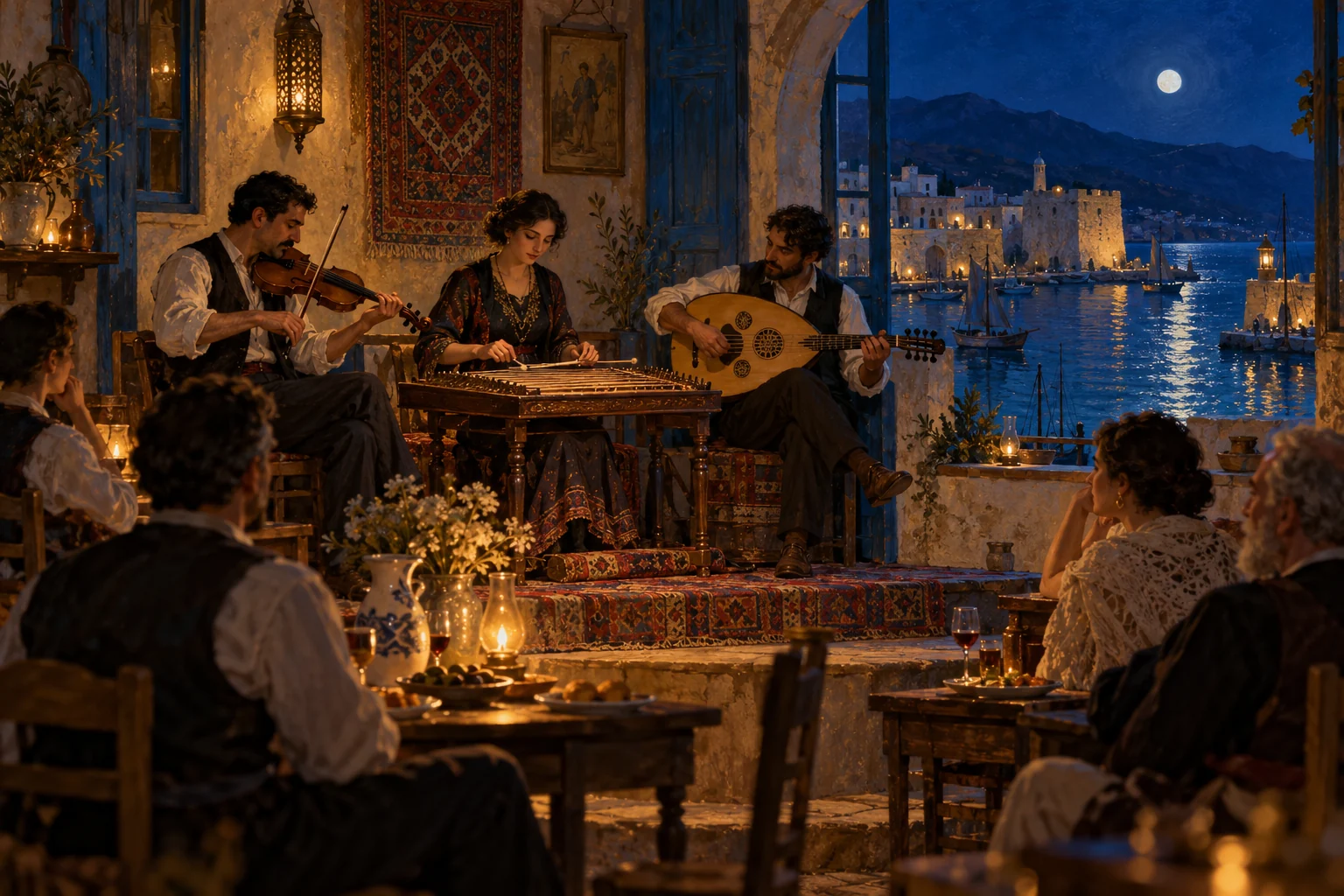
The Asia Minor reportage of Domna Samiou contains material with Stefanos Vartanis on violin, Nikos Stefanidis on cannon and Mathios Balabanis on goblet drum. The accompanying data allows a targeted listening round. Follow one instrument at a time and ask who wears the melody at what time. Do parties run the same, complement each other or react an instrument between two thoughts? The recording is a concrete entrance to a broader musical world. It does not need to be treated as a model for all historical ensembles in order to be particularly valuable as a document.
Decoration and recognition
A melodic line can be rich in small movements and yet have an easily recognizable course. Neurie first only the rest points and then listen to the way in between. Where is a tone approached, circled or postponed? Compare the line of the voice with an instrumental passage. Maybe you recognize a kindred gesture in a different sound color. Use this as a listening question. That two movements remind you of each other is not yet proof that one originated directly from the other. Historical relationships continue to require sources and specific comparisons.
A reminder gets a new space
The report also includes singers with a refugee background from places in Asia Minor. This creates an opening to look at music and memory. First describe what the source actually mentions. Not every melancholy sound tells the same story and not every song is a literal record of loss. Music can wear fun, recognition, skill and a shared background. Therefore, give the people involved more space than just the role of representative of grief. Their choices in implementation and their mutual association are also part of the document.
Related to rebetiko, not dissolved in
The file on rebetiko offers the wider entrance to urban music, recordings and changing audiences. Read both subjects side by side, without expecting boundaries between repertoires to be equally sharp everywhere. Research into early recorded urban song shows how line-up and musical arrangement are relevant to style questions. A proper division can help as a first orientation, but becomes less useful when it makes the concrete musical exchange invisible. Therefore follow names, versions and modes of play. These allow comparison without pre-empting all differences under one general denominator.
Listen further: build a small recording card
Write down the place with which the repertoire is connected, the recording site, the performers and the occupation. Then describe one melodic match and one difference. What information could you have guessed wrong without the documentation? Then listen to a bouzouki recording from the rebetiko file. The comparison does not have to produce a story about an inevitable development. She can easily show that different musical means have existed side by side and that a port as entrance invites especially to follow people, routes and collaborations more closely.
Sources & Listen inputs
- Domna Samiou, Asia Minor
Own audiovisual archive, with appointed performers, instruments, songs and dance examples from the Lesser Asian music traditions.
- Spilios Kounas urban song in early recordings
Scientific context in style, occupation, orality and historical analysis; no simple fixed boundary between repertoires.
Sources checked for 29 October 2026. The listening questions are newly written exercises; they do not attribute a predetermined result to a recording. The external archive pages contain where available their own audio or video.