GREEK PHILOSOPHOBIA · DIVISION
Xenophanes: Who makes the gods in his image?
An early criticism of human projection and an investigation into the limits of knowledge.
Xenophanes criticizes poets who attribute gods to human weaknesses. His fragments are not only about religion: they also ask the question how people know truth and what is worth a careful guess.
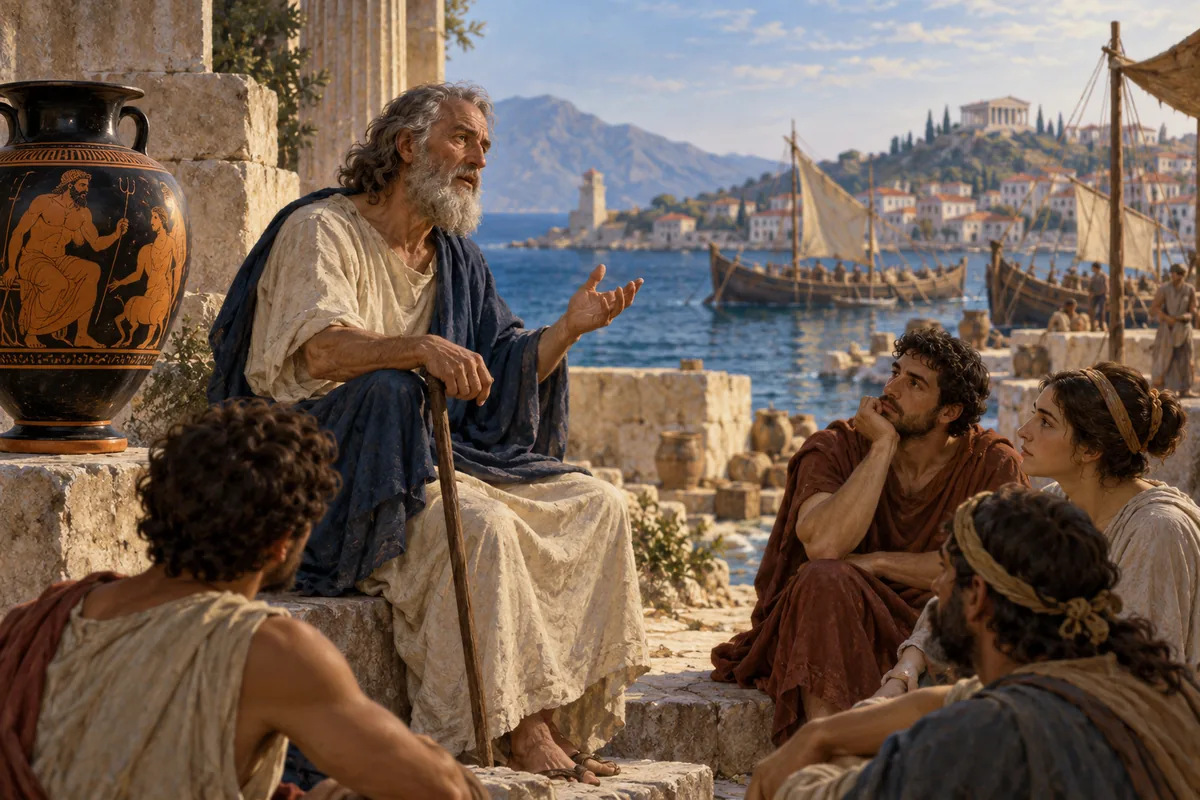
Gods with human faces
Xenophanes notes that different peoples depict their gods with their own appearance. If horses or cattle had hands to sign, according to his famous fragment, they would probably represent their gods as horses or cattle. The pointe is not simply that gods do not exist. He asks how human habits the image of the divine forms.
In other fragments, he criticizes Homer and Hesiodus for ascribed deities that people would find shameful: stealing, adultery and deceit. This makes representation a philosophical problem. A story can teach a community something, but also reduce the moral measure of the gods to human weakness.
What do people know?
Xenophane's pygmy epistemology is often summarized with the idea that even those who happen to be telling the truth do not always know he owns her. The exact interpretation of his fragments is controversial. It is clear that he is thinking about the difference between truth, conviction and what one can claim on good grounds.
An important fragment leaves room for research: people looking, and with time they can discover something better. That is not relativism in which all opinions are equal. It is an attitude of intellectual modesty: good reasons can improve beliefs, but human security remains limited.
Poetry and criticism
Xenophanes himself was a poet. His criticism of poetic images of God does not mean that he rejected poetry. He used poetic form to argue, mock and explore religious language. This makes the dividing line between mythos and logos less simple than a schoolbook story in which one form replaces the other.
His work invites a critical question: what values are represented by stories as divine or self-evident? This question remains useful in religion, politics and popular culture. At the same time, we should not make him modern atheist or scientist without proof; his own divine views are fragmentary and explained differently.
View question
Take a modern image of power or divinity. What human qualities are presented as ideal? What does Xenophanes say about the creator, and what can she not prove about the existence of the depicted?
Sources and read on
- Xenophanes, fragments B 11, B 14–16 and B 18; stored with subsequent authors.
- Internet Encyclopedia of Philosophy, "Presocratics"
- Internet Encyclopedia of Philosophy, "Ancient Greek Philosophy"