MYTHOLOGY & TRAGEDIA · DIVISION 24 / 40
Orpheus and Eurydice: music, looking back and the limit of loss
An underworld tour of art, trust and the limit of memory can be reduced.
Orpheus tries to cross a line with vocals that remains closed to ordinary mortals. His journey to the world of death not only raises the question of how powerful art can be, but also why a loved one cannot be safely recovered as property.
A well-known story in various literary forms
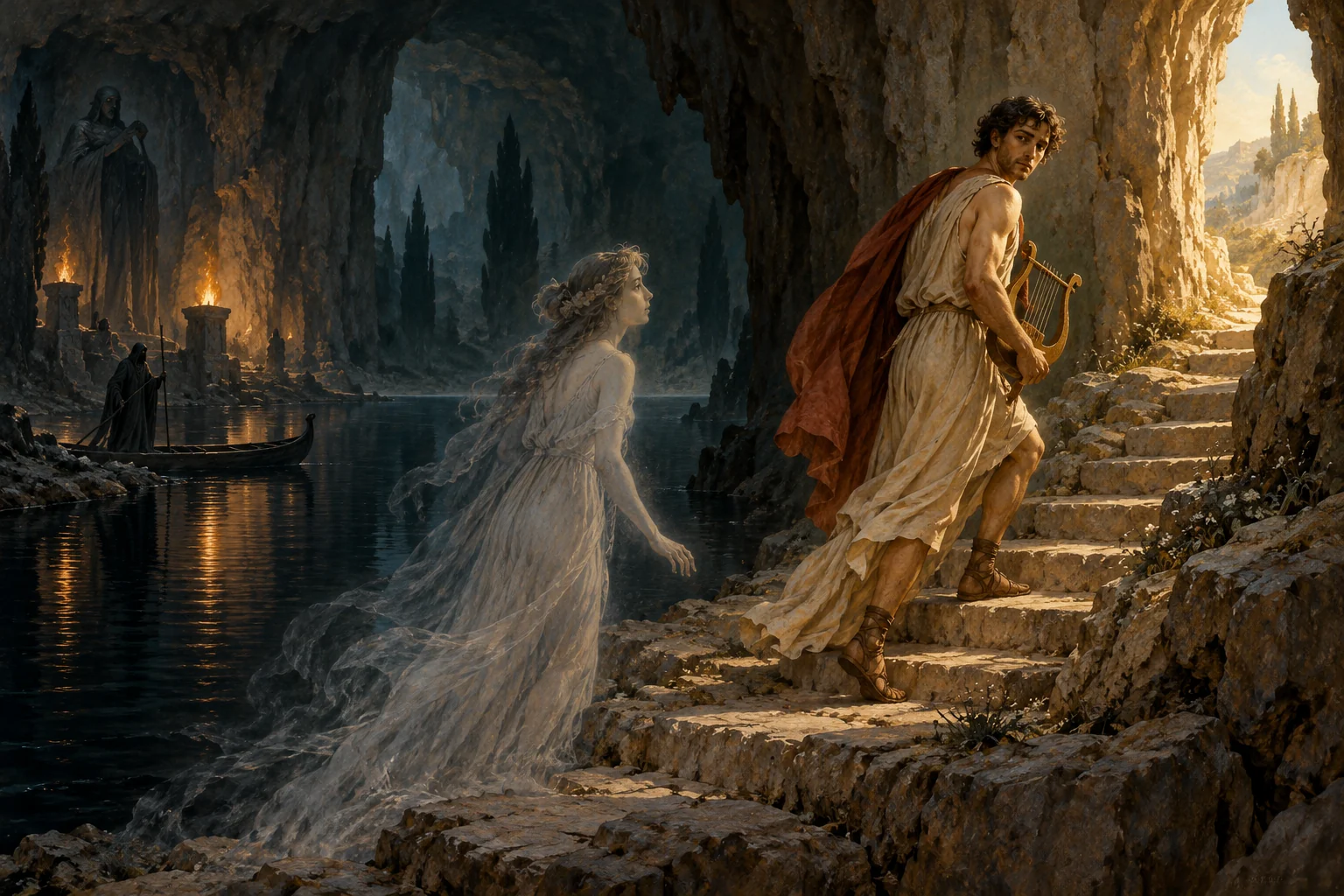
The elaborate versions of the Roman poets Vergilius and Ovidius tell how Orpheus descends to ask for Eurydice back. His music moves the powers of the underworld. However, the return is subject to a condition: he must go ahead of her and not look back before they have reached the upper world. Right at the end, he looks back and loses her again.
That's not proof that there was one original, fully fixed Orpheus myth. The two poets place the story in various larger works and give it its own accents. With Vergilius, Eurydice's death is part of the history of Aristaeus; with Ovidius, the episode is part of an ongoing poem about changes. The version that a reader chooses thus helps determine which questions come to the fore.
Why look back?
The gesture seems small, but carries the whole drama. Looking back can be read as impatience, as fear that Eurydice is not really following, or as the desire to get certainty. A condition that can only be maintained by confidence collides with a need for visible confirmation. That's an interpretive way to understand the scene; the story doesn't give a general theory about all relationships.
We recognize the tension outside the myth. Sometimes control can protect a process, sometimes it interrupts exactly what is needed. A comparison becomes fruitful when you describe the exact conditions. Orpheus doesn't simply stand for someone who doesn't trust enough. He finds himself in an exceptional situation where the outcome costs him everything and the agreed rule remains opaque at the same time.
The power of music has a limit
Singing can temporarily move the dead world, but it does not undo mortality. As a result, the story is more than a praise to the omnipotence of the artist. Art can force listening, shape grief and make an absent person appear present. That's something other than an actual return from the dead.
For a reflection on music, this distinction is very strong. A melody can bring a memory immediately close without turning back time. Those who listen to an old song can find something and feel sharper at the same time that it is over. That double effect is not a shortcoming of art. It is one of the special ways in which memory and experience can work together.
Where's Eurydice's voice?
The title of the myth tends to focus on Orpheus. Yet the loss is also hers. In the literary versions Eurydice gets limited space to speak for himself. It therefore pays to read a scene again from the person who follows, wait and disappear again. What's she hearing? What rule should she trust? What choices are at her disposal?
Such questions do not restore missing antique testimony. They are a conscious reading strategy to see how the perspective of a text works. You don't have to invent new facts to discover that an immersive hero history makes certain experiences less extensive. The absence of a voice can also have meaning.
Orpheus is not the same as all orphic traditions
Orpheus was also associated with religious poems and authoritative knowledge. The different traditions that are often called orphic do not coincide with this love story. It is therefore wrong to derive from the journey of one singer a complete, uniform antique belief system. Always compare the concrete poem, ritual or document you're talking about.
In the knowledge universe, this file connects the myth with Persephone and the music pages. The line to musical memory is a thematic association. She doesn't say that a contemporary piece of music comes directly from a particular antique ritual.
Think on for yourself
Read about it once as wrong and once as understandable love. Can both lectures point to something true? Then describe a work of art that brings someone or something from your past close. What really returns, and what remains irreversibly absent?
Sources and read on
- Vergilius, Georgica 4
Primary text, 4.453–527 Orpheus and Eurydice in the story of Aristaeus.
- Ovidius, Metamorphosen 10
Primary text, 10.1–85; another literary development of the underworld.
Texts consulted on 29 October 2026. The Dutch explanation is new; the source links give access to ancient texts and scientific context.